October 2025.
New Orleans, Louisiana.
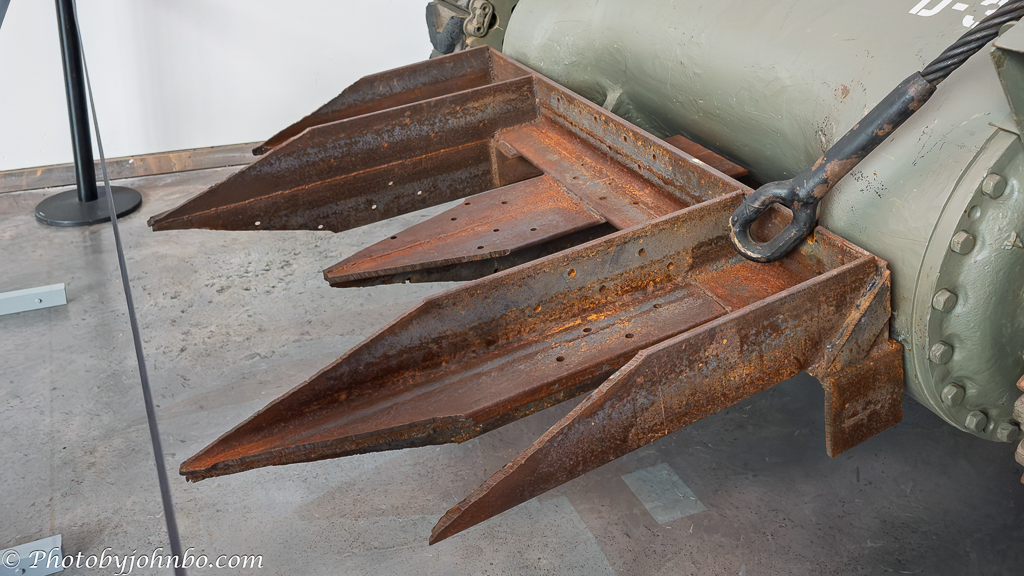
In October 2025, we spent a few days exploring New Orleans, the Big Easy. High on our list was a visit to The National WWII Museum, and we were not disappointed. The museum’s exhibits do an incredible job of bringing the experiences of the Greatest Generation into sharp focus. With Veterans Day approaching, I’m featuring one small but remarkable exhibit: a Sherman tank fitted with a rusty, almost improvised‑looking attachment bolted to its lower front.
The Problem
When American forces pushed into the Normandy countryside after D‑Day, they ran into an unexpected obstacle: the bocage. These ancient hedgerows—earthen embankments topped with dense, tangled vegetation—turned every field into a fortified position. Tanks couldn’t simply drive through them; their front ends rode up the bank, exposing their thin underbellies to German fire. Infantry couldn’t advance without armor, and armor couldn’t advance without exposing itself. Progress stalled, and casualties mounted.
The Battlefield Solution
The answer didn’t come from a factory or an engineering bureau. It came from a sergeant with a welding torch. Sgt. Curtis Culin of the 102nd Cavalry Reconnaissance Squadron realized that scrap steel from German beach obstacles could be cut, shaped, and bolted to the front of a Sherman. By fabricating simple prongs into a set of cutting teeth, Culin’s modification allowed tanks to bite into the hedgerow, split it, and push through without climbing. What looked like a crude, rusty attachment was in fact a battlefield innovation born under fire.

The Results
Once fitted with the new “Rhino” cutters, Sherman tanks could punch openings through the bocage in seconds. Infantry could follow safely. German defensive lines, once anchored on the hedgerows, began to collapse. What started as a field-built expedient spread rapidly across armored units and broke the stalemate in the fields. This crude device, hastily welded and tested in combat, made a massive difference in Normandy.
At its heart, the story of the hedgerow cutter is the story of one soldier who refused to accept a battlefield stalemate. Sgt. Curtis Culin’s contribution didn’t end with a clever idea welded onto a single Sherman. Once his prototype proved its worth, he became the driving force behind turning that field‑built experiment into a widespread battlefield tool. Culin demonstrated the cutter to commanders, explained how it worked, and showed that any workshop with a torch and scrap steel could build one. His practical know-how, paired with the urgency of the moment, quickly got the device into production.
Word spread quickly. Commanders saw the demonstration, recognized its value, and ordered its adoption across the First Army. Field workshops began fabricating cutters around the clock. Within weeks, hundreds of Shermans rolled into the bocage fitted with Culin’s improvised device—an innovation conceived in the field, built under pressure, and deployed at remarkable speed. It shows that the most effective solutions often came right from the ingenuity of the soldiers who needed them most.
In the November 10, 2026, Tuesday Trek post, come along with me as I visit the National WWII Museum and share some of the stories there.
About the Photos: When I saw the display, I knew it would be a great piece to feature for Veterans’ Day as a Cellpic Sunday. Although I brought the Nikon Z7 II for the museum walk‑through, I pulled my Samsung S25 Ultra out of my pocket and captured these images in Pro mode as DNG RAW files. I minimally processed them in Adobe Lightroom Classic, using the Denoise tool to address the ISO 640 and ISO 1000 images and the Adaptive Color profile to correct the mixed museum lighting. I adjusted the Highlights, Shadows, Whites, and Blacks sliders to maximize dynamic range. I’ve uploaded the images to my Flickr gallery here so you can view them in 2K HD and examine the image metadata.
I invite fellow bloggers to join in by creating their own Cellpic Sunday posts. There’s no set theme. The first rule: your photo must be captured with a cell phone, iPad, or other mobile device. The second rule: link your challenge response to this post or drop a comment here with your link so others can find it. And remember, despite the name, there’s no penalty for sharing on a day other than Sunday.
Lynn and I are traveling for the next couple of weeks. Feel free to comment, but I may not be able to respond as quickly as usual.
John Steiner.

