October 2025.
New Orleans, Louisiana.
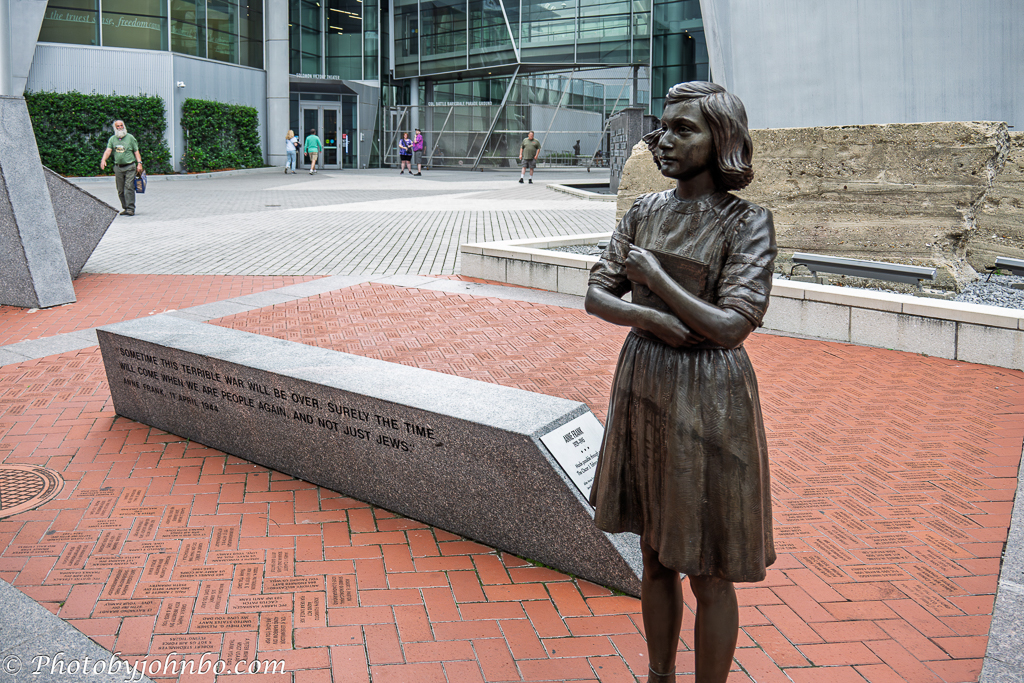
For Veterans Day this year, I am sharing photos from our visit to the National WWII Museum in New Orleans. We often think of the soldiers who sacrificed their time and even their lives as members of the Greatest Generation, but that term applies to anyone whose life was shaped by the war’s demands and losses. From Rosie the Riveter’s factory work to the farm-inspired ingenuity of Curtis Culin’s hedgerow cutter, from the heavy toll on the merchant marines to the atrocities of genocide, the museum doesn’t sugar‑coat the stories of sacrifice and cost. The campus is a multi‑pavilion complex of five major buildings, each dedicated to exhibits that together tell the stories of the men and women of World War II. As with many world‑class museums, the experience begins before we even step inside. A quiet bronze figure of Anne Frank stands near the entrance, a reminder that the stories preserved here reach far beyond the battlefield.

The museum’s five buildings cover so much ground that most visitors can’t take it all in in a single day. We spent about five hours exploring just three of them and quickly added the museum to our list for a return visit. One series of large placards focused on the civilian Merchant Marine—brave sailors who carried munitions, fuel, and other essential supplies needed to keep Allied forces fighting across the globe. Though they were not combatants, they suffered the highest casualty rate of any American service.

In another gallery, a diorama features a camouflaged Opel sedan, the kind of civilian car the German army routinely requisitioned and disguised for courier and staff duties. Vehicles like this were often concealed with branches and foliage to avoid detection from the air, a reminder that mobility in the field depended as much on improvisation as on machinery. An accompanying “Soldier’s Story” placard highlights Lt. Col. Abraham J. Baum of the 4th Armored Division. Although his missions did not involve this specific vehicle, his experience underscores how often soldiers relied on improvised transport and quick camouflage to survive in rapidly shifting combat conditions.

Elsewhere in the same pavilion, another diorama shifts the focus to the early fighting in North Africa. A Jeep is positioned against a backdrop referencing the setback at Kasserine Pass, the 1943 battle that exposed the inexperience of American forces and forced rapid improvements in leadership and tactics. One accompanying placard tells the story of Col. John Waters, captured during the Tunisian campaign, whose experience reflects the personal cost of those early operations. The versatile Jeep was the US Army’s true workhorse, used for everything from scouting and command to basic transport.

In the same North Africa gallery, a US M2A1 105mm howitzer sits under a canopy of camouflage netting, flanked by desert sandbags and several complete 105mm rounds with their green projectiles still seated in the brass casings. This was the standard American field gun during the Tunisian campaign, providing the firepower that supported infantry and armored units across the harsh desert terrain. Its presence here underscores how quickly US forces had to adapt to the realities of North African combat—harsh conditions, long distances, and an enemy already seasoned by years of desert warfare.

As regular readers might guess, one of our first stops was the US Freedom Pavilion: The Boeing Center, the museum’s massive aviation hall. Suspended overhead is a C‑47 Skytrain, one of the workhorses of the Allied war effort, surrounded by other iconic aircraft displayed at eye level from the elevated walkways. During the war, aircraft like this carried paratroopers, hauled supplies, evacuated the wounded, and kept entire campaigns moving—a reminder of the countless men and the mountains of material that sustained the Greatest Generation’s fight across multiple continents. The C‑47 also holds a personal connection for me; it’s the military version of one of the first airliners I ever flew in as a teenage passenger. The civilian DC‑3 still flies around the world today, and there’s even a bright yellow example at the Fargo Air Museum named “Duggy–the Smile in the Sky.”

The P‑51 Mustang was developed to solve a deadly problem: our bombers were flying deep into German territory without long‑range fighter protection, suffering heavy losses on every mission. The Mustang’s speed, range, and high‑altitude performance finally gave the Eighth Air Force the escort it needed, and the aircraft quickly became one of the war’s most effective fighters. One of the most storied units to fly the Mustang was the Tuskegee Airmen, whose distinctive red‑tailed aircraft became a symbol of both skill and determination. The Tuskegee Airmen proved their incredible capabilities despite severe discrimination, earning the deep respect of the bomber crews they protected.

Unlike other museums that suspend historic aircraft far above visitors’ heads, this building features elevated walkways that bring several of the aircraft almost to eye level. That design makes views like this one possible—a close look at the waist‑gunner’s position on a B‑17 that would have been impossible to capture from the main floor. From this vantage point, it’s easier to imagine the young airmen who stood here in freezing temperatures and thin aluminum skins, defending their bomber from enemy fighters. Pilots often received the glory for bringing a damaged aircraft home “on a wing and a prayer,” but every man on a bomber crew faced the same dangers. Statistically, their missions carried some of the highest casualty rates of the war.

Our visit also included Final Mission: USS Tang Submarine Experience, an immersive recreation of the submarine’s last war patrol. Before entering the exhibit, each visitor receives a watch bill representing a real crewmember, a small but meaningful touch that personalizes the mission ahead. Inside, the exhibit uses sound, light, and motion to recreate the submarine’s final moments under attack. It offers a brief but intense look at the cramped quarters and split-second decisions submariners face.

As we headed for the exit after a full five hours immersed in World War II, we passed a simple exhibit of mailboxes and a portrait of a woman clutching letters from her loved one. Letters were a soldier’s emotional lifeline to home and to the families who waited anxiously for their return. To speed delivery across vast distances, the military created Victory Mail, a system that photographed letters onto microfilm, transported them overseas, and reprinted them for distribution—saving both time and precious cargo space. Families kept every letter, often tied with ribbon or stored in boxes, a fragile record of hope, fear, and connection. For many service members, a letter from home could lift spirits more than food or rest.
Exploring the galleries, exhibits, and personal stories that fill this remarkable museum left us with a deeper appreciation for the men and women who lived through the war years—those who fought on distant fronts and those who waited anxiously at home. The museum does an incredible job of keeping the focus entirely on the actual people who lived through the conflict. It invites reflection long after you step back outside into the present day.
If you are planning to immerse yourself in these historic exhibits, expect to spend a solid half-day or more wandering the campus. Admission options vary, and additional experiences—such as the Final Mission: USS Tang Submarine Experience—are available for an extra fee. For the most current ticket tiers, operating hours, and to secure your passes in advance, visit the museum’s official Plan Your Visit Page here.
About the photos: I captured all images on the Nikon Z7 II with the NIKKOR Z 28–400mm f/4–8 VR lens. My first mistake was leaving the 24–120mm f/4 in the hotel room. The museum’s interior lighting is relatively dim, and one image pushed the ISO above 50,000. The 24–120’s wider 24mm field of view and constant f/4 aperture would have helped in several situations; with the 28–400, the lens begins stopping down almost immediately past 28mm, limiting light as I zoomed. Fortunately, Lightroom Classic’s Denoise tool handled the high‑ISO files well, producing a tight, film‑like grain pattern in the darker shots. In the Jeep image, I used Generative AI to remove the partial placards at the bottom and reconstruct the small amount of foreground they obscured. I applied the Adaptive Color profile to correct the mixed museum lighting, then adjusted Highlights, Shadows, Whites, and Blacks to maximize dynamic range. My Flickr gallery here includes many more images than appear in this story, all in 2K HD with full metadata.
Lynn and I are traveling for the next couple of weeks. Feel free to comment, but I may not be able to respond as quickly as usual.
John Steiner.

