February 2016.
Tucson, Arizona.
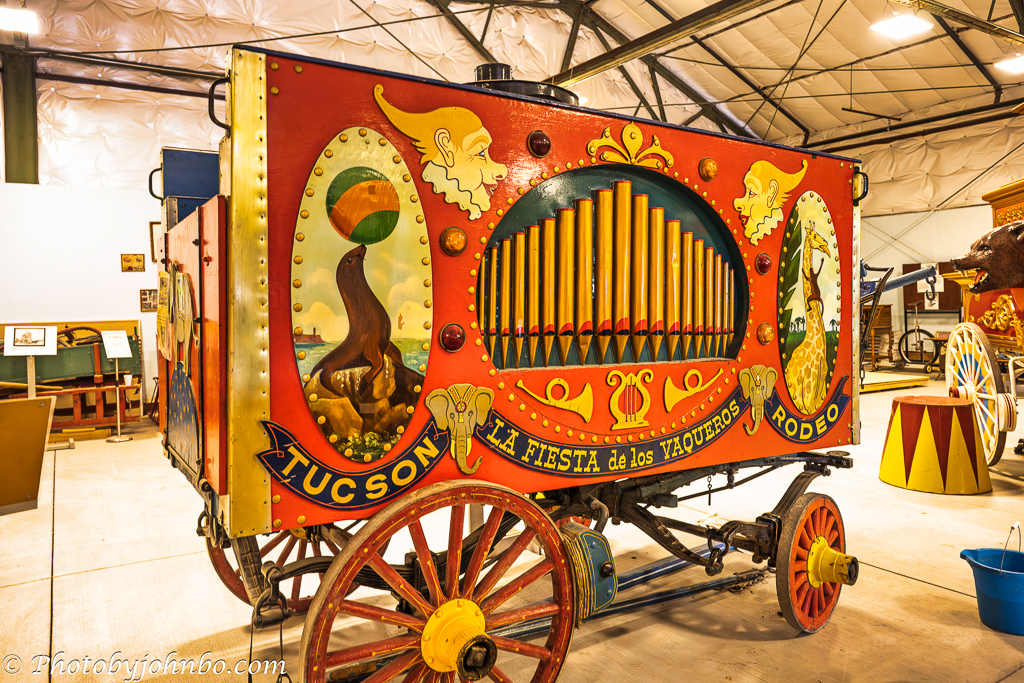
We missed the Tucson Rodeo Parade this year by a few days, and by the time we got back into town, every seat for the final weekend of La Fiesta de los Vaqueros was long gone. But missing the action didn’t mean missing the story. Just south of the airport sits the Tucson Wagon & History Museum, where the wagons, carriages, and circus‑bright showpieces wait all year for their moment in February. Since we couldn’t see the parade roll down 12th Avenue, we went to see where it begins—in the quiet buildings where Tucson’s rodeo history lives in full color.

Our first stop was one of the collection’s celebrity pieces—Roy Rogers’ Snake Oil wagon, parked among the rows of parade vehicles that fill the museum’s grounds. The Tucson Wagon & Rodeo Museum isn’t a single hall but a cluster of buildings, each one sheltering its share of the more than 170 wagons, carriages, and parade rigs on display. The collection is arranged by style and era, showing how Western transportation evolved over the decades. This wagon introduced us to how deep the collection runs and how much history is tucked into every corner of the site.

I was surprised to find another celebrity wagon—a movie star, as it were. While placards throughout the museum detail each vehicle’s past, this particular fringe-top surrey shows a unique transition from a 19th-century utility wagon to a piece of mid-century Hollywood history. Its exact build date is unknown, but the cantilever folding seat design first appeared in 1867, and the C. H. Stratton Carriage Co. produced similar models in Buffalo from 1888 to 1898. Long before its “15 minutes of fame” in the musical Oklahoma!, the surrey was a local Depression‑era acquisition, one of 15 wagons bought in 1932 for just $50 using funds borrowed from Tucson businesspeople. It’s a fun bit of trivia that Oklahoma! was filmed almost entirely in Arizona because, by the 1950s, the real Oklahoma looked too modern for its 1906 setting—legend even says the production planted acres of corn in the San Rafael Valley near Sonoita and irrigated it until it was “as high as an elephant’s eye” just in time for the cameras to roll.

Fans of early television may remember Duncan Renaldo as the Cisco Kid, the charming, quick‑witted hero who rode across 1950s screens with his partner Pancho. They weren’t masked vigilantes like the Lone Ranger—just two “good guys” who always seemed to take the blame for someone else’s trouble. Renaldo’s horse trailer is one of the unexpected celebrity pieces tucked into the Tucson Wagon & Rodeo Museum, a reminder of how Western lore carried into mid‑century pop culture. It also ties neatly back to the museum’s earliest years, when wagons were first gathered for the Tucson Rodeo and Parade beginning in 1925, long before Hollywood ever came calling.

After the parade wagons and celebrity rigs, the museum’s collection shifts from wheels to the gear that supported everyday life in the West. The saddles and tack displays highlight the craftsmanship that went hand in hand with the wagons themselves, reminding visitors that transportation in the 19th century wasn’t just about the vehicles but the equipment that made them useful. These artifacts offer a clear look at the practical, daily realities of working with livestock on the frontier.

On either side of a row of 19th‑century wagons, street scenes of old Tucson invite exploration. A recreated Wells Fargo office is one of the first storefronts you encounter—a nod to the era when the company handled banking and express services long before it became a modern financial institution. And those cowboys in the doorway aren’t mannequins; they’re volunteers preparing for the upcoming parade, many of whom also serve as museum docents, helping visitors navigate the collection and its many stories.

On the other side of the street, a recreated doctor’s office and pharmacy are furnished with period-accurate equipment. It reflects a time when medical care, including childbirth, often took place in small community offices or makeshift clinics, long before modern obstetrics standardized procedures and technology. The metal examination tables, enamel basins, and simple instruments on display echo what frontier families would have encountered in the early 1900s, when nurses and midwives handled most deliveries, and doctors were summoned only for complications. This side of the museum’s streetscape adds an intimate layer to the display, reminding visitors that daily life in Old Tucson included moments of both hardship and hope.

Every old Western recreation I’ve ever visited features a saloon, and the Rodeo Museum is no exception. Their barroom scene is fully staged—bottles lined up behind the counter, a longhorn mount over the mirror, and two figures caught mid‑story. One tends the bar while the other, arm bandaged from some earlier scrape, leans in as if sharing the latest frontier gossip. The whole setup has a lived‑in feel that makes it easy to imagine the clatter, smoke, and tall tales that once filled places like this.

Just beyond the bar, the museum stages another familiar fixture of Western lore—the saloon girls. Their colorful costumes and poses recreate the entertainment side of frontier life that Hollywood often featured. The display adds a bit of fun to the streetscape while hinting at the actual entertainment business in early frontier towns.

As we walked from one building to another, I stopped to visit with a friendly volunteer, scraper in hand, carefully removing old yellow paint from the wheel’s spokes. It was quiet, meticulous work—the kind of hands‑on effort that keeps the museum’s restoration projects moving forward. Watching him tend to a single wheel underscored how much care goes into preserving these wagons, one layer of paint and one piece of hardware at a time. I asked for permission to take a photo for this post, which was freely given.

Stepping between buildings, we entered the museum courtyard that connects the wagon‑filled halls. Near an outdoor display of early 19th‑century farm equipment, I spotted these two wagons patiently awaiting reconstruction and their turn in line for the rodeo parade. Weathered wood, loose hardware, and faded paint tell their own stories. Still, they also highlight the ongoing work that keeps this collection alive—each wagon eventually goes to volunteers who scrape, sand, repair, and revive it for its first season in the spotlight.

As I walked past this hotel lobby setup, I first assumed it was simply a period recreation of a vintage front desk. A nearby docent pointed out the mural above, which depicts the long-lost El Conquistador Hotel as it looked in the 1950s. Even the furnishings, from the sconces to the desk accessories, were either salvaged before the hotel’s demolition or crafted as faithful replicas. If this scene feels familiar, it’s because I shared the hotel’s history and my digital reimagining of the mural in a post back in March—a project that used a photo of the mural above this desk to bring those lost colors back to life. You can find that digital recreation here.
The Tucson Wagon and History Museum operates seasonally, reopening each year in early December and welcoming visitors through the first weekend in April. Public hours typically run Thursday–Saturday, 9:30 a.m.–2:00 p.m., with admission this season at $10 for adults, $9 for seniors, and $2 for children under 16, plus discounts for active military, first responders, and educators. Because hours and pricing can shift from season to season, it’s always best to confirm the latest details on the museum’s website and the rodeo website here before planning your visit. For a closer look at these images, click over to my Flickr site here, where the gallery is displayed in 2K HD with fully documented metadata.
About the photos: I took these photos with either my Nikon Z7 II or my Samsung S25 Ultra and processed them in Adobe Lightroom Classic and Luminar Neo. Some images used Photoshop’s AI removal tool to remove distractions. You can check out the gallery in 2K HD on my Flickr site here.
John Steiner.

