October 2025.
Lemons Gap and Desert Palmettos.
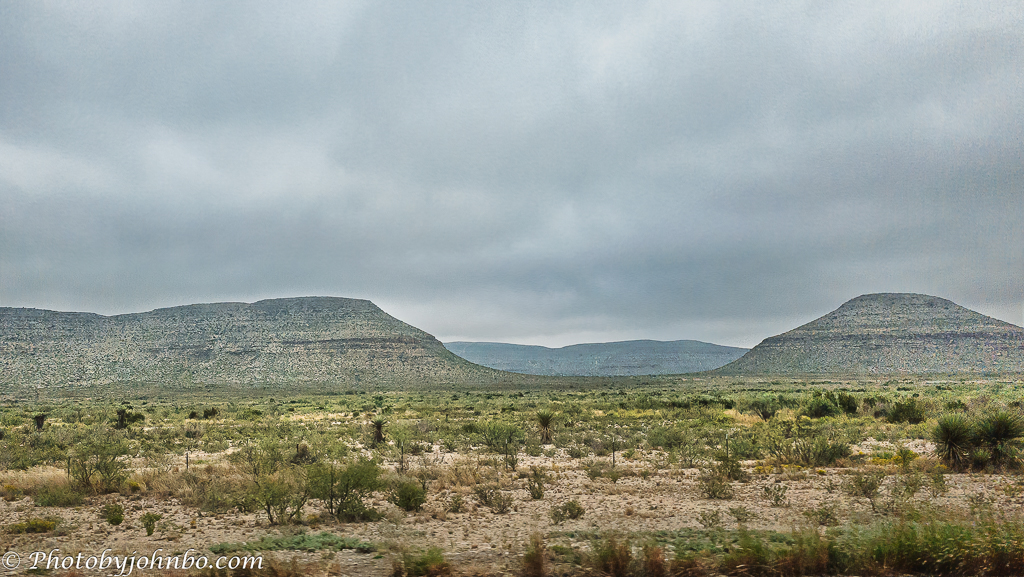
After visiting Big Bend and spending the night in Alpine, we set out for Corpus Christi. Just east of Marathon, US Highway 90 carried us through Lemons Gap—a geological gateway marking the eastern edge of the Marathon Basin. At first glance, it looks like another stretch of desert hills. But pause for a moment, and the scene unfolds into a story written across hundreds of millions of years.
On the horizon, the flat-topped mesas rise skyward. Their “lid” is Cretaceous limestone, laid down about 100 million years ago when a shallow seaway covered much of Texas. These layers—Edwards or Buda Limestone—are the caprock, a reminder of oceans long gone. If the mesas tell the story of vanished seas, the ridges reveal an even older chapter.
It’s easy to be deceived by the perspective here. While the two jagged ridges in the midground create a striking visual “gateway” for the camera, the actual Lemons Gap is a much larger break in the distant, flat-topped Housetop Mountains. The highway threads easterly through a distant notch to escape the basin, while these closer, tilted ridges—home to the hardy Dwarf Palmettos—are the ancient, folded ribs of the basin floor itself.
Closer in, the tilted ridges in the midground of the photo belong to the Tesnus Formation and Dimple Limestone, dating back nearly 300 million years. Once flat seabeds, they were folded and thrust upward during the Ouachita Orogeny, the same mountain-building event that raised the Appalachians. Here in Texas, erosion and uplift have peeled back the younger layers, exposing this hidden core.
And then, tucked among the ridges, the dwarf palmettos (Sabal minor). Native, hardy, and resilient, they thrive in pockets of moisture where seepage from underground or seasonal rains collects. Unlike their towering cousins, these palms rarely grow taller than a person, their fan‑shaped fronds spreading wide from a mostly hidden trunk. The fronds provide shelter for birds and small mammals, while the dark berries feed wildlife across the desert corridor.
Taken together, the view at Lemons Gap is more than scenery—it’s a timeline written in stone and fronds. The mesas on the horizon date back some 100 million years, the jagged ridges in the midground reach back nearly 300 million years, and the dwarf palmettos growing among them trace a lineage of 80 to 90 million years. In one roadside view, geology and biology share the same deep‑time stage. For me, it was simply another landscape photo taken along Highway 90 with fascinating ridges and a dramatic sky. But in writing this Cellpic Sunday post, my research revealed that Lemons Gap is a window on Earth’s history.
About the photo: I was riding in the back seat of the Suburban on our fall trip, busy taking pictures with my Samsung S25 Ultra in Pro Mode so I could use the DNG files for optimal processing. DNG files support adaptive profiles in Adobe Lightroom Classic and other advanced AI features. I then moved the image to Luminar Neo, where I used the new Light Depth tool to increase brightness in the foreground and the desert palmettos. To view the image in 2K HD or see the metadata on my Flickr site, click on the image.
I invite fellow bloggers to join in by creating their own Cellpic Sunday posts. There’s no set theme. The first rule: your photo must be captured with a cell phone, iPad, or other mobile device. The second rule: link your challenge response to this post or drop a comment here with your link so others can find it. And remember, despite the name, there’s no penalty for sharing on a day other than Sunday.
John Steiner


[…] John’s Cellpic Sunday – 30 June […]
Thank you for the great photo. Those mountains in the distance are historic on another level (millions of years…wow).
I like your point on “pause for a moment.” So much detail is captured in that pause in a lot of ways. Thank you for the superb info into. your processing regimen. Always appreciated.
[…] Cellpic SundayWeekly Prompts: The One Day Challenge […]
Thanks, Suzette! We went by that view without stopping, and only when I processed the photo and looked at the details of the palmettos, that I realized the photo was much more about the geologic history than the unusual plants. I was glad that the GPS coordinates were useful in finding out the geologic details.
That is a wonderful landscape John. Thanks for all the information as well. I reckon it would be significant for the indigenous tribes too.
Here’s my Cellpic Sunday
Thanks Brian! That is a great thought. Their history in the region goes back so much further than this descendant of European descent.
What a nice landscape. It reminds me of scenes out of the Wagon Train T.V. show where the settlers were crossing the desert. Here’s my contribution to Cellpic Sunday.
Thanks, Donna!
[…] Cellpic Sunday 31 May 2026 […]
Masterful capture! You have a real eye for finding beauty in the small things.
Thank you!
[…] Cellpic SundayWeekly Prompts- One Day Challenge […]
Great image and tutorial!
Thanks, Anne!
😎
[…] this week to these great photo challenges: BushBoy’s Last on the Card, Johnbo’s Cellpic Sunday, Lens-Artists: Rule of Three, Natalie’s Public Art Challenge, and Pepper’s One Step at […]
John, the image is great and I enjoyed reading about the area.
Thanks, Beth!
That’s a really big view, physically as well as on the time scale too! My entry here – https://flightsofthesoul.wordpress.com/2026/05/31/straight/
It is! When I saw the image at editing, I knew I had to say something about the geology of those folds.
It is so fascinating to look back in time and know that the desert was an ocean, John!
Indeed! And here in Fargo, the area around Eastern North Dakota and into Western Minnesota was once under Lake Agassiz centuries ago.
Amazing! It’s also fascinating to note that in the high country of Yosemite, (Tuolumne Meadows, 11K+), there is glacial polish on all of the domes, but still a few sharp peaks never touched by the carving of the glaciers.
I have been there many times! And I always wonder about the geology. I have tried reading Roadside Geology of Texas but it is so dense, I don’t follow the details. So thank you for this explanation of what we are seeing there. 🙂
You are welcome. Thanks for your comment.
Walk through a park – Ladyleemanila
[…] Posted for Bushboy’s Last on the Card and Johnbo’s Cellpic Sunday. […]
Thanks for adding all that information to that wonderful photo. Here’s my contribution:
https://yvensong.com/2026/05/31/last-on-the-card-may-2026-cellpic-sunday/
You are welcome! Those ridges made me find out more about them.
First, I can’t imagine that you were riding in the back seat of your suburban! Vince barely lets me drive when we are together even when he is dying from exhaustion. Secondly, the story of antiquity is amazing looking at the picture. I wouldn’t have imagined all that history from the picture alone. In some cases a picture is not worth 1,000 words. You took us into and beyond the picture where our eyes couldn’t see. Well done on both accounts.
Thanks, Marsha. That Suburban belongs to my niece and her husband. Lynn and I always ride in the back seat, me behind the driver. On occasion, I drive if the two “drivers” need a break. >grin< It's our autumn trip (usually October) 30-day journey-mobile.
Wow, a 30-day road trip. You and Lynn are the adventurers.
[…] this week to these great photo challenges: Brian’s Last on the Card, Johnbo’s Cellpic Sunday, Lens-Artists: Rule of Three, Natalie’s Public Art Challenge, and Pepper’s One Step at a […]
[…] John’s CellPic Sunday-2026.06.07 […]