April 2025.
Kōloa, Kaua‘i, Hawai‘i.
When I first visited Kaua‘i, I learned about Poʻipū Beach, a shoreline shaped by a shifting sandbar called Nukumoi Point. The sandbar naturally links the beach to a small offshore island, creating two distinct beach experiences side by side—one calm and protected, the other more open to the surf—making the shoreline feel like two beaches in one. Back in 2013, Monk Seals were regular visitors to the sandbar, but by the time I returned in 2025, their appearances had become far less frequent.

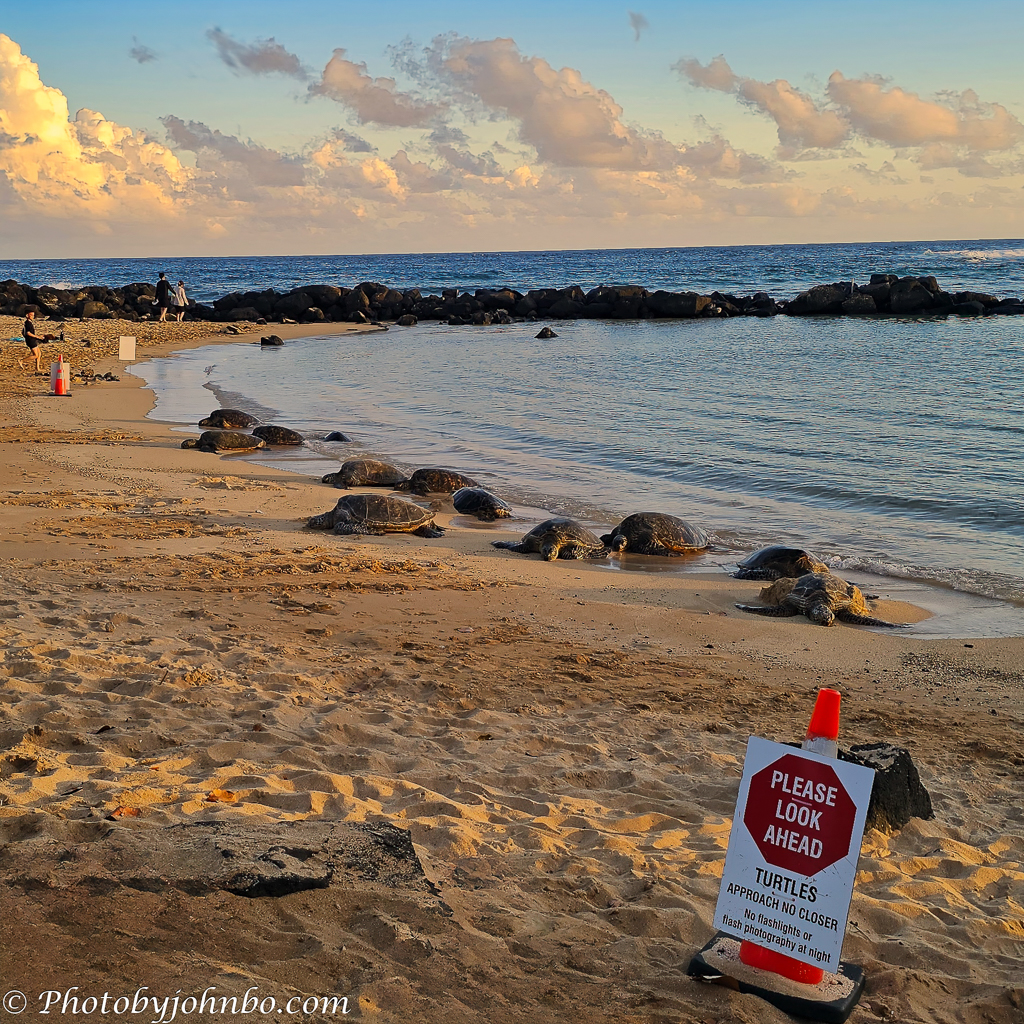
We’d heard there were parking issues and big crowds at sunset, drawn not only by the honu but also by the evening sky. We found a good place to park and a clear spot to view the turtles from a safe distance. Though the beach was busy, it never felt overwhelming. People kept a respectful distance from the turtles—and that’s where a telephoto lens on a cellphone really earns its keep.
As I framed the scene, one detail caught my eye: the lead honu had a small pile of sand pushed up against its shell. I later learned this is classic honu behavior when they’re settling in. They’ll use a flipper to brace themselves, push sand aside, or even pile it up as they shift their weight.

Our host told us that every evening, honu (sea turtles) arrive with the setting sun, a habit that started during the early days of COVID, when travel restrictions emptied the beautiful cove and its twin beaches. With the shores suddenly quiet, the turtles found the solitude they needed to start making nightly visits. Even now, with people back on the sand and the beach far from deserted, the turtles keep coming—a dozen or more arriving at sunset as reliably as the tide.

Stepping away from the sheltered beach and the resting honu, we moved to the larger, more open stretch of shoreline where people were already settled into the sand or their beach chairs, waiting for the sunset. I found a spot where I could stand and frame the scene over the heads of the sunset watchers. Much has changed since my first visit, but the peace of a Poʻipū sunset is still exactly the same.
About the photos: I captured these images with a Samsung S23 Ultra in JPG mode. I did basic processing in Lightroom Classic, followed by a quick pass through Luminar Neo’s toolset. For the sunset image, I removed a couple of distracting elements in the lower-right corner using generative AI. I uploaded all the images and their metadata to my Flickr site in 2K HD here. One technical quirk I recently discovered—Flickr doesn’t report the exact millimeter setting when you use any digital zoom. Whether you tap a defined telephoto stop or pinch-to-zoom, it only lists the widest native focal length of the active physical lens module. I hadn’t noticed this quirk until I checked the details on the turtle photos. I was standing in the same spot by the “Please Look Ahead” sign for all of them, using telephoto settings to “get closer,” yet both close‑up views reported the same lens statistic even though they were shot at different zoom levels.
John Steiner.


The beach looks very amazing, John! Looks like the turtles enjoyed their time there.
Here’s my response: https://aptivisjoyfulcorner.wordpress.com/2026/10/04/cellpic-sunday-oct-4th-2026/
I may be a little late next week as I don’t often take non-tech related pictures, though. Have a great Sunday! ☺️
What a fabulous experience. I hope the people leave the honu alone and let them have a peaceful place to rest.
Here’s my Cellpic Sunday