This week, Sofia challenges us with a little Wabi-Sabi, her twist on Looking Back to #125. Since Wabi-Sabi is a concept I’m only vaguely familiar with, I appreciated that she started with a quote that defines it.
“Wabi-sabi is a beauty of things imperfect, impermanent, and incomplete. It is a beauty of things modest and humble. It is a beauty of things unconventional.” – Leonard Koren.
Sofia continues, “So, let’s break down the concept into three groups, Imperfect, Impermanent and Incomplete and see how that can change how we photograph.” That’s how I’m going to categorize my images for the challenge.
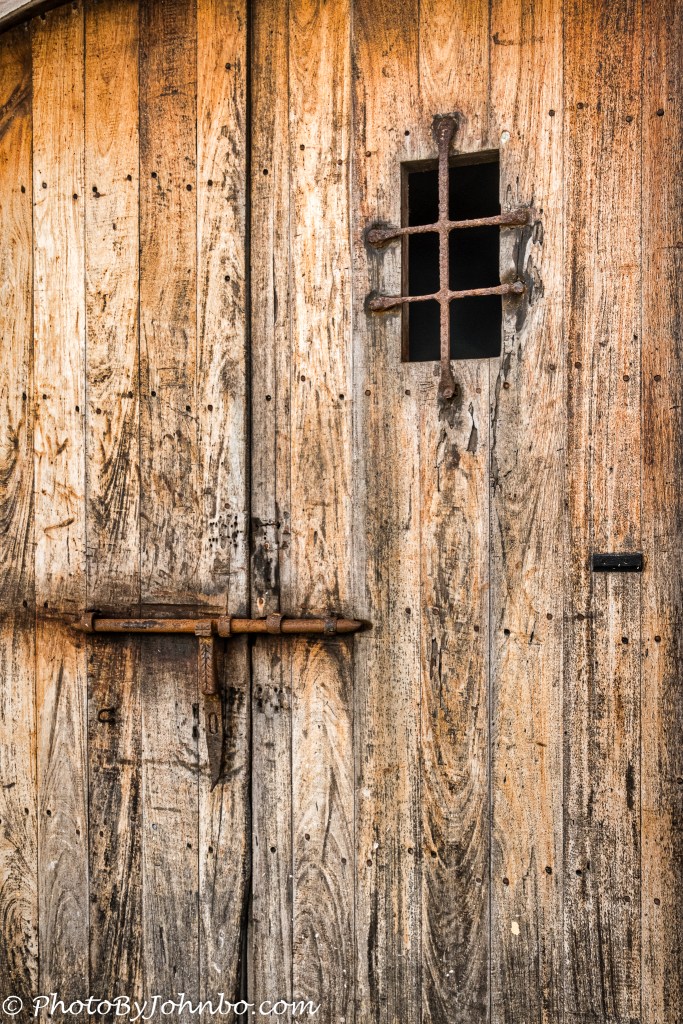
An interior door on El Morro, a 16th-century fortress in Puerto Rico, is my opening image—an example of imperfect, protected by little more than heavy wood and simple iron hardware. No key slots, no glass windows, no Wi-Fi-connected security cameras watching who comes and goes. It was built to be functional rather than elegant, and centuries of weather have added plenty of wear. Yet those signs of age and use are precisely what give the door its character.

My second image falls into the Impermanent category. The Great House at Casa Grande has stood in the Arizona desert for more than six hundred years. The community that built it is long gone, its purpose remains uncertain, and much of the surrounding settlement has returned to dust. What remains hints at the story while reminding us that time eventually transforms everything.

During a visit to a botanical garden, a temporary exhibit featured various works of art. With apologies to the artist, I categorized this piece as Imperfect. I found it incredibly beautiful, and the outstretched hands prompted me to title the photo “Jus’ Sayin‘”. This 2018 photo was captured during the annual “Sculpture in the Garden” exhibition at the North Carolina Botanical Garden in Chapel Hill, NC. The outdoor sculpture looks as though it grew directly from the surrounding landscape. Its bark-like textures and natural forms are paired with a peaceful figure, eyes closed and palms raised, as if pausing for a quiet moment of contemplation.

In 2021, a team of artists stopped in Fargo, parked their RV, and began painting one of their signature Greetings Murals. This example for the challenge is Incomplete. I captured this photo of two passersby examining the mural about two days before it was complete.
The artists’ work is still incomplete in another way. Although they no longer travel by RV, they continue to add Greetings Murals part-time. The mural in my photograph would soon be finished, but the project itself continues to evolve.

The dilapidated Bingo Grain Company elevator captures a moment suspended between past activity and gradual decay. It exemplifies Impermanence, reflecting both the fate of the rail line and the institutions that depended upon it. Once a bustling prairie hub where local farmers brought their harvest for rail shipment, the elevator now yields to time, wind, and weather. Its peeling wood and exposed timbers show how even the most robust structures of human commerce eventually return to the landscape.
Like the elevator, the town flourished with a school, bank, and local businesses, but as rail service dwindled and agricultural shifts consolidated the region, its vitality faded. Today, with its remaining structures slowly collapsing into the grass, Okaton shows how entire communities can rise, transform, and gently recede into the prairie.

My final photo captures the Impermanent nature of a sunset. At 77 years old, I’ve lived through roughly 28,000 sunsets. I certainly haven’t seen them all, but every one marked the end of a day that will never come again. You can find these images and associated metadata in 2K HD on my Flickr site here.
I hope I’ve done justice to Sofia’s theme. I enjoyed learning more about the concept, and Leonard Koren’s quote gave me a clearer understanding than anything else I came across.
Last week, I enjoyed reviewing everyone’s responses to my challenge. Thanks to all who participated.
Next week, it’s Patti’s turn to host the challenge that goes live on Saturday, November 7 at noon Eastern Time. Follow her here so you don’t miss her challenge.
If you’re sharing a Lens‑Artists Challenge response for the first time, welcome—we’d love to visit your post. To participate, publish your take on this week’s theme, link back to this page, and add the Lens‑Artists tag so others can discover your work. You’ll find more details on how the challenge works here.
Lynn and I are traveling for the next couple of weeks. Feel free to comment, but I may not be able to respond as quickly as usual.
John Steiner


Love your photos, John. Great post.
A good variety of selections John