October 2025.
Sorrel, Louisiana.
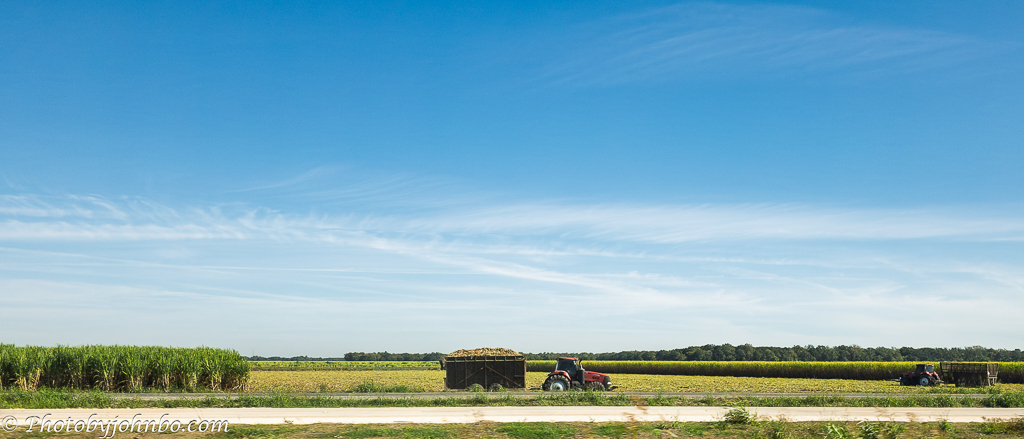
In other trips through Louisiana, we made our way to New Orleans via I-10 or skipped the Big Easy by using the I-12 bypass. On our fall trip in October 2025, we avoided the Interstates and followed a more southerly route via US Highway 90 to New Orleans. Taking this route, we learned about Louisiana’s largest field crop, sugar cane. As we drove along US 90, we could see that the 1.5 billion dollar harvest was well underway. Along the roadside, tractors and harvesters worked the fields, pulling in cane by the ton.

Sugar cane towers over the roadside, and as I later learned, it looms just as large in Louisiana’s economy. Our recent trip to Hawaii taught me that sugar cane is no longer part of the islands’ agricultural rhythm. I assumed then that sugar cane was something America imported in bulk, not something grown at home. Southern Louisiana quickly corrected that notion. Its fields yield over a billion dollars’ worth of cane each year, even as the United States spends twice that on imports. Add Florida and Texas to the mix, however, and the domestic harvest rivals what arrives from abroad—shipments flowing in from Mexico, Brazil, and beyond.
Our detour along US 90 revealed more than just a new route—it introduced us to the scale of Louisiana’s sugarcane industry. Mile after mile of tall green stalks confirmed that this billion‑dollar crop is not only the state’s largest field harvest but also a vital part of America’s sweet supply.
About the photos: As we drove along US 90, I captured several photos of the harvest from my back seat viewpoint. The images were captured on my Samsung S25 Ultra in Pro Mode, allowing me to set a fast shutter speed of 1/1000 sec to eliminate motion blur from the moving vehicle. The opening panorama was created in Adobe Lightroom Classic from two images captured in succession. The photos had noise reduction and Adaptive Color presets applied before being sent to Luminar Neo for final touches. The panoramic view was cropped to remove a power pole, and Luminar Neo’s Remove Powerlines AI removed the lines draping across the image. For those interested in pixel peeping or viewing the metadata, I posted these photos in 2K HD on Flickr here.
I invite fellow bloggers to join in by creating their own Cellpic Sunday posts. There’s no set theme. The first rule: your photo must be captured with a cell phone, iPad, or other mobile device. The second rule: link your challenge response to this post or drop a comment here with your link so others can find it. And remember, despite the name, there’s no penalty for sharing on a day other than Sunday.
John Steiner


[…] Cellpic Sunday 17 May 2026 […]
[…] Johns Cellpic Sunday […]
Australia sell around $80 Million -$115 Million of sugar to the US annually, around 500,00 tonnes. The coast near me used to have cane farms for miles. The money went into Macadamia Nuts which is far less work for a much bigger return
Here’s my Cellpic Sunday
That’s a long way to ship! Apparently we Americans love our sugar!
Consumption per capita would be astounding I feel
Your post is so interesting, John. I only learned about the Louisiana sugar cane industry a few short months ago from a TV show’s brief mention of it in passing. You captured the vastness of the fields well. It is amazing what can be accomplished in large-scale agriculture these days. Superb photos; I can sense the vast expanse of the area and the magnitude of the harvest…wow, just wow!.
As always, I learned from your details on processing your images. Great share, John. Thank you so much.
Thanks, Suzette! I was amazed to see all that sugar cane. I wasn’t even sure what it was at first glance.
Amazing!
Our garden in May – Ladyleemanila
[…] Cellpic Sunday […]
Once again great “shots from the car” John! And thanks for the info on sugar cane grown on the mainland.
Thanks, Anne!
[…] Sharing this week for Kym’s Writer’s Quotes (WQ): Family Ties and Johnbo’s CellPic Sunday. […]
John, there is so much to see when we get off the interstates and drive the back roads. It’s nice to know that sugar cane is still grown here.
Indeed, Beth! I’m hankering for another road trip, just waiting for North Dakota’s first true signs of Spring. Around here, Mother Nature doesn’t quite understand the calendar seasons. >grin<
I didn’t know that either about the sugar cane industry, John! Lovely image, especially with the scale of the car to show the height of the crop. those southern states can use the economic boost! Here is mine this week, with some fun Google AI enhancements:
https://secondwindleisure.com/2026/05/17/sunday-stills-friends-family-and-people/
Thanks, Terri!
I had no idea Louisiana grew so much sugar cane.
Big surprise to me as well, Brad!
Great photos, and, as always, interesting information. Here’s my entry for the week:
https://throughbrazilianeyes.com/a-last-light-on-the-laguna/
Another absolutely splendid travelogue, thank you John. ‘Though I’ve never been to Louisiana, I confess I did not know sugar cane was one of it’s chief crops, so thank you. I love the wide shots of the fields – one pre-harvest, one mid-harvest. This is from Cam (the farmer!!!): Did you notice how it is harvested please? With a combine? Thanks John. pp
I didn’t know, and didn’t see anything that looked like a combine I’ve seen in the upper Midwest. I looked it up, though, as you got me curious. They have equipment designed especially for the cane harvest in Louisiana. Like the combines I know about, they process the crop and transfer the processed cane into a semi driving beside the harvester.
Thank you. Cam says thank you too. I’m learning so much from your posts – you ought to charge!!! pp
[…] For John’s Cellpic Sunday. […]
Oh I didn’t know that US grows sugarcane..In India, we’ve known sugarcane since like forever, so much so that it is part of ancient harvest festivals which are still celebrated today! One of the best refreshing drinks for us in the summer heat is fresh cane juice with ice, lemon, ginger and a bit of salt! Try it if you ever get the chance!
My entry here:
That drink sounds good, PR! Save some for me.
[…] #CellpicSunday […]
So that’s where all the sugar is coming from these days. I wonder where they grow Truvia? LOL It seems a lot more exotic to see it growing in HI, but it’s great they are growing it somewhere. This phrase shocked me, “even as the United States spends twice that on imports.” Why do we do that, when states like LA want to grow the crop. Don’t they have enough land? Speaking of land, TX seems pretty big, and they get tons of rain. Hmmm.
I put your question to Gemini about land use and agriculture. The response I got was interesting. It’s fascinating how a photo of a beautiful, green Louisiana field can unravel into a complex web of international treaties, water rights, and macroeconomic policy. It shows just how interconnected our food systems really are.
The response could create an entire post about why we import more sugar cane than we raise, and it’s not all about politics, Texas is locked in a huge drought and sugar cane needs lots of water, and beet sugar grown in North Dakota, Minnesota, and Idaho supply about 55-60% of domestic sugar production.
Interesting, John. Drought is the reason we can’t grow it here in CA. We used to grow cotton and don’t anymore for the same reason. We could cut back on our sugar consumption and save a lot of money in medical bills, too.
[…] Cellpic Sunday May 17, 2026: – Raindrop Photography – Sidewalk Scene […]
[…] Steiner likes us to share cell pictures, for his challenge Cellpic Sunday, which the more recent family photos were. He also encourages playing with our images, which I […]
Yikes! That is so much sugar and we also produce corn syrup. I love your crop images.
Thanks, Patti! There’s lots of sugar beets produced in North Dakota and Minnesota, also.
[…] John’s Cell Pic Sunday-2026.05.24 […]