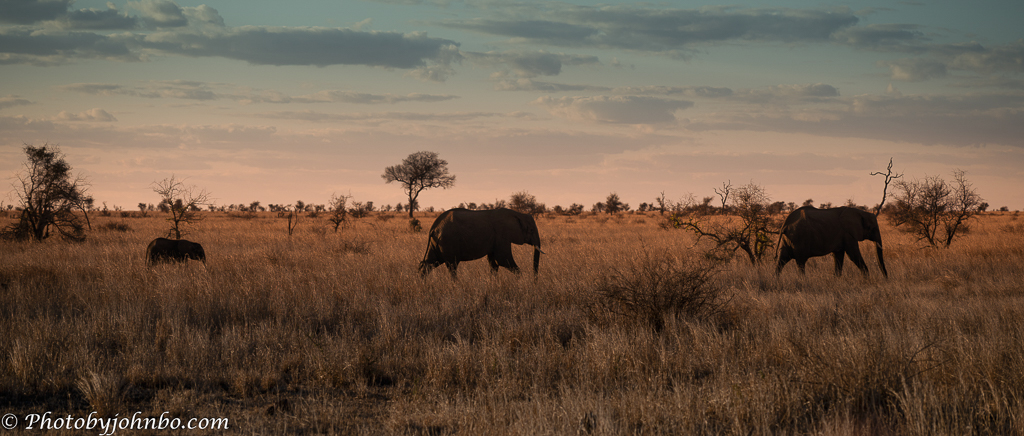
Tina hosts this week’s challenge. She writes, “The basic idea of the “rule” is that images with three subjects (or more, but always an odd number) are more appealing and therefore more memorable.” You can read her entire challenge post here. Don’t confuse it with the other compositional rule based on the Rule of Thirds. For my opening example, the photograph taken at dusk in Kruger National Park, South Africa, shows three elephants moving in single file—a straightforward demonstration of the Rule of Threes. Beyond the trio itself, the landscape naturally embraces the theme, dividing beautifully into three distinct layers: the textured foreground of the golden savanna grass, the middle ground anchoring the wildlife, and the soft sky in the background. While the elephants’ spacing also aligns with the Rule of Thirds—a separate guideline—it’s the layered depth, combined with the trio itself, that gives the image its full compositional strength.

In Theodore Roosevelt National Park, one of my favorite places to visit in North Dakota, it took several trips before we finally encountered a band of wild horses. The park has a healthy population, but they’re not often visible from the main roads and are more commonly found roaming the backcountry. On this visit, they were close enough that a cropped image at a 270mm zoom setting brought the trio into clear view for sharing.

At La Jolla Cove, on the Pacific Ocean shoreline near San Diego, many photographers stroll along the concrete walkway hoping to capture views of the sea lions that gather in the sheltered waters. On this day, I happened to see a bull sea lion and two females resting on the rocks. The bull was constantly barking—no doubt reminding everyone, human or animal, that he’s in charge here.

At Bosque del Apache National Wildlife Refuge near Socorro, New Mexico, we stopped to photograph the migration in late November 2016. We’d missed the peak, but thousands of Sandhill Cranes and both Canada and Snow Geese still filled the refuge. I captured many birds in flight—most with more than three—but managed a couple of images showing trios on the wing over the autumn trees or lifting off from the riparian wetlands. My favorite frame from that day is actually a flight of two, set against the beautiful Chupadera Mountains with hundreds of geese feeding in the fields near the Rio Grande. Of course, I couldn’t use that one for this challenge, but this freshly processed image fits the theme perfectly.

This image shows the 9:03 Gate at the Oklahoma City National Memorial, symbolizing the first moment of recovery after the bombing of the Alfred P. Murrah Building. Visitors stand at the base of the structure, giving a sense of scale, while the opening frames the reflecting pool and the city beyond. Looking more closely, the scene reveals an unexpected abundance of threes—the gate structure divides into three vertical sections, three people stand in front of it, three traffic lights appear through the opening, and three more people wait on the sidewalk beyond. It’s a subtle, layered echo of the Rule of Threes woven naturally into the composition.
Thanks to Tina for this challenge. While searching for images that meet the criteria, I processed a couple of photos I hadn’t shared before. I also discovered a photo from 2020 that I almost included, but it belongs to a set of images I forgot to write about. I will debut that image in its own Tuesday Trek feature. Next week, Patti hosts the challenge that goes live on Saturday, June 6. Be sure to follow her here so you don’t miss her Lens-Artists Challenge.
If you’re sharing a Lens‑Artists Challenge response for the first time, welcome—we’d love to visit your post. To participate, publish your take on this week’s theme, link back to this page, and add the Lens‑Artists tag so others can discover your work. You’ll find more details on how the challenge works here.
John Steiner


A wonderful set. I like your choice of wildlife trios, they are wonderful to look at
Thanks, I.J.!
Beautiful gallery, John. I love the birds in flight. Superb trios all..
Thank you, Suzette!
Beautiful, I especially like the animals, elephants, horses and seals!
Pamela, thanks much!
Great selection of threes John. I like the Cranes flying overhead
Great threesomes John, especially the elephants and the sea lions!
Thanks, Sarah. I really enjoyed Tina’s challenge.
Well done as always John. I loved all of your examples but especially the memorial. First I’ve not seen it before and second the multiple examples of threesomes is terrific.
Thanks, Tina! It was only the three people in the foreground of the memorial that first attracted me, then I looked closer to discover those other “threes.”
John, wonderful collection of threes. My favorites are the three cranes and the memorial.
Thanks, Beth. I had two images of three birds in flight. I’m glad I chose this one.
Beautiful set, John! Loved especially all the animals!
Thanks, Ann-Christine!
Great response John. I loved the elephants and the memorial.
Thanks, Anne!
Great – of course, I love the elefants. But that seal (?) family (?) is wonderful.
I’m not sure if the smaller female is a descendant of the two “parents” or if she is another member of his “harem.”
Probabyl not but I don’t care. They look like a family 😉
Awesome examples. I need to comb my archives…
Thanks, Rebecca!
Absolutely love the display of animals here!
Thanks, Dina!
Your animal photos are awesome, John. The sea lions and especially the elephants are firm favourites 🙂
Thanks, Sofia! It appears I like to capture threes in a shot. I have lots to choose from in my archive, but thought I’d stick mostly with the animals.
I loved that, it was a great decision.
What a strong set for the Rule of Threes — those three elephants moving single-file across the Kruger layers are stunning, and the bull sea lion ‘reminding everyone he’s in charge’ made me laugh out loud. The wild horses of Theodore Roosevelt are a treasure too; it took our family a few tries to finally spot them in the backcountry as well, so I know that patience-rewarded feeling. Lovely eye, John.
Thank you for the kind words. This was a fun challenge to respond because it brought back so many memories of trips past.
Great gallery – the birds in flight and elephants are my favourites
Thank you!!
Love all the animals especially the horses!
They are beautiful! Thanks, Nora!