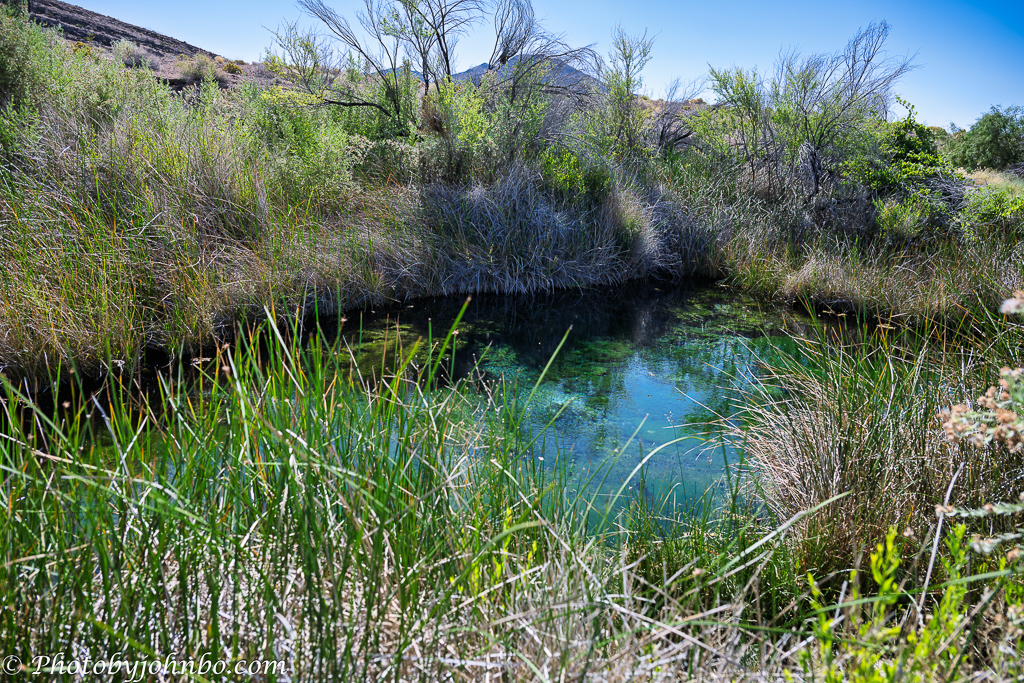
June 2024.
Amargosa Valley, Nevada.
Last year, our annual family reunion was held at my nephew’s home in Pahrump, Nevada. We had some time to explore the area, and we discovered an oasis in the Mojave Desert. A 40-minute drive brought us to the entrance of the Ash Meadows National Wildlife Refuge.
Spread across more than 23,000 acres, Ash Meadows is a rare desert wetland fed by crystal-clear springs that bubble up from an underground aquifer. It’s home to over two dozen species found nowhere else on earth, including the tiny Amargosa pupfish that thrives in waters just a few inches deep. Boardwalks wind through reeds and mesquite groves, offering glimpses of turquoise pools and the occasional lizard basking on sun‑bleached wood.

The boardwalk at Point of Rocks winds eastward through mesquite and creosote, drawing the eye toward a rocky rise that feels close enough to touch. But desert distances in-camera are deceptive. What looks like a short stroll becomes a slow realization: the rocks haven’t moved, and you’ve walked a mile. The wide-angle lens exaggerates the intimacy, but the Mojave has its own way of stretching space—every landmark appears deceptively close. The rocks in the background are part of the low ridges that flank the Amargosa Valley.

Near the springs and just beyond the boardwalk, the desert appears deceptively green. Clusters of mesquite and desert willow rise from the sand, their roots tapping into the hidden springs below. Against a green backdrop, a lone leafless tree stands in quiet contrast to the verdant foliage that seems almost improbable in this arid basin. In the distance, the Amargosa Valley foothills stand half-hidden, like sentinels watching over the oasis.

As we walked by, this Desert Spiny Lizard, unmoving and resting on the boardwalk border, kept a watchful eye on my attempts to capture his likeness. In the blistering, 100°F (38°C) heat of the Mojave sun, his stillness was a lesson in desert patience. But while the lizard seemed perfectly adapted to the dry scrub and hot sun, the air nearby felt surprisingly cooler, reflecting the shade and the coolness of the nearby waters. Soon, the rhythmic sound of flowing water became audible, and we saw pockets of water like those in the opening photo as we explored the boardwalk. The easy, loop trail is only about 0.5 miles (.8 km), and it took us about 20 minutes to walk.

In a pool not much deeper than a puddle, I saw the movement of silver flashes. The Ash Meadows Amargosa pupfish—found nowhere else on earth—glided through warm spring water, its tiny frame caught the light. These fish have survived in isolated desert springs for thousands of years, adapting to temperatures that would challenge most aquatic life.
As we finished the pleasant, 20‑minute loop back to the parking area, I felt a renewed appreciation for this hidden oasis. The only resident along the boardwalk had been a Desert Spiny Lizard, but Ash Meadows shelters far more elusive residents. Kit foxes and coyotes patrol the edges of the springs, and the occasional burro wanders in from the valley. Overhead, migratory birds find rest in the reeds. We turned the car down the road toward Crystal Reservoir, eager to see how this oasis opens into wider waters.

Our next stop was Crystal Reservoir. Though fed by natural springs, the reservoir itself is a man‑made lake, held behind a low dam that expands the oasis into a broad sheet of blue water. As we walked down to the shoreline, two Ruddy Ducks glided across its surface, leaving gentle ripples in their wake. They were my first bird sighting in the refuge. Against the backdrop of reeds and distant mountains, their presence added a new voice to the oasis, subtle yet reassuring in its rhythm.

Looking south, the 70-acre lake hosted a dozen or so ducks, all too far away to identify species. Though fed by natural springs, Crystal Reservoir’s dam creates a calm surface, a man-made expansion of the desert’s hidden waters. Swimming is allowed here, but a sign warns of swimmer’s itch, so even in the high heat of the day, we decided not to get cool in the water. The reservoir is the only designated swimming area in the refuge. Still, it also serves a quieter purpose: offering habitat for waterfowl, dragonflies, and the occasional heron that stalks the shoreline. Though other birds frequent the lake, we only saw ducks on our visit.

Located near the Crystal Springs Boardwalk, the Ash Meadows National Wildlife Refuge Visitor Center is open seven days a week, typically from 9 AM to 4 PM. However, visitors should check the U.S. Fish and Wildlife website here as their hours may vary seasonally. Admission is free, and the center offers a range of amenities, including restrooms, shaded picnic tables, a small bookstore, and interactive exhibits that introduce the refuge’s rare species and spring-fed landscapes. It’s a great place to pick up maps, ask questions, or simply cool off before heading into the desert trails.

Inside the center, cooled by welcome air conditioning, a small bighorn sheep invited us to explore the interactive exhibits. The displays blend lifelike models with immersive backdrops, offering glimpses into the refuge’s rare species and desert ecosystems. One moment, I was eye-to-eye with a bighorn ram posed against a painted marsh; the next, I was tracing the journey of spring water from aquifer to oasis. Touchscreens, maps, and interpretive panels guide visitors through the geology, wildlife, and conservation efforts that make Ash Meadows so unique. It’s a compact but thoughtfully designed space that invites visitors to learn about the reserve.

We stepped out of the visitor center onto the back deck to take a walk in the desert heat. The view of the desert was interrupted by the zigzag of the Crystal Springs Boardwalk. It begins just beyond the visitor center, a 0.9‑mile (1.5 km) fully accessible loop with benches and interpretive signs spaced along the way. The main boardwalk meanders generally south/southeast and heads out toward the springs, then splits into two parts to form the overall loop. In the distance, the Resting Springs Mountain Range is prominent, with the mile-high (1.62 km) Stewart Peak dominating the background.
We headed down the boardwalk but didn’t take the time to walk the Long Trail. The boardwalk is part of the overall Crystal Springs Interpretive Trail. However, the path around the springs is maintained as a boardwalk to protect the sensitive spring area. Despite the arid surroundings, the boardwalk leads through one of the lushest areas in the refuge, where Caribbean‑blue water flows year‑round and rare species thrive in the shallows. The springs here are part of a vast aquifer system that stretches all the way to Utah.

The Funeral Mountains rise along the eastern edge of Death Valley, their jagged silhouette visible from Ash Meadows. Part of the Amargosa Range, they reach over 6,700 feet (2,042 m) at Pyramid Peak and mark the threshold between spring-fed life and desert extremes. Their name likely comes from the dark debris flows at their base, said to resemble mourning bands—fitting for a region with place names like Coffin Peak and Furnace Creek. These somber titles reflect the impressions of early travelers who saw both danger and awe in the valley’s stark beauty.
Our visit to Ash Meadows included Point of Rocks, Crystal Reservoir, the Crystal Springs Boardwalk, and the Visitor Center. Each stop highlighted a different aspect of the refuge, from rare pupfish to waterfowl and desert landscapes. Other sites, such as Devils Hole and the historic Longstreet Cabin, remain for another visit, but the places we explored gave a clear sense of the oasis and its role on the edge of Death Valley.
About the photos: All photos were captured with my Nikon Z7 II, coupled with the Nikkor Z 24-120 f/4 lens. Most photos were processed entirely in Adobe Lightroom Classic, with some images brought into Luminar Neo for additional tweaks. For those who like to pixel-peep or scan the metadata, all of these images, along with a few more of the refuge, are in my Flickr gallery here.
John Steiner


What an amazing place. I love the boardwalks
It is, indeed, an oasis in the desert.
Sometimes the desert can yield surprises, and this is one of them. Thanks for sharing John.
It is, indeed. I’m fascinated by the lake, nearly full in the middle of summer in the desert.
John, thanks for the tour of this lovely place.
Thanks for reading, Beth. It is amazing.
What a stunning gem in the middle of the desert. Thanks for the tour John.
It is an amazing place, no man-made pumps or artificial support, just natural spring water. Thanks, Brad!
It looks lovely.
How lovely to find water in the desert! I love your photo of the lizard, and the little endemic pupfish are fascinating 😀
We had family activities at a reunion in Pahrump, and I wasn’t sure I wanted to be away from the festivities for so long, given the travel time. It was well worth the trip to spend a morning there.
What a lovely place!
Perfect setting for a family reunion. I loved this post thank you – the images and the story. Thank you so much! pp
Thanks, Pam!