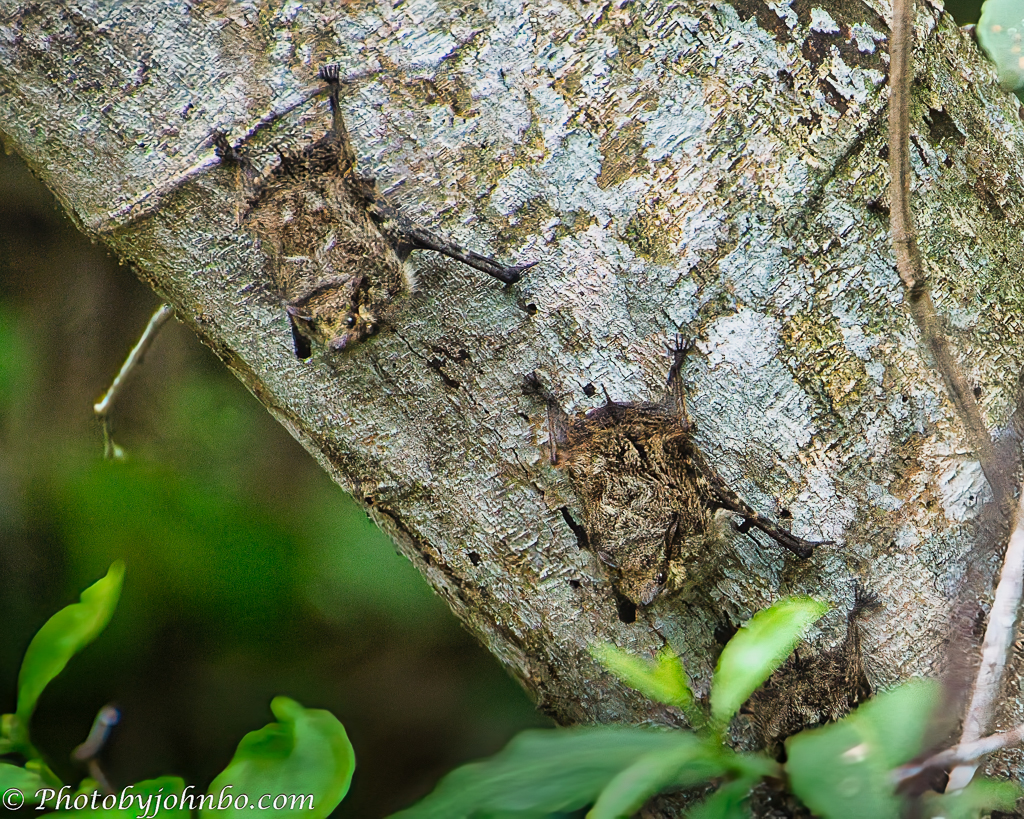
This week, Anne invites us to put texture front and center. As she writes, “Texture helps my two‑dimensional examples have a three‑dimensional quality. Now it’s your turn. Show us your images where texture plays an integral part.” Her full challenge post is here. I’ll confess that texture isn’t something I consciously chase unless it practically jumps out of the frame. At first, I could only think of two images—and one of them made an appearance not long ago. That sent me to Excire Search, the AI tool I rely on for keywording in Lightroom Classic. It didn’t disappoint: more than forty images popped up, each one a clear candidate for this week’s theme. In the end, I didn’t use either of the two I’d remembered.
My opening image features two Proboscis Bats clinging to the trunk of a riverside tree, photographed during a jungle cruise in Belize. I chose a slightly wider shot than the one Excire flagged—this one shows both bats clearly and gives a better sense of how well they camouflage themselves against the bark. It’s a perfect place to begin, because texture is the entire story here: the rough, grooved surface of the tree, the delicate folds of the bats’ wings, and the way their bodies almost disappear into the pattern of the wood.

From here, the sequence moves through a small tour of natural textures before shifting into the man‑made world. Each image has its own moment—so I’ll let the textures reveal themselves as you scroll.
We start with New Mexico’s Tent Rocks, named because the conical‑shaped sandstone deposits resemble Native American tipis. The sedimentary striations are the real story here—thin, horizontal layers that give the stone its subtle texture and hint at the long geologic history behind it. In this image, the late‑morning sun casts sharp shadows from nearby branches across the lower portion of the formation, adding a second layer of texture that interrupts the smooth sandstone with graphic, almost calligraphic lines.

From the nearly smooth sandstone in New Mexico to the rough and weathered texture of the ironshore limestone formations at Hell, Grand Cayman, the millennia have sculpted what we think of as solid, permanent rock into artistic forms in nature’s good time. Here, ancient coral reefs were transformed into limestone, then slowly eroded by acidic water, tropical rain, and constant weathering. The result is a jagged, other‑worldly surface—sharp ridges, deep pockets, and darkened edges—that turns this small patch of coastline into a natural sculpture garden.

On a wildlife hike through the Arizona desert, we came upon a dry wash dampened by recent rain. This conglomerate rock caught my eye because of its contrasting textures—the solid, embedded pebbles locked into the stone and the soft, velvety moss that spreads across the surface. Conglomerates are literally rocks made of other rocks, a mix of rounded stones and sand fused together over time by mineral‑rich groundwater. The moss adds a living layer atop that ancient structure, softening the hard edges and settling into the tiny pockets between the pebbles. Over millions of years, pressure and natural cementation turned this jumble of river‑worn stones into a single mass, leaving behind a surface where geology and biology meet in a single textured frame.

On a visit to Kirstenbosch Gardens in Cape Town, South Africa, I spotted this palm frond and knew immediately that it would someday fit a texture‑focused challenge. The sunlight brought out every ridge and vein in the leaf—the smooth arcs, the raised edges, and the alternating bands of light and shadow that turn a simple frond into a study in natural design.

Nature gives us textures shaped by wind, water, and time—often chaotic, often unpredictable. Man‑made textures, by contrast, tend to follow the rules of design and function. This grille from a 1933 Pierce‑Arrow is a perfect example; its smooth vertical bars forming an orderly pattern that stands in sharp contrast to the organic textures earlier in the sequence. The open design draws cooling air into the engine bay, but it also reflects the craftsmanship of the era—a blend of form and function where even a practical component becomes a piece of industrial art.
Thanks to Anne for reminding me that so many of my photos depend as much on texture as they do on composition to tell the subject’s story. Some textures are instantly recognizable while others defy easy description, yet each one adds its own layer of meaning to an image. Last week, Ann‑Christine chose “Illustrate a Quote,” and I found it enlightening to see the wide range of quotes and the innovative photos everyone selected to share. Next week it’s Ritva’s turn to challenge us—her post goes live on Saturday, May 16, at noon Eastern Time.
If you’re sharing a Lens‑Artists Challenge response for the first time, welcome—we’d love to visit your post. To participate, publish your take on this week’s theme, link back to this page, and add the Lens‑Artists tag so others can discover your work. You’ll find more details on how the challenge works here.
John Steiner


They’re all great shots, but my clear favourite is the bats. Great post again, John! pp
Thanks, Pam!
This is a very fine texture set, John. I first thought those bats were simply sections of the bark peeling off. How well they hide on the bark! The rocks and everything else you shared had great texture examples, too.
Thanks, Egidio. When I was taking the photo, the tour guide mentioned bats (plural) but in the viewfinder, I wasn’t even sure I was seeing one bat. The first photo I took had the lower bat “cut off” partially. Fortunately the next couple of photos included both bats. It took my loading them into Lightroom to see them clearly.
nature gets the tops score from me, the rock formation is a great shot. John
Thanks, Ritva!
Nice job on finding images that highlight texture John. I especially like the sandstone, palm, and grille.
Thanks, Brad!!
Especially like the sandstone.
I have some really interesting photos of those “tent rocks” and the conical shapes they exhibit. It’s a beautiful and rugged landscape. Thanks, Sandy.
My pleasure.
I like your choices John, especially the bats. I had a difficult time finding them until I made out their legs. And, of course, a car would be included!
I HAD to have a car. >grin<
Those bats really are camouflaged. Thanks, Anne!
John, I really like the variety of textures you chose. I have to admit I had to look hard to find those bats. My favorite nature image is the Moss on Conglomerate Rock. The car is great.
These are great John, I’m with the others, I loved the bats! Also the Pierce Arrow is beautiful!
Thanks, Tina!
I could have done a whole post on car textures along, but I resisted. >grin<
I could barely see those bats when I was in the boat along the shore taking the photo. Their body fur really hides them on a tree.
Such a lovely variety of textures John and those bats are so well camouflaged! 😊
Thanks, Xenia! That photo of the bats was just waiting for someone to say, “Texture.” >grin<
Some wonderful examples, John. I didn’t realize those darker patches were bats until I read the title of the image. My favourite is the eroded limestone spires. I can feel the harsh scratchy surface just by looking at your image.
Indeed! Those sandstone cones are fascinating. Thanks, Vicki.
Great textures John, love the variety.
Thanks, Leanne!
Superb gallery. Such a variety of textures
Thanks, I. J.!
Wonderful examples, John
Thanks, Rupali!
Wow, John! Those bats blend in so well.
They do, indeed!