January 2023.
Saint Augustine, Florida.
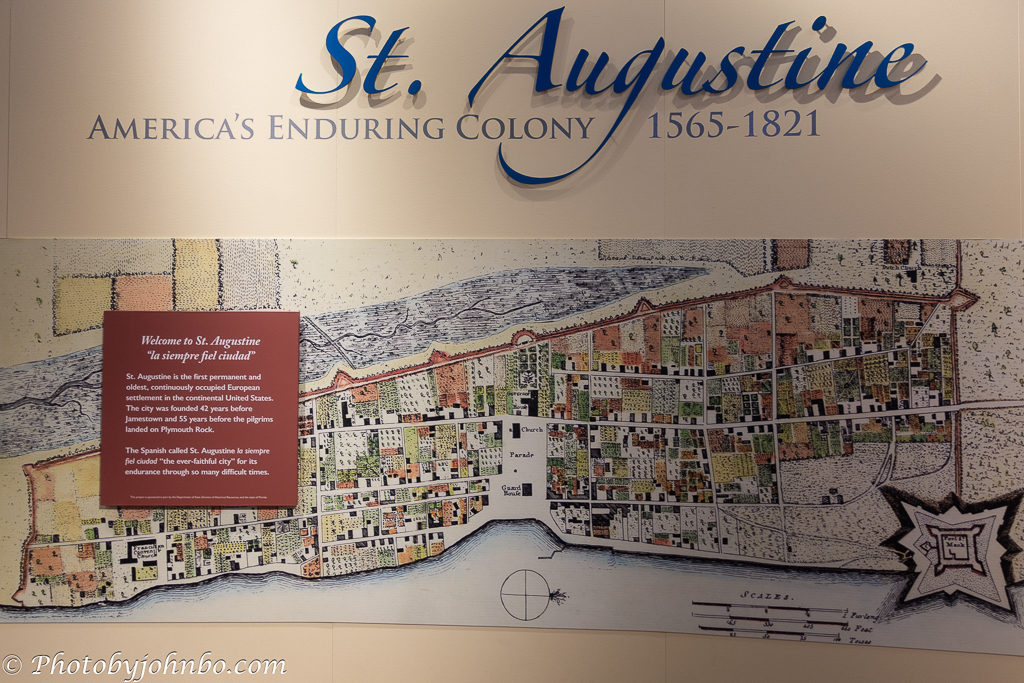
Who would believe that this Florida city is the oldest continuously occupied European settlement in the continental United States? That’s what the placard says on this map of the city in the St. Augustine & St. Johns County Visitor Information Center. We began our tour there, just steps from the parking garage in the historic district. Even with the $20‑per‑vehicle‑per‑entry fee, we chose the Historic Downtown Parking Facility because street parking is limited and nearly always full, though you might get lucky and find a spot nearby.
The visitor center is a free museum that covers the city’s earliest days under Spanish rule. Near the entrance, we saw a map: a modern illustration of St. Augustine’s colonial-era street layout, showing the historic district as it appeared during the Spanish period (1565–1821). In July 1821, Spain formally transferred East Florida (including St. Augustine) and West Florida to the United States under the Adams–Onís Treaty. The treaty was signed two years earlier, in 1819, but ratification delays meant the handover didn’t occur until 1821.

The museum’s exhibits walk visitors through that long Spanish era, starting with the earliest days of exploration and settlement. One of the first displays features a model ship and figures representing life during the First Spanish Colonial Period (1565–1763). Long before the 1821 transfer to the United States, St. Augustine had already endured centuries of change, challenge, and survival under Spanish rule.

Outside on the sidewalk alongside A1A (recently renamed the Jimmy Buffett Memorial Highway), we came upon a historic cemetery. Across from the City Gate, which marks the entrance to Saint George Street, is the old Public Burying Ground, used during the 1821 yellow fever epidemic. The Presbyterian Church acquired the property in 1832 and maintains the cemetery to this day. Though commonly called the Huguenot Cemetery through the years, it was never exclusively Huguenot; the name reflects its role as a Protestant burial ground for non‑Catholics in the decades after the church took ownership.

Passing through the gateway, we entered a lively pedestrian street. Unlike many pedestrian streets in the United States, Saint George Street was never a modern roadway converted to an open-air mall. Its entire history is rooted in foot traffic, horses, and wagons, and the city has intentionally preserved that character. Interspersed among the historic buildings—like the oldest one-room schoolhouse in the United States—are souvenir shops, bars, restaurants, tobacconists, and treat shops.

The Peña‑Peck House reflects St. Augustine’s layered past. Built in the 1740s for the Spanish Royal Treasurer, it has thick coquina walls that show the same shell‑stone texture that defined so much of the city’s colonial architecture. When Dr. Seth Peck and his family moved in during the early American period, the home adapted to a new flag without losing its Spanish bones. Today, it’s a museum furnished to reflect how the Peck family lived in the mid‑1800s, with domestic routines and everyday objects displayed throughout the original Spanish construction. I didn’t tour the museum interior, but the courtyard next door caught my attention.

From a nearby placard, I found out the courtyard is part of the original Peña‑Peck property. There’s no admission to the space, just a low fence that lets you look in from Saint George Street. The Woman’s Exchange maintains it today, and even from the outside you can see how the fountain, palms, and pebble walkway create a small outdoor space that once belonged to the family who lived next door.

At the south end of Saint George Street, I looked to my right and spotted a historic church sitting a block to the west. As I walked over to photograph it, I came across a monument near the Cathedral Basilica of St. Augustine. The Father Pedro Camps Monument honors the spiritual leader of the Minorcan community that arrived in the city in 1777 after a nearby colony collapsed. Father Camps guided the group through years of hardship, keeping them together when disease, exploitation, and isolation threatened to scatter the community. After their resettlement in St. Augustine, he continued to serve as their pastor until his death. The monument honors his role in preserving the identity and cohesion of the Minorcans during one of the most difficult chapters in the city’s history.

The Cathedral Basilica of St. Augustine is home to the oldest Catholic parish in the contiguous United States. Although the parish was established at the city’s founding in 1565, construction of this coquina church wasn’t completed until 1797. An 1887 fire heavily damaged the interior, but the thick coquina walls survived, allowing the church to be restored with a prominent bell tower and enlarged footprint. Today, its Spanish Colonial facade, clay-tile roof, and quiet surrounding grounds make it one of the focal points of the historic district.
Saint George Street isn’t long by modern standards. At only about six blocks, it packs a lot of history into those short stretches between Orange Avenue and King Street. That’s all the better, since it’s easy to slow down and stop at an eatery or historic wine bar along the way. Be prepared for heavy pedestrian traffic, especially in the winter months when most people visit the old city, but that’s part of the charm—a busy street layered with centuries of stories.
About the photos: For street photography, I often use my Sony RX100M5 with its fixed 24–70mm F1.8–2.8 lens. Its compact size is barely larger than a smartphone, making it far less conspicuous than my Nikon gear. I blended the photos from three exposure brackets using Lightroom Classic’s HDR Merge tool. I kept edits to a minimum, but I used Lightroom’s masking tools extensively to remove the HDR look from the skies and tweak subject exposures. I removed distractions from some images with Lightroom’s AI Distraction Removal tool. For those who like to pixel‑peep or scan metadata, the gallery is on my Flickr site here.
John Steiner

