June 2025.
Fargo, North Dakota.
Note: The answer to the question posed about the spiral staircase in my challenge response, “Where Does It Lead?” is at the end of this post.
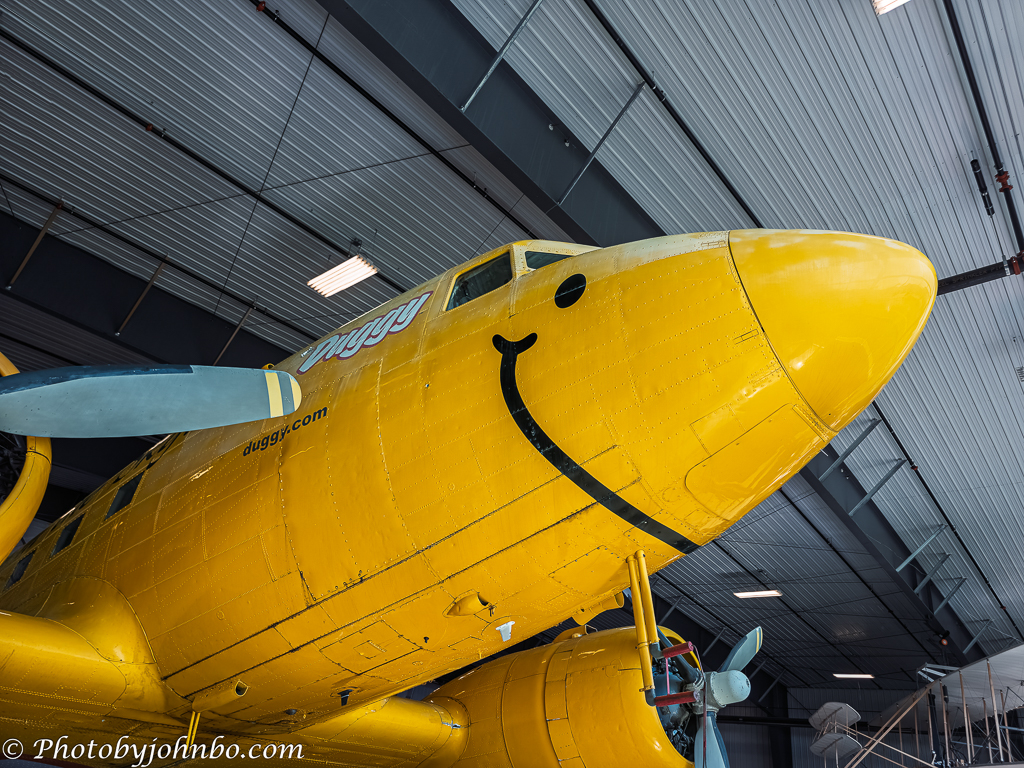
In 2025, my grandson and I headed to the Fargo Air Museum for a photo walk with our Nikon cameras. Inside, I spotted Duggy and snapped a few quick shots with my Samsung phone to include in a Cellpic Sunday story about the iconic piece of aviation history born of the military and reborn as an aviation outreach program for the Young Eagles, a national effort to increase awareness of aviation opportunities for students 8 to 17 years old.
Duggy was one of over 10,000 military cargo and troop carriers built during World War II as a Douglas C-47 Skytrain. Sent to Australia, the aircraft served in the Pacific Wing of the Air Transport Command. After the war, the C-47 entered commercial service as war surplus, and starting in 1950, spent decades as a Canadian government transport and utility aircraft.

The Douglas DC-3, the commercial twin of the C-47, spent decades hauling passengers and freight. This rugged airframe remains in active service around the world today, uniquely capable of operating from short, rough, unimproved airstrips at incredibly low operating cost. As a teenager, I had a personal connection with the legendary DC-3. In the early 1960s, when I lived in Long Beach, California, I won an award that included a flight to San Diego to visit the San Diego Zoo. That was my first-ever plane ride… even today, I remember walking up the incline from the rear door to find my seat. Looking at the photo today, the incline isn’t nearly as steep as it lives in my memory… but to a kid on his first flight, it felt like walking up the sloping aisle of a movie theater.
I had barely earned my private pilot’s license in 1997, right around the time North Dakota aviation pioneer Bob Odegaard was cementing his legacy. In 1998, he and Harry Thompson bought the aircraft from the Canadian government, flew it to North Dakota, registered it as N1XP, and restored it to a classic olive-drab C-47 from the early days of the North Dakota Air National Guard.
Meanwhile, artist Mitch Carley had spent years drawing a friendly cartoon DC-3 named “Duggy”—after Donald Douglas—with the dream of using it to teach kids that they could achieve anything with hard work.

In 2003, Carley teamed up with the National Aviation Hall of Fame (NAHF) to build a youth education initiative called SkyReach. They realized they needed a real, flying “spokesplane” to grab kids’ attention at airshows. When they pitched the idea to Bob Odegaard, Bob absolutely loved it. He offered N1XP as the real-life version of the character. In late 2004, the rugged military transport was sent to SkyHarbour in Canada, where it was completely reconditioned and sprayed in a striking, high-visibility yellow paint scheme, complete with that massive, friendly smile right on the nose.
Duggy made his public debut at EAA AirVenture Oshkosh in 2005, naturally aligning with the Experimental Aircraft Association’s (EAA) Young Eagles program—a national effort dedicated to giving youth ages 8 to 17 their first taste of flight and introducing them to aviation career opportunities.
With its friendly face and rich history, Duggy became a beloved, flying ambassador for the program. The airplane traveled to airshows across North America, welcoming thousands of wide-eyed kids to step inside, touch a piece of living history, and realize that the sky was well within their reach.
That 2005 public debut at Oshkosh wasn’t just a hit with the crowds; it caught the eye of Hollywood royalty and passionate aviator Harrison Ford, who was serving as the EAA Young Eagles Chairman at the time. Right there on the tarmac, a legendary meeting took place. Bob Odegaard, Mitch Carley, and Ford met at the aircraft, where Ford climbed into the cockpit for official “right seat” copilot training in the historic DC-3.

1. Harrison Ford (left) and Mitch Carley.
2. Bob Odegaard (right) presents Harrison with his copilot wings.
3. Bob Odegaard (left) in his yellow Duggy uniform training Harrison Ford.
After taking control of the massive taildragger, Ford received his honorary DC-3 copilot wings. It was a moment of pure aviation magic—the legendary pilot of the Millennium Falcon stepping out of the bright yellow “Smile in the Sky,” smiling alongside the men who brought the character to life.
Following Bob Odegaard’s tragic passing in 2012, the national airshow tour wound down. Bob was a true pioneer who poured his heart into preserving aviation history and sharing it with the next generation. While Mitch Carley’s Duggy and the Odegaard-Thompson reconstruction might still be flyable, his traveling days are over. This vibrant piece of North Dakota history has found a permanent home at the Fargo Air Museum, where that big, friendly smile still greets every visitor who walks through the hangar doors.
Far more than a static warehouse of relics, the Fargo Air Museum lives up to its identity as a true “flying” museum. Guided by a mission of education, preservation, and restoration, they don’t just protect history—they keep it flyable. It’s a place where aviation truly takes flight, ensuring legendary aircraft like Duggy can keep inspiring new generations of aviators to look to the skies.
About the photos: I took the two opening photos with the Samsung S25 Ultra using the Expert RAW app. True confession time—though this is a Cellpic Sunday post, I included the 2017 image of Duggy to highlight his tail art even though it was taken with a Nikon D500.
I processed all images in Adobe Lightroom Classic using the June 2026 version 15.4 update. I immediately noticed that the subject masking tool has improved significantly—a major help when wrestling with the harsh, uneven lighting of an airplane hangar.
The enhanced mask tool was especially useful on the second image. By intersecting a subject mask with a left-to-right linear gradient starting behind the aircraft’s windows, I could selectively increase exposure on the fuselage, keeping the background naturally dark while preventing Duggy’s iconic yellow paint from fading into the shadows.
Answer to last week’s Spiral Staircase photo:

Where does the path lead? Did I shoot from the top looking down, or from the bottom looking up? It’s all a matter of perspective.
I was looking up from below. The metal steps don’t give it away easily because they appear visually symmetrical. However, the handrail stanchions lead upward into the image—meaning the handrails are farthest from the camera’s viewpoint. Those circular rings in the center are at floor level; the lowest ring partially blocks the safety rail rising from the second-floor landing. While the receding arc seems to be due to distance alone, it’s also because the lighthouse walls taper as the tower rises. I wanted to stand dead center directly beneath the circular rings, but it was the holiday season, and an eight-foot Christmas tree sat right in the middle of the floor!
John Steiner


That’s sending smiles across the sky, John. He’s a true pioneer.
Thank you so much for sharing a little piece of history! Here’s my take for this week:
https://aptivisjoyfulcorner.wordpress.com/2026/10/18/cellpic-sunday-oct-18th-2026/