This week, Anne hosts the challenge she calls “Move Your Body”—a prompt built around changing your position rather than your camera’s focal length. She writes, “I love my 18 to 300 mm lens. I use it all the time because I don’t like to change lenses in the field. How many of you use a zoom lens? Now, what would happen if you had a fixed lens and had to walk forward, backward, or sideways to get the shot?” You can read her entire challenge post here.
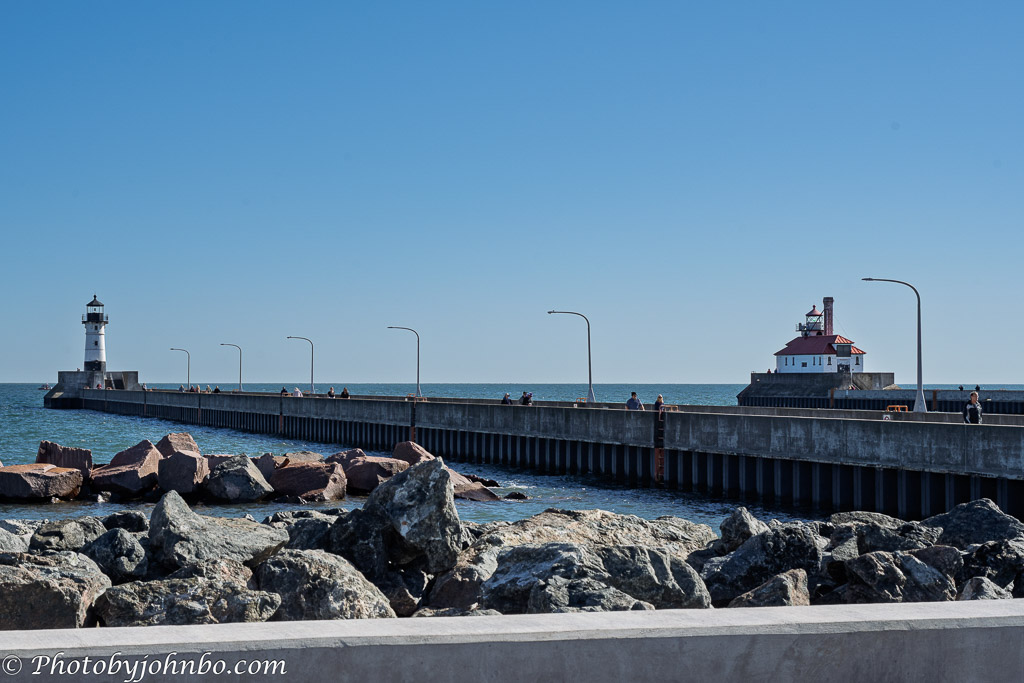
We were in Duluth, Minnesota, on our annual Autumn trip when Anne’s challenge went live—serendipity at its finest. One of our stops was Canal Park, adjacent to the Duluth Harbor Channel, where iron ore freighters and boats of all kinds enter and leave the harbor on Lake Superior. It seemed the perfect place to try out Anne’s “Move Your Body” theme. My opening photo features the two channel markers—structures that resemble lighthouses, though each serves a distinct purpose. The left tower carries a green light facing away from the harbor, while the right tower displays a red light toward incoming vessels. Together, they guide sailors safely into the channel entrance at night.
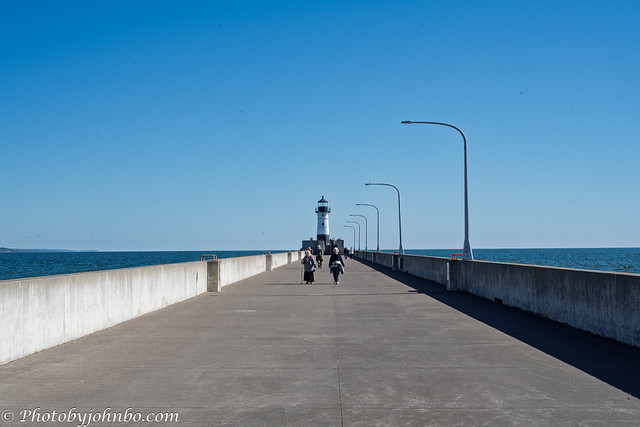
On each side of the channel, a wide walkway invites visitors to stroll along the water—close enough to study the markers and watch freighters glide past. For all of my photos, I set my Nikkor 24–120mm zoom lens to 50 mm to simulate a fixed‑focal‑length lens. For my second shot, I stepped to the center of the walkway to get a clearer view of the channel‑marker promenade.
Adjacent to the walkway is a small maritime museum that highlights the history of Duluth’s harbor and its iron‑ore freighter terminals. Inside, visitors can watch a short film and explore various exhibits, including a collection of artifacts recounting one of Lake Superior’s best‑known tragedies—the sinking of the Edmund Fitzgerald during a fierce November storm.
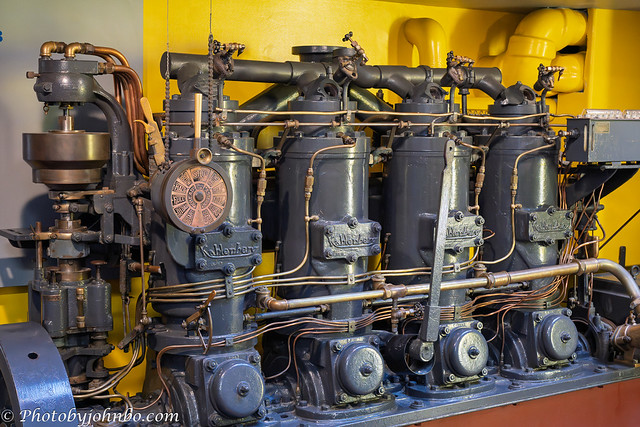
One display—a ship’s engine—offered a perfect example of how moving my body can reveal details that a zoom adjustment or simple crop would never match. A round dial marked with speed instructions sits on the engine, and the captain operates it remotely from the bridge. A matching dial on the bridge rotates to signal the engineer, and the telegraph wheel on the engine mirrors whatever setting the captain selects.

To show the detail on the dial and make it readable, I could have cropped the image or zoomed in for a closer look. To capture the entire engine at first, I stood at an angle that let me frame it fully. By stepping closer and facing the telegraph straight on, the intricate markings on the dial become crisp and legible—an advantage of changing my physical perspective.

This photo shows the walkway at the opposite end of the north channel marker. In the background is the museum I mentioned earlier—a favorite stop for visitors who enjoy watching the harbor traffic. Monitors around the museum display scheduled arrival and departure times so people can plan their visit, enjoy a pleasant day by the water, and watch freighters move in and out of the channel. A row of benches accommodates those who settle in to watch the transitions.

We’d seen the monitors when we first entered the museum, and no ships were scheduled to use the channel during our expected stay—but a public‑address announcement alerted us to a newly added departure of the Presque Isle, an iron‑ore freighter. On the monitor, I noticed the ship was now listed as a 12:04 PM departure. Once again, I moved my body to the upper level of the museum ramp as the ship entered the canal, giving me a better vantage point for its transit through the channel.

A few minutes later, we saw the ship heading out to the lake, and that got me thinking that with a fixed lens, I could simply stand in one spot and let the subjects come to me. Here’s the freighter leaving the harbor; I still had to rotate my body to capture its full length—sometimes the best move is to stay put and let the action pass by.

Not every ship using the channel is a big ore‑hauler. Vessels of every size come and go throughout the day, and from that same elevated viewpoint, I captured this sailboat heading out to the lake. That’s all for my challenge response this week. As I scanned the image metadata, I noticed that not all of them were exactly at 50 mm—some registered at 49, some at 50, and some at 51. That’s because the rotating zoom ring lacks hard stops and has only an index marker, so the mechanical precision is a bit loose. But what’s a millimeter or two among friends? >grin< If you’d like to check out the metadata or view any of the photos in 2K HD, you can do so on my Flickr album here.
Thanks to Anne for making me move my body, get outside, and enjoy a day on the water with my Nikon Z7 II and my “fixed” zoom lens. Last week, Beth had us looking at bridges, one of my favorite topics. Coincidentally, I saw—and photographed—a couple of bridges new to me this week. They may show up in a future bridge challenge. Next week, it is Ritva’s turn. Be sure to follow her here—don’t miss her challenge, which goes live on Saturday at noon Eastern Time.
We are still on our annual autumn road trip, now traveling in Wisconsin, so my Internet time is limited this week. Feel free to comment, but I may be slow to respond.
If you’re sharing a Lens‑Artists Challenge response for the first time, welcome—we’d love to visit your post. To participate, publish your take on this week’s theme, link back to this page, and add the Lens‑Artists tag so others can discover your work. You’ll find more details on how the challenge works here.
John Steiner


John, You moved really well, I liked the Ship’s telegraph,Ship’s Engine. I like taking similar photos as well.
Thanks, Ritva!
Wonderful gallery, John. I love your point “that sometimes one has to wait for the subject to come to them.” Looks like a wonderful place to sit and watch the workings of the waterway. That barge is spectacular. Thank you for all the information to add to your posts; I learn a lot. Much appreciated. Continued safe travels!
Thank you for the kind words, Suzette. We enjoyed our stay on a beautiful day at Canal Park.
You are welcome, John.
Thanks for another fun and interesting tour John.
Glad you enjoyed, Brad!
John, the ship’s telegraph is a beauty. You captured it very well. I liked the gallery and different views you used.
Thanks, Egidio!
John, you showed us the importance of waiting for something to come to you. I think waiting is harder than moving your body! You also showed us that we can “fix” a zoom lens! This post was certainly well done.
Thanks, Anne! You are correct about waiting being harder than moving!
👍
A fantastic challenge response John. I’m with a few others here on how waiting for something to come to you can really pay off, as it did here. I particularly like those engine images, setting the scene and then closing in for the details, great stuff 🙂
Thanks, Steve! We had a great time in Duluth, enhanced by my adding the challenge images to our visit to the harbor park.
John, you certainly moved around a lot to capture these great images. You couldn’t have had a more beautiful day for exploring. I enjoyed them all but I think my favorites are the ones of the engine.
Indeed, we had a great time on a beautiful day in the park! Thanks, Beth!