In the Northern Hemisphere, August feels like the midpoint of summer. Long days, peak warmth, festivals, fairs, and community events all seem to cluster around this stretch of the season. So for this first week of August, Patti has leaned into summertime celebrations for our challenge. She writes, “How and what do you celebrate in your part of the world or in places you’ve traveled? Do you commemorate an historical event? The grape or olive harvest? Religious events? Do you go to music festivals? What milestone events do you commemorate?” You can read her entire challenge post here.
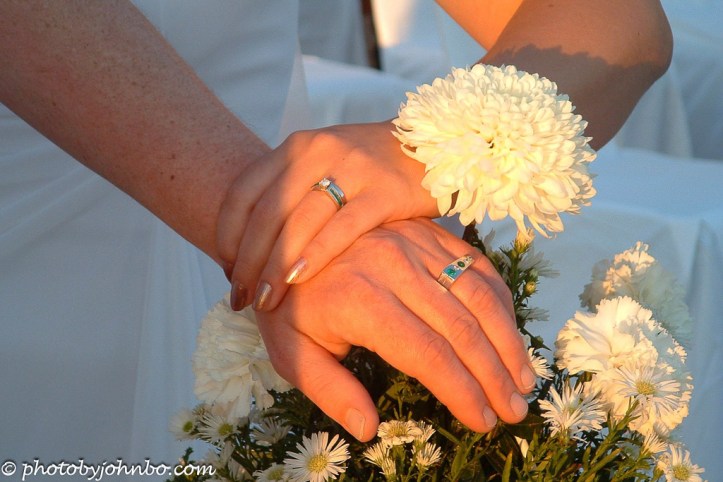
For my opening photos, I start with two personal celebrations—the weddings of our son (above) and our daughter. Both weddings had the support of a professional photographer, but I couldn’t resist bringing out my own camera for a few images. The wedding‑rings shot is a classic among wedding photographers, but placing the hands over a bouquet added a touch of extra elegance to the moment. I captured this image with a Fuji FinePix 3800 point-and-shoot camera.

Both were destination weddings on beaches in Mexico—Josh’s in Mazatlán and Carrie’s in Ixtapa. The image here was taken over the photographer’s shoulder with my Kodak Z812S point‑and‑shoot. Both weddings happened before I got back into photography “for real,” but as with all the photos for Patti’s challenge, I completely reprocessed them for 2K HD. These images from 2006 and 2009 held up surprisingly well in their original JPEG form.

In 2017, I learned that Buckeye Days, a community celebration, includes a rodeo. At that time, the rodeo was held in an outdoor arena. Although it was a sanctioned Senior Pro Rodeo event, it wasn’t just for seniors. One of the most charming events—mutton busting—is reserved for young cowboys and cowgirls, typically ages 5 to 7 and under 55 pounds. I loved watching the determination of these little ones as they tried to stay upright on the sheep.
Buckeye Days began in 1935 as a community gathering designed to bring together residents of all ages for parades, contests, street dances, and a rodeo reflecting the town’s cowboy heritage. Over the decades, it grew into a multi-day festival featuring whisker-growing competitions, carnival rides, a cattle drive parade, and the long-running Hellzapoppin’ Rodeo. What began as a small-town gathering has become one of Arizona’s oldest and liveliest community celebrations.

In December 2018, I spotted this car and trailer decorated with bright lights for the holidays. I later learned that Buckeye has held a mid-December community parade along Monroe Avenue since 2004. What began as a small neighborhood gathering grew into the annual Glow on Monroe Parade, featuring decorated vehicles, horse-drawn wagons, marching bands, and local families lining the avenue. Over time, the event expanded to include late-night shopping, Santa greetings at 6th Street Plaza, and competitive residential light displays.

For years, family members encouraged us to visit a Renaissance Faire. In 2014, we attended our first fair in Apache Junction, Arizona. We’ve revisited it since then, and now a touring troupe comes to Fargo every year. I enjoy the jousting matches most, as they allow me to test my ability to capture the moment of contact. Here, the green-and-white lance has just made contact with the jouster’s shield. The shield is the target, with riders scoring points for a direct hit and for shattering the lance’s balsawood tip on impact.
The modern Renaissance fair traces its roots to 1963, when Phyllis and Ron Patterson created the first Renaissance Pleasure Faire in California as a blend of living history and counterculture theater. What began as a small, improvisational Elizabethan village staffed by actors quickly grew into a national movement that added jousting, costumed performers, and period music. Today’s fairs blend historical reenactment with fantasy, keeping alive that original vision of an immersive step into an imagined past.
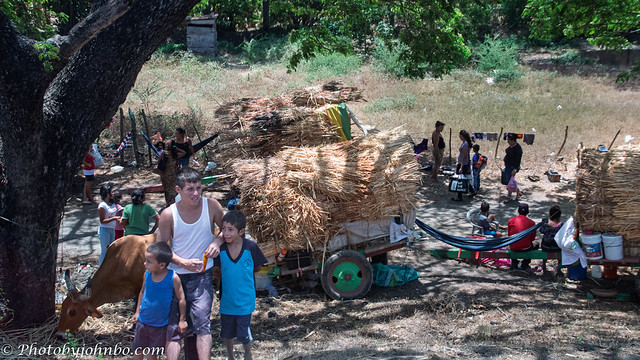
In the days before Holy Week, the faithful who will be participating in a centuries-old event gather in Nandaime, Nicaragua, to prepare for the journey to Popoyuapa. Their goal is to honor Jesús del Rescate (Jesus of the Rescue) and express gratitude for miracles received during their lives. To these faithful Christians, the pilgrimage is one of the most important religious experiences in the country.
This photo of pilgrims stopped along the way was captured from our bus, stuck in traffic while a long line of ox and pony carts traveled single‑file past our window. Once the journey begins, the caravans move slowly, often spending three to five days on the road before reaching Popoyuapa. Families travel together in carts loaded with food, water, and bedding, pausing to rest the animals or share a meal before continuing. As we watched the procession inch along the highway, it became clear that the pilgrimage is as much about community and endurance as reaching the sanctuary itself.

In February, we stayed in New Orleans for a couple of days before departing on a Western Caribbean cruise. We didn’t know when we planned the trip that the extended Mardi Gras season would already be underway. Although the religious calendar marks Carnival from Epiphany to the day before Lent, New Orleans stretches the celebration across several weeks, filling the city with parades, marching bands, and neighborhood festivities long before Fat Tuesday arrives. Our visit happened to land right in the middle of that early-season excitement. Two parades were scheduled each day, though heavy rain canceled the second day’s event. By the end of our trip, we had collected plenty of beads and trinkets tossed from the floats.
Mardi Gras is New Orleans’ own expression of the ancient celebration of Carnival, a tradition that long predates the city itself. Rooted in European pre-Lenten festivities, Carnival evolved over centuries into a lively season of parades, music, and costumes. New Orleans shaped these traditions into something distinctively its own by blending French, Spanish, African, and Creole influences. That same spirit of color, rhythm, and spectacle carries across the Americas, including the Carnival festivities we encountered in Mazatlán.

In 2015, we visited Mazatlán to escape winter and celebrate the ninth anniversary of our son’s wedding there. As it happened, the city’s Carnival festivities were well underway. Mazatlán’s Carnival is one of the oldest and largest in Mexico, dating back to the late 1800s, when the celebration blended European Carnival traditions with local music, dance, and coastal culture. Over time, it grew into a weeklong spectacle of parades, elaborate floats, fireworks, and regional banda music.
Carnival in Mazatlán shares ancient roots with Rio de Janeiro’s world-famous celebration—both descend from European pre-Lenten traditions. Each city expresses Carnival in its own way. I could have shared an image of the stadium in Rio where Carnival is held, but during our tour, the stadium was empty—a distinct contrast to the annual spectacle. Where Rio creates massive competition and choreography, Mazatlán offers a blend of local tradition, music, and seaside celebration. Together with New Orleans, all three cities honor the same festive season in their own distinct cultural style.
That’s all for my response to Patti’s challenge. Many of these images were shared in blog posts from years ago, all processed with less capable editing tools, and, truth be told, less editing expertise. I decided to give each image a fresh 2K HD look with modern tools and (hopefully) better processing skills. You can view the full image album and metadata on Flickr here. Thanks to Patti for reminding me that I have participated in and photographed many more celebrations than I originally thought when I first read her challenge. Looking back at Anne’s previous “Summer Daze” challenge, I’m reminded that those lazy, hazy days of summer weren’t so lazy after all. Next week, Egidio will host the upcoming challenge. Be sure to follow his blog here so you don’t miss the challenge when it goes live at noon Eastern Time on Saturday, August 8.
If you’re sharing a Lens‑Artists Challenge response for the first time, welcome—we’d love to visit your post. To participate, publish your take on this week’s theme, link back to this page, and add the Lens‑Artists tag so others can discover your work. You’ll find more details on how the challenge works here.
John Steiner.


A great read John and the images are excellent. I’m a bit jealous. A great idea to shoot the wedding rings over the brides bouquet. It works really well. I know where you’re coming from in relation to older post processed images. I open some old files and think ‘that was awful’ but I wouldn’t have felt like that at the time. As you say it was the best you can do with the skills you had and tools available at that time. I tell myself it was all part of learning my craft and I’ve no doubt I’ll look back on my current efforts in a few years time and think ‘I could have done better with that’.
Thanks, Steve! You have nothing to be jealous about. I’ve seen your work. People in a job or with their hobbies are always learning and the tools are always evolving.
An interesting selection from personal celebrations through local ones to international! I have to say I feel a bit sorry for the sheep in the mutton busting 😀 And it struck me as odd that you would have a Renaissance Fayre when that period isn’t part of US history, though the jousting does look like a fun photo opp! My favourite shots were the wedding rings one and the dragon in Mazatlán.
I was surprised to learn the modern Renaissance fair was actually created by a California couple — an artist and a teacher — whose 1963 counterculture event took on a life of its own. The idea grew so popular here that it even inspired a restaurant chain built around medieval jousting tournaments. That chain now operates ten permanent castles located in major metropolitan entertainment districts across the United States and Canada.
What a treat you’ve given me this morning John. Your images are colorful and happy. Your information for each helps us understand the focus of each picture. Loved it!
Thanks so much, Anne!
😎
This is a great collection, John. You shared personal celebrations with touching photos, and there were also plenty of other festivities from around the world.
Thanks, Egidio. I had to put on my thinking cap to find some of these… Excire wasn’t much help. >grin<
Wow!
Amazing images and most interesting to see from my side of the world. I have to say the first wedding photo is my favourite though. (Nice hands I might add).
First, apologies for not seeing your comment earlier, Vicki. It was in my spam folder.
That post reminded me that it was my son and daughter-in-law’s 20th anniversary. Thanks so much for your comment.
Quite the collection, John, colourful and joyful. Love the last one especially!
Thanks, Sofia!
A fun and creative approach to the challenge John. I especially loved the wedding photos you shared. And how fun to return to Mazatlan to celebrate the anniversary. Excellent choices for the week.
Thanks, Tina! I really don’t go to many celebrations, I guess. >grin<
Wonderful post, John. A great combination of personal celebrations and community events. I love your son and daughter’s wedding images!
Thanks, Patti! I’m glad I thought to include the weddings. Reprocessing them brought back some great memories.