This week, Patti challenges us to focus on Geometry. When I first saw the theme, my reaction was, “Oh no! Where’d I put my slide rule, compass, and protractor?”
Then, I realized that I like to photograph unusual architecture. Buildings are full of angles, curves, circles, and symmetry. But geometry isn’t limited to what humans create. The same patterns appear throughout nature, from flowers and insects to stone carved by wind and water.
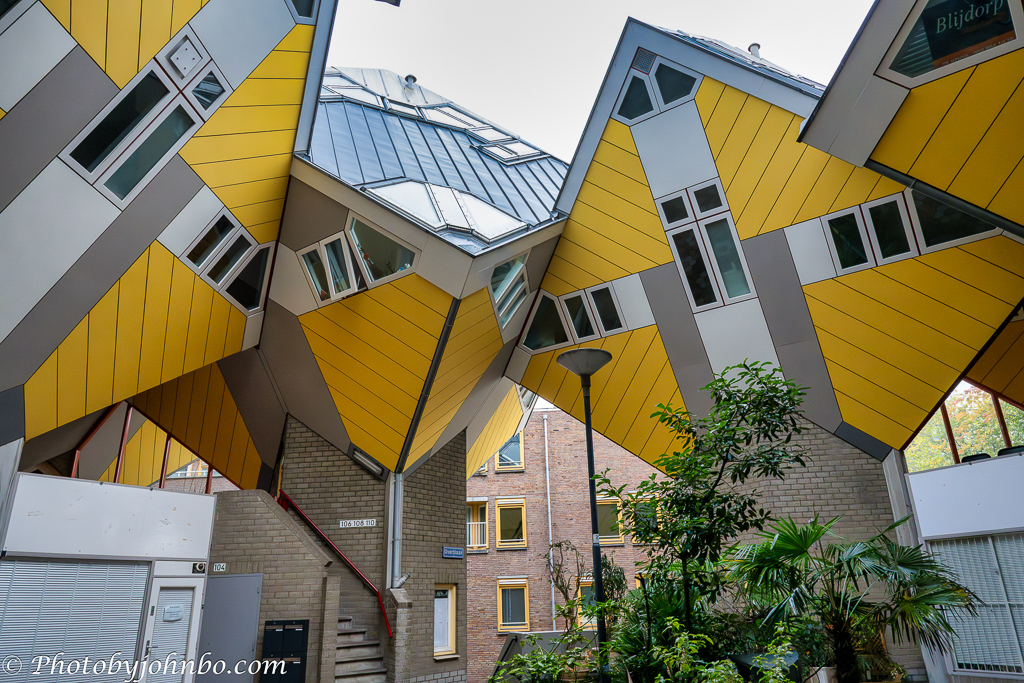
My opening image came to mind immediately. On a walking tour of Rotterdam, we visited the Cube Houses apartment complex. By putting the cubes on their points, the architect created strong diagonal lines. The intersecting angles add visual energy to the scene. Taken from a lower level, the photograph emphasizes the designer’s unusual creation.

In Phoenix, a new state capitol building left the original statehouse vacant. Now a museum featuring state history, it offers wonderful architectural details to photograph. I photographed the scene slightly off-center to emphasize how the circular dome echoes the chandelier. The repetition of circles, juxtaposed with straight lines, creates a pleasing tension.

On a visit to Sioux Falls, South Dakota, we stopped by one of the most beautiful cathedrals I’ve seen in the upper Midwest. Inside, a spiral staircase caught my eye for its sweeping curves and repeating forms. Viewed from above, each level mirrors the one below, creating a pattern that draws the viewer deeper into the scene. The geometry transforms an ordinary staircase into something far more interesting.

In northern New Mexico, we visited a dargah—a shrine honoring a revered Sufi saint and serving as a place of prayer, reflection, and pilgrimage. Invited to view the construction project led by a family member, I was immediately drawn to the intricate wooden ceiling above. The collection of polygons creates a striking symmetry, highlighted by the central star-shaped window.
Architects often borrow design principles from the natural world. Patterns found in flowers, shells, plants, and rock formations naturally find their way into buildings and art. Perhaps that shouldn’t be surprising. Nature has been using geometry far longer than humans have been drawing plans for it. The next four images show geometry as a natural part of the world around us.

A large sandstone monolith stands near the Lake Powell Dam. Sandstone is easily shaped by wind and water erosion, though it takes centuries for those forces to leave their mark. The nearly parallel lines etched into the surface create natural variations that produce unique patterns.

With a wingspan approaching a foot (30 cm), the Atlas Moth is one of the world’s largest moths. When I first saw it, I thought for a moment someone was looking back at me. Sitting motionless on a tree in a butterfly garden in Tucson, Arizona, it was almost intimidating in its size. I selected this photo because the bilateral symmetry of its shape and markings is striking.

Inside a greenhouse filled with growing pineapples, I was struck by how small the young fruit was—no larger than an apple. I chose this image to showcase spiral patterns found in nature, where leaves radiate outward from a central point in clear geometric harmony.

The botanical garden on the North Dakota State University campus in Fargo is a must-visit destination for me every summer. I rediscovered this image when I started looking through my gallery for geometric shapes in nature. Its concentric layers create an orderly pattern of repetition as the flower matures. An example of radial geometry, its color and shape combine to create a visual treat.
I never did find my geometry tools… thanks to Patti for reminding me that high school math wasn’t my strong suit. >grin< Last week, Sofia’s Wabi-Sabi challenge encouraged us to find beauty in the imperfect, impermanent, and incomplete. Next week, Beth takes the lead. Follow her here so you don’t miss her challenge, which goes live on Saturday, November 14, at noon Eastern Time.
If you’re sharing a Lens‑Artists Challenge response for the first time, welcome—we’d love to visit your post. To participate, publish your take on this week’s theme, link back to this page, and add the Lens‑Artists tag so others can discover your work. You’ll find more details on how the challenge works here.
Lynn and I are traveling for the next couple of weeks. Feel free to comment, but I may not be able to respond as quickly as usual.
John Steiner


Loved the opening image, I remember seeing this before or similar. Those are something different for sure. The Spiral Staircase I also liked. The butterfly , such beauty in symmetry android geometry. Great post John