June 2024.
Pahrump, Nevada.
I’m a sucker for local and regional museums that showcase their communities’ histories. You never know what you’ll discover—like the time I visited the Martin County Historical Society Museum in Fairmont, Minnesota, and stumbled onto photos of Paul McCartney explaining his and Linda’s unexpected connection to the Minnesota small town.
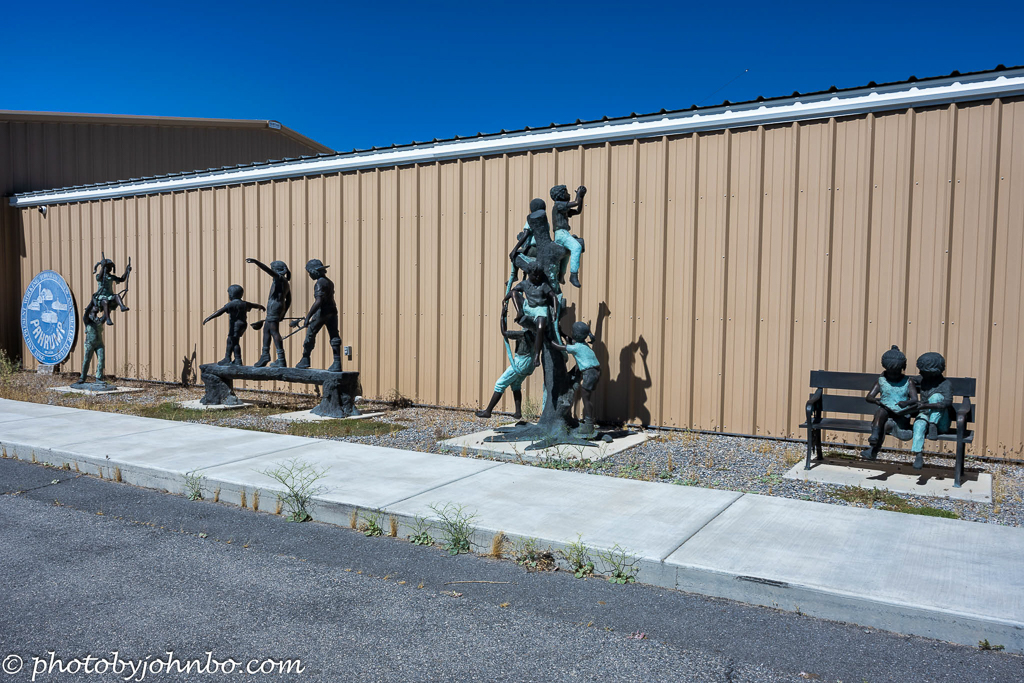
As we pulled into the small parking area at the Pahrump Valley Museum, we were greeted by bronze sculptures of children at play. The artwork adds a welcoming touch to what would otherwise be a modern, windowless, warehouse‑style building. Let’s step inside and explore some of the stories that shaped Pahrump and the Mojave Desert.

As always, I’m “hanging around” outside, taking photos while my sister waits for me to catch up. I guess I’d better hurry; it’s time to start exploring the museum—it’s free, aside from the customary donation that keeps these small museums open.
Before we head inside, it’s worth noting that the museum’s exhibits follow a loose path through the region’s past—railroads and early settlement; agriculture and ranching; mining and borax transport; nuclear testing; community life; and military history. The exhibits cover a surprisingly wide variety of topics for a modest building on the edge of town.

Regular readers know of my love for all things transportation. Ships, trains, planes, automobiles, and even Conestoga wagons all give me wanderlust and a desire to see other places. Museums add another layer by offering historical context, telling the stories of early times in our country’s development. Two dioramas here focus on the rise of railroads and their early role in Nye County, Nevada. The first is a collection of railroad equipment with rails that appear to stretch into the distance and a train approaching the station.

At the station, an office provides the station master with a place to conduct railroad business. It appears it’s time for his break. I just hope he doesn’t spill his coffee—what’s that I hear? A whistle! I hope he wakes up in time to greet the incoming passengers and manage the flow of goods from the train’s freight cars. Looking at the display, it seems early rail service in Nye County relied on a very relaxed staff.

When we first started wintering in Arizona, I was surprised to find cotton fields. After all, my impression was of a dry, lifeless terrain with endless sand dunes. It took only a few drives into the desert to disabuse me of that perception. This display of cotton farming in Nevada didn’t surprise me because I’d learned that cotton is a major export in Arizona. Though Nevada’s agricultural output is smaller, farming has long been part of life in the state’s rural valleys—alfalfa, small grains, and livestock operations shaped communities like Pahrump well before the casinos and housing developments arrived.
The next section of the museum takes a sharp turn from farming and early settlement into Nevada’s nuclear legacy. An entire wing is devoted to the history of the Nevada Test Site, located about an hour’s drive (60 miles/97 km) north of Pahrump, with Yucca Mountain itself about thirty miles to the northwest. The exhibits cover far more ground than I can feature here, tracing everything from the region’s geology to Cold War operations and the people who worked in these remote desert facilities. I’ve chosen just a few highlights, but they offer a glimpse into how deeply the test site shaped life in southern Nye County.

If you look closely at the Yucca Mountain map, two geological core samples flank the display. They’re a subtle reminder that the same deep layers of volcanic tuff and sediment that once guided mining exploration also shaped decisions about where underground nuclear tests could be conducted safely. The map shows the rugged terrain north of Pahrump where the Nevada Test Site operated for decades, a remote landscape chosen for its isolation and its geology.

This control‑room display highlights the operational side of the Nevada Test Site, where teams like NEST, the Peacekeeper program, and CP‑1 coordinated everything from underground test monitoring to emergency response. The panels describe how specialists tracked seismic data, managed communications, and maintained readiness in an environment where precision and safety were non‑negotiable. It is an interesting contrast to the open desert just outside the museum doors, showing how much specialized activity once took place in these valleys.

The hazmat suit brings the story down to a human scale. After seeing maps, control panels, and technical displays, this protective gear is a reminder that real people worked in these environments, often in situations that demanded caution and specialized training. Whether responding to contamination risks, handling radioactive materials, or supporting emergency operations, workers relied on equipment like this to keep them safe. Seeing the gear up close brings the test site’s massive scale down to the individual level.

A nearby display features a military dress uniform. While the testing operations themselves get most of the historical attention, the people who served in support roles—whether in security, logistics, or day‑to‑day base operations—were just as essential. Displays like this one remind me that behind every program and every facility were men and women who lived and worked here, contributing to the region’s history in ways that rarely make the headlines.
After walking through the museum’s deep dive into Nevada’s nuclear history, the next exhibit shifts to a very different part of the state’s identity. I’ve known since my first experiences with gambling—which served mostly as a self-funded educational expense—that Nevada has long been a mecca for those who try their luck, and no museum here would feel complete without at least a nod to that legacy.

I’ve dabbled in games of “no‑chance,” but I’ve always had respect for the people who make a living in that world. This old one‑armed bandit wasn’t active—it wasn’t even plugged in—but it still tells the story better than anything else about Nevada’s long relationship with gambling and the machines that kept visitors coming back for one more pull.

I’ve always thought of prospecting as its own kind of gambling—turning a shovel and hoping to strike something valuable. The mining diorama takes that idea from metaphor to reality. Long before casinos lit up Nevada’s highways, men came to these deserts with picks, shovels, and a willingness to take risks of a very different kind. This display captures that early spirit of chance and hard labor, the kind that shaped towns like Pahrump long before the neon arrived. It’s a fitting lead‑in to the borax story that follows, where the region’s mining history reaches one of its most iconic chapters.

As a child, one of my favorite shows was Death Valley Days, the Western anthology sponsored by the company behind 20 Mule Team Borax. Dale Robertson was the host I remember best, spinning stories of the desert and the mule teams that hauled borax out of some of the harshest country in the West. Seeing this carving brought those half‑faded memories back, and the plaque beside it fills in the real history behind the legend. Between 1883 and 1888, Twenty-Mule Teams hauled borax 165 miles from Death Valley to Mojave, starting nearly 200 feet below sea level and climbing to 4,000 feet before the trip was done. A fully loaded outfit weighed more than 36 tons, with wagon wheels towering 5 to 7 feet high and a water tank holding 1,200 gallons just to keep the animals going. Reading those numbers drives home the grit it took to move borax across the desert long before modern roads or machinery.
Walking out of the museum, I was reminded how much history is tucked into these desert valleys—some of it familiar from childhood memories, some of it entirely new, and all of it shaped by the people who lived and worked here long before Pahrump became the community it is today. From nuclear testing to prospecting, from mule teams to slot machines, the exhibits trace a story that’s far bigger than this small town, yet still rooted in the landscape just outside its doors. It was an interesting stop that gave me a much better understanding of how many different industries shaped this corner of the desert.
About the photos: These images, taken in June 2024, were the result of my first interior photo shoot with the Nikon Z7 II and the NIKKOR Z 24–120mm f/4 S lens, and the experience was a genuine learning moment. I bracketed every shot with three exposures—one at the metered value, one at -1, and one at +1. When I reviewed the files later, I discovered that many of the base exposures were seriously underexposed, and I’m still not entirely sure why. Fortunately, the +1 frames held enough data to recover the full dynamic range without relying on the bracketed set. I ended up discarding the other exposures and processed each image in Adobe Lightroom Classic. The Z7 II’s wide latitude made it clear that, going forward, I no longer need to bracket to capture the full tonal range in scenes like these. These images, along with their metadata, can be viewed in my Flickr gallery here.
John Steiner.


I was in 2 minds whether to stop by, John, but I’m really glad I did. It’s a very American museum and well beyond my experience, but I found it fascinating. I knew nothing of the nuclear testing and I always associated mining with the gold rush, so it’s good to see a different side of things. Thank you for sharing the experience xx
Local museums have a real reflection of the area they serve. Thanks, Jo!
Thanks for bringing the desert alive John. It did play an important part in our history, from gold to borax.
That section on borax brought back those days when I watched westerns in black-and-white on a small-screen TV so many years ago.
😎
This is pure Americana and plenty of history!
Indeed! Thanks, Egidio.