It’s good to be back responding to challenges after our hiatus. This week’s lead-off is from Ann-Christine. She writes in her challenge post, “I am all for adventures, and I think many of you are too! So, this first week after our break, I want to welcome us all back, and, to adventures we remember – from long ago or lately have experienced. Big or small … You can show adventures from one place only or from more places, and I am convinced adventures can be told in fewer images than this…but please try to stick to a maximum of 10 pictures.” You can read her entire challenge post here.
When she asked for memories of adventures big or small, my mind went straight to our recent journey down the Rhine. For me, the adventure of travel isn’t just about moving from one point on a map to another—it’s about the details I explored and photographed along the way.
Traveling south from the Netherlands through Germany, I was drawn to the spires, domes, and sanctuaries lining the riverbanks and dotted along the vineyard hills. Each church tells a story of the town it watches over. Here are eight views of historic European churches and cathedrals from our journey.
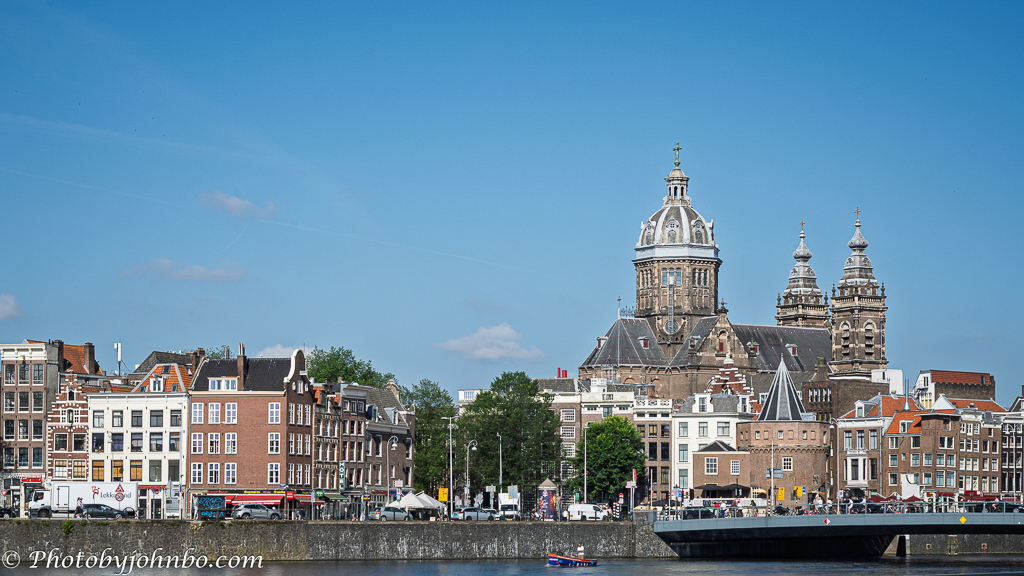
On this, our first river cruise, we chose Viking’s Rhine Getaway on the Mani from Amsterdam, Netherlands, to Basel, Switzerland. We also chose the pre-cruise with a walking tour of Amsterdam. From across the canal, our guide pointed out the Basilica of Saint Nicholas (Basiliek van de Heilige Nicolaas). Built between 1884 and 1887 by architect Adrianus Bleijs, it is a striking blend of Neo-Baroque and Neo-Renaissance styles. Dedicated to the patron saint of sailors and Amsterdam itself, it replaced the hidden “attic” chapels Catholics relied on during centuries of Protestant rule.

On our walking tour of Cologne, Germany, we stopped at one of Germany’s most visited landmarks, the Cologne Cathedral (Kölner Dom). This High Gothic masterpiece took over 600 years to complete, remains the seat of the Archbishop of Cologne, and is home to the Shrine of the Three Kings. Our tour guide noted that despite sustaining 14 direct aerial bomb hits during World War II, the cathedral’s majestic twin spires remained standing, soaring 515 feet (157 m) above the city center. For this shot, I focused on the spires as my images of the full front façade were marred by the low-perspective leanback.

As we cruised south on the Rhine, Schönburg Castle came into view—one of the first hilltop fortresses along this iconic stretch of the river. I’ll share a complete series on these historic landmarks in future posts, but this image highlights the prominent red Church of Our Lady (Liebfrauenkirche), set in the small town of Oberwesel. Construction on this High Gothic parish church began in 1308 to replace an earlier 13th-century sanctuary. Renowned for its vibrant red-and-white facade, the church houses the famous “Golden Altar”—one of the oldest surviving High Gothic altarpieces in Germany.

Assmannshausen, Germany, was easy to recognize. Below the colorful buildings, the town name was emblazoned on the east bank of the river. The slate spire of the town’s Church of the Holy Cross (Heilig-Kreuz-Kirche) set against the steep, terraced vineyards of the Rhine Gorge created an idyllic image of historic Germany. Dating back to the 14th century, the church overlooks a village famous for its red Pinot Noir (Spätburgunder) grapes. Its compact footprint reflects the space constraints of building along the narrow, rocky banks of the Rhine.

Just above Assmannshausen, near those steep vineyards, I saw the spire of another church—in fact, I even managed to capture one image with both structures in the same frame. Sitting high among the vines is the Krufter Kapelle (Maria-Hilf-Kapelle). Rebuilt in 1912 on the site of a 17th-century wayside shrine, it serves as a sanctuary for local winegrowers praying for a bountiful harvest and a peaceful retreat for pilgrims walking the trails high above the river.

After our Middle Rhine castle run, we docked at Breisach, Germany, where we had three choices for the day: stay local for a walk around Breisach, take a bus excursion to Speyer, or head across the border to Strasbourg, France. We chose Strasbourg, where our excursion included a river cruise around Sainte-Hélène Island on the Ill River.
During our boat tour, we got a clear view of the spires of St. Paul’s Church (Église Saint-Paul). Built in the late 19th century as a Protestant garrison church, its twin 249-foot (76 m) Neo-Gothic spires rise dramatically right at the fork where the Aar and Ill rivers meet. Its commanding position at the tip of the island makes it one of the most photogenic landmarks in the city.

As we followed a bend in the river, I saw the brilliant white façade, pastel green rooflines, and gleaming golden onion domes of the All Saints Orthodox Church (Église Tous-les-Saints) sitting on the banks of the Marne-Rhine Canal (Canal de la Marne au Rhin), near the Parc de l’Orangerie and the Council of Europe. Completed in 2018, this modern interpretation of traditional 16th-century Russian architecture was built to accommodate up to 300 worshipers. Its bright white walls and gilded domes offered a distinctly Byzantine silhouette as we drifted by.

On the next stop of our Strasbourg tour, the Strasbourg Cathedral of Notre Dame (Cathédrale Notre-Dame de Strasbourg), I recalled our guide noting that travelers often confuse this grand cathedral with its famous namesake in Paris. I took several photos of the beautiful architecture, but its towering height in the cramped square resulted in severe perspective distortion. With no room to back up, I decided to focus on a detail shot of the intricate stonework above one of the entrance portals.
That’s when my processing adventure began. As I worked in Lightroom to pull out the stonework detail, I struggled mightily with a stubborn pink cast. I kept tweaking sliders, convinced it was a masking artifact or a strange white balance error on my camera sensor. Finally, I went back and inspected the unprocessed RAW file—only to find the exact same rosy tone staring back at me. I’d have saved myself a lot of trouble if I’d remembered the tour guide also mentioned that this French masterpiece is uniquely built from local pink Vosges sandstone!
Having already talked myself into blaming a lighting anomaly, I decided monochrome was the way to go and ran the file through Silver Efex Pro 3. The high-contrast black-and-white conversion highlights every dramatic shadow and fine detail in the carving—though looking back, leaning into those natural pink tones might have been quite something, too!
That’s all I have for Ann-Christine’s challenge featuring our recent adventure along the Rhine. Of course, in future posts, I’ll share many more images of those historic sights on our journey. Thanks to Ann-Christine for selecting a challenge that coincidentally dovetailed with such a recent adventure, concluded only last week. I’m still catching up on my sleep with jet lag and long flight times. Next week, Anne hosts. Be sure to follow her here so you won’t miss her challenge when it goes live at noon Eastern Time on Saturday, July 25.
If you’re sharing a Lens‑Artists Challenge response for the first time, welcome—we’d love to visit your post. To participate, publish your take on this week’s theme, link back to this page, and add the Lens‑Artists tag so others can discover your work. You’ll find more details on how the challenge works here.
John Steiner


I do love the Orthodox look, John. It seems so cheerful xx
That is a beautiful building, and so surprising that it was built in 2018 instead of a far earlier time.
I do hope you enjoy the cruise John. And had a good pre cruise stay in Amsterdam
We did enjoy the cruise. The pre-cruise excursion was a great intro to Amsterdam. We liked the cruise enough that we signed up for another next year.
Wonderful!
This takes me back to our own Rhine cruise years ago, though we didn’t do such an extensive route. I love your final shot of Strasbourg Cathedral, which is where we started 🙂 Apparently the spires of Cologne Cathedral were spared by Allied bombers because they were such a useful landmark for navigating.
I didn’t have space to include it in the text, but another reason there wasn’t that much damage is that all of the stained glass windows were removed prior to allied bombings so nearby explosions didn’t have a chance to damage the fragile glass and the structure being more open without the windows allowed blasts to dissipate throughout the building.
Ah yes, I remember reading that too
Oh, John, I just knew your post would be an absolute corker and you definitely did not disappoint. Great images and a truly wonderful narrative – thank you for sharing all those details and memories. 600 years! Just imagine! And it even survived bombings. Pure amazingness. Thank you so, so much! pp
Thank you so much for your positive comments every week, Pam!
Thanks for taking me down the Rhine, John. That was a bucket list item, but now I’m too old. So, it was great to experience it through your wonderful images. Loved the editing on Strasbourg Cathedral of Notre Dame. The black and white brings out all the detailed stone work perfectly.
Thank you, Anne, for the compliment. After this cruise, I’d like one more European cruise to complement this one, the Danube would complete the set. Maybe next year.
That’s a great blog John. Lovely pics. I saw a post last week on FB by a friend who was meant to be cruising the Rhine area. Part of her trip had been cancelled due to low water levels. They were transferred by coach around those sections 🙁
As was our cruise. We were on the Mani, transferred to the Eir, and passengers on the Eir were bussed to the Mani. Details will be described in a future post. 😃
I love how you approached this challenge, John, really interesting to focus on the churches you saw along the way. I love your last one in monochrome but I’d love to see it in colour too 😀
I am planning to include that edit when I write about our Strasbourg excursion. Thanks, Sofia.
Looking forward to it 🙂
Beautiful architecture.
European churches are stellar examples of classic architecture, for sure!
Beautiful captures of the spires. The details on the Cathedral of Notre Dame are amazing.
Thanks, Pepper! Amazing and beautiful subjects.
Great post John – they DO love their churches there don’t they?!?!? A beautiful set, each with its own special element(s). I laughed at your comments about the “pink” church, which IMHO you should have posted in color so we could see what it looked like!! But all of your images, including that one, are wonderful. Sounds like you had a great journey.
Thanks, Tina! I ran out of time in getting processing done having wasted so much time trying to get the “pink” out of the image. You can bet it will be featured in color in another challenge post when I get it done.
Great shots of all the classic architecture!
Thanks, Rebecca.
Rich history through beautiful photos. What an adventure!
We learned so much history on that cruise, and there is so much more to share about the logistics of the adventure.
Fabulous photos of the Rhine River adventure, John! We are gearing up to go in two months! Thanks for sharing the sights of these amazing structures. we’re doing the A-B cruise (as its called by “insiders”), with pre-extension in Amsterdam and post in Basel. Did you have any issues with water levels like what is happening now? (according to what I read on FB)? I really appreciate the preview!
Ours was the first ship this season to experience the ship swap. I’ll tell the full story in a future post, but you can expect to swap and be happy if it doesn’t happen.
For us, we packed our luggage and set it outside our cabin, then they chartered a boat with a lower draft so we could get the full Castle Run experience. Then they put us on a bus to find our suitcases in the same room on the Eir that we had on the Mani.
A beautiful adventure along the river, John! Such a beautiful country this. Found you today in the spam section – along with many others… Love your church take and the B&W. Adventures are everywhere, and I see you already plan for another one in Europe.
Your prompt reminded me to look at my SPAM folder, and I see I have a couple of Cellpic Sunday posts from others sitting there as well.
I wonder what’s up with that. Tightened filtering, I guess.
What a wonderful adventure John, so lovely to see some of these old churches and basilica from a different angle 😊
It was, and I have more to share in the coming weeks. Thanks, Xenia!