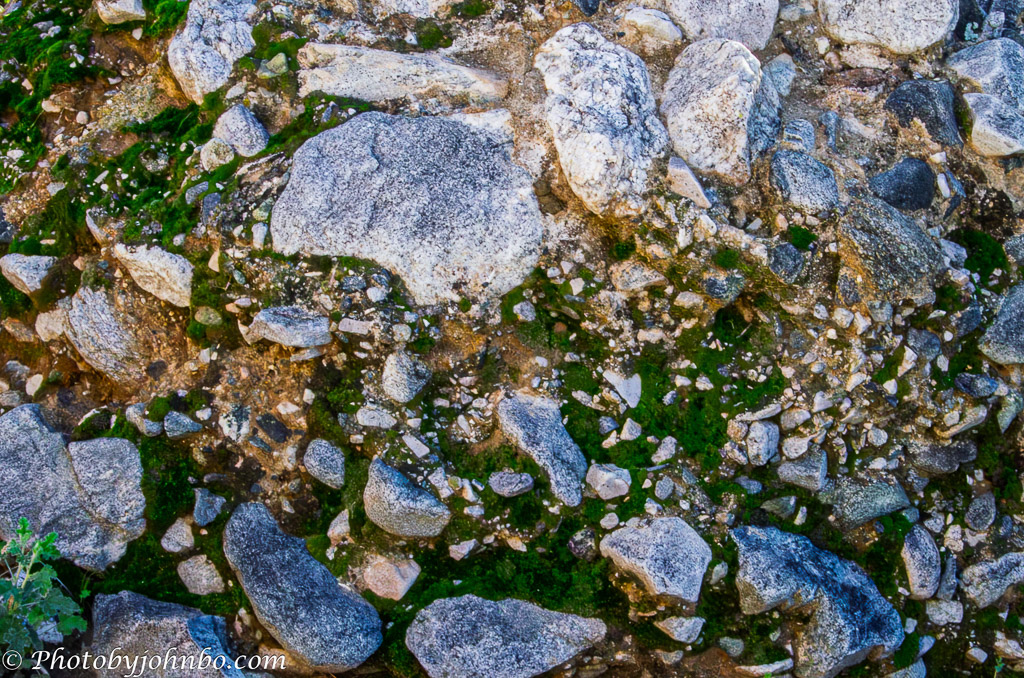
This week, Sofia asks us to create a quiz, a collection of objects that might be hard to identify. She writes, “Think of anything that looks ambiguous, difficult to understand or unusual, look for details instead of the whole thing, conceal what might give away what your subject with editing, but most of all, have fun!“
I enjoyed modifying some older images to “mystify” them. Each object is in a different category, identified in the photo caption. At the end of the post, I’ll identify each one so you can check your guesses without staying in suspense.
My opening photo shows something found in nature. The hint: It holds a hundred stories of ancient flowing water, yet it hasn’t moved an inch in millennia.

The next category is Musical, featuring an item I found at the Musical Instrument Museum in Phoenix. It needs human lungs to make a sound, but the paper picks the piece.

The saguaro in the background gives away another Phoenix-area location. It catches the desert rain today, but its original purpose was far drier and much harder work.

For Illusion, we visit another Phoenix spot—a room where standing in the wrong corner completely rewrites the laws of human anatomy.

The last category is Light. Unlike the others, this subject isn’t anywhere near Phoenix. Two lights momentarily share the same frame, though they may have nothing in common.
Now for the reveal. I photographed each subject around the Phoenix area during our winter stays in Buckeye.
#1. Natural: On a hike in Spur Cross Ranch Conservation Area, I saw a rock covered in algae—and on closer inspection, it was actually a conglomerate, a natural mix of pebbles and sand that once tumbled along an ancient streambed. Over time, more sediment buried the pile, pressure squeezed everything together, and minerals in water acted like glue, cementing the rounded stones into one solid mass. What looks like a single rock is really a snapshot of Cave Creek’s tumbled stones, preserved in place for millions of years and now wearing a thin coat of desert green algae.
#2. Musical: According to the placard on display, this instrument was manufactured in Germany, c. 1900. Mechanical Mouth Organs were first sold in the 1870s, and player trumpets like this one used paper music rolls in much the same way as a player piano—except the performer had to supply the air by blowing into the mouthpiece. In the United States, they were marketed as phonographic cornets or trumpettos.
#3. Ancient: On a hike in Cave Creek, the guide and hike leader told us about the history of these purposely hollowed stones—and once you know what you’re looking at, the metate and mano make perfect sense. Generations of Indigenous people used the larger stone as a grinding surface and the smaller hand‑stone to crush mesquite pods, seeds, and later corn. The shallow basins weren’t carved so much as worn into the rock by centuries of use, each pass of the mano slowly shaping the surface.
#4. Illusion: In Scottsdale, the Museum of Illusions presents visitors with the settings and instructions to create photographic illusions—and this striped room is one of the most effective. A short wall bisects the space, and a full wall‑sized mirror mounted on that divider lets people stand behind it and pose. By balancing on the leg hidden behind the wall, the mirror creates the effect of floating in midair, and hiding the face behind the divider completes the Illusion of a disembodied torso. It’s up to the person behind the camera to keep the shot level and make sure the stripes on the wall and the mirror line up cleanly, the final touch that sells the trick.
#5. Light: On an evening in December 2020, a celestial event brought me out for some night photography—and the Great Conjunction of Jupiter and Saturn did not disappoint. The two planets appeared unusually close in the sky, a rare alignment that made them look through my 300 mm lens like a paired set of lights hanging over the horizon. A closer look at Jupiter reveals three of its Galilean moons—Io, Ganymede, and Callisto—lined up beside the planet, tiny points of light that completed the scene. Saturn looks much less sharp in the image because the planet’s orbit carries it millions of kilometers farther from Earth, making it a tougher target for long‑lens detail.
Let me know in the comments how well you did on my little quiz. If you’d like to take a closer look in 2K HD, or check out the image metadata, my Flickr gallery is here.
Last week’s challenger was Ritva, and her topic featured one of my favorite photographic passions—image editing. I can spend a few minutes correcting an image’s defects, or hours creating a vision I imagined that didn’t match what the camera recorded. Next week, it’s my turn to host, and my challenge will go live on Saturday, September 5, at noon Eastern Time.
If you’re sharing a Lens‑Artists Challenge response for the first time, welcome—we’d love to visit your post. To participate, publish your take on this week’s theme, link back to this page, and add the Lens‑Artists tag so others can discover your work. You’ll find more details on how the challenge works here.
John Steiner.


Although you could have just shown me a black screen with 2 large and 3 small dust specks and I would have believed you I’m very impressed with a photo that actually shows the Jupiter moons. (note to self: maybe I should talk to my optometrist, I’ve never seen any moons other than our big one). The others are intriguing as well. Thanks for the explanation for the rock. Just imagine how often it had to be used to have that dent.
I was as surprised as anyone when I got the image of the conjunction on my computer and zoomed it to see those three pinpoints.
I thought they might be moons, but I had to wait to meet with an astronomer friend for a confirmation. The fourth moon, Europa, was behind Jupiter at the time.
👍🏽
You came up with some good ones!
Thanks, Dawn!
I got the metate and mano, missed everything else – and I would not have guessed the conglomerate was an ancient streambed pressed into one rock. The mechanical mouth organ that runs on paper rolls but still needs your lungs is a wonderful thing to learn on a Thursday. Our kids would lose their minds in that Museum of Illusions striped room.
Thanks! This was a fun challenge to create, just thinking about how to find objects that are unusual without going deep into a macro detail. There are several Museum of Illusions in the U.S. and around the world. If they are anything like the one in Scottsdale, they are well worth a visit.
A fun quiz John – I got most of them but the first one had me stumped and I wasn’t sure which planet was in the final shot with the moon. We saw similar grinding stones in Sequoia NP a few years ago 🙂
Nice work, Sarah! Thanks for playing along!
Great quiz, dear John 👍
Thanks for sharing
The Fab Four of Cley
🙂 🙂 🙂 🙂
Thank you, Klausbernd!
John, you selected some treasures here. I love the information at the end on each one, especially the musical instrument, the amazing illusion room, and the Jupiter and Saturn conjunction. I guessed the first one in part but not that the pebbles had formed one stone. I also learned a new word, “trumpettos.” Great fun. I love learning new things. Thank you!
Glad you enjoyed, Suzette. This challenge of Sofia’s has been fun all around seeing everyone’s images.
Yes, it was fun! Thanks John. Safe travels always.
I admit, I didn’t do very well on the quiz. Your music image did bring back some fun memories of visiting that museum, though!
Diana, that is probably my favorite museum of all time, and I admit to thinking, “Why would I want to go there.?” >grin<
Mine too! My husband and I spent the entire day there.
I got them all in general. Like the museum exhibit. I saw it as one, but couldn’t guess the details. I also knew the black sky and planets, but not which ones. The rest I got.
Thanks, Anne! Fun challenge Sofia gave us.
Interesting twist on the challenge John. You found some head scratchers. I guessed the trumpet but didn’t know its name, and grinding stone.
Thanks, Brad. I liked the idea of keeping it unusual things in their entirety instead of macro shots.
Well done.
Excellent set and clues you gave us, John. Like Anne, I had a general idea of what it was. The illusion image is even more amazing after reading how it’s done. Great gallery!
Thanks, Egidio!
Thanks, Egidio! The illusions are great for people with cellphone cameras. Signs on the floor and nearby tell people where to stand and how to complete the illusion in camera.
Tricky shots, especially the illusion image.
Thanks, Rebecca. This was a fun challenge!
This is the post I’ve been waiting for all week – I knew your “mysteries” would be corkers and you didn’t disappoint. I only solved one, the player trumpet and that only because Mum and Dad had a player piano with similar rolls. Great post, John! Most especially “Light”. I absolutely love night sky star photographs but I’m an incredibly terrible photographer of them. I guess that’s why I like and admire the night work of other photographers. That’s one great shot! Did you frame it (or a version of it)? Thanks for the fun, John, I thoroughly enjoyed your puzzles! pp
Thanks, Pam! I didn’t have it framed. Perhaps I should. Since the photo is of a Christmas conjunction in December 2020, This year, I put together a post telling how the shot was created and processed. It’s scheduled to be published on Christmas Eve.
I’ll be watching for it!
A very interesting approach John! All of the items were really interesting. I loved the rocks and the instrument especially.
Thanks, Tina! Sofia picked a great challenge, and one not ever been done here.
That “player trumpet” is a terrific find
A fascinating artifact from the Musical Instrument Museum.
That hint for the opening photo — a hundred stories of ancient flowing water that hasn’t moved an inch in millennia — had me squinting at the screen for a good minute before I gave up and scrolled to the answers. The one from the Musical Instrument Museum in Phoenix stumped me completely. This is exactly the kind of game our kids would take way too seriously in the car.
That was a hard clue! Obtuse and obscure. >grin<
I found the game a blast when I was reading other people's post.
John – Good collection of enigmatic images. I guessed two😃: the ancient grinding stone and the Great Conjugation. I was out there in the dark that same night so I have a similar shot. Saturn was hard to capture. I like how your moons turned out.
Thanks! I took a lot of pictures that night, most similar. Saturn was just too far to clearly see it, much less, the rings.
John, I only got the musical instrument and the ancient one correct but I had fun trying to guess the rest. Great collection for the challenge.
Thanks, Beth!
I had an idea of the last one. I knew the third one had to be some sort of optical trickery. Well done!!
I love your take on this, John. It’s just so you! I managed to get a couple only 😀
Thanks, Sofia!