February 2026.
Falmouth, Jamaica.
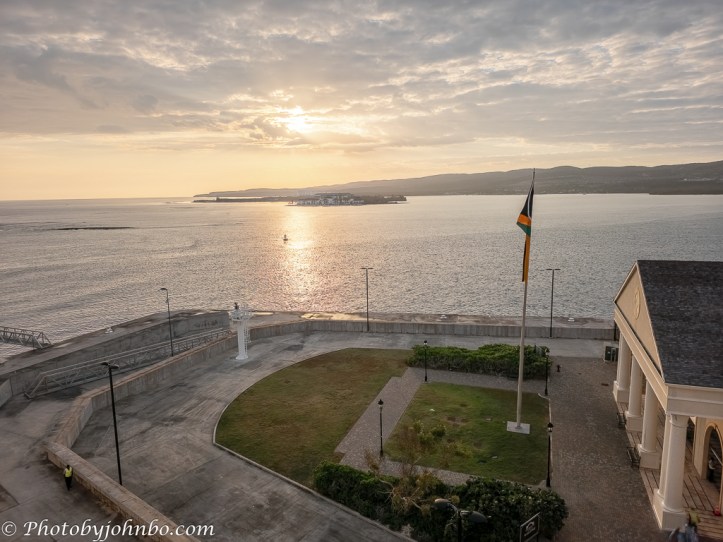
When Lynn and I awoke that February morning, the ship felt perfectly still. No vibration, no hint of forward motion—a sure sign we were already docked. There was no need to rush; our excursion wouldn’t depart until mid‑morning, almost noon. Light pressed around the edges of the closed balcony curtains, and just after 7 AM, I stepped outside to find a glorious sunrise spilling across the harbor. Beyond the railing, the old port buildings came into view, their weathered lines hinting at a long history.

The cruise port entrance was already busy with cruisers from the Norwegian Star taking the walk to the building entrance. Some stood waiting for the bicycle taxis to carry them through the long corridor of shops to the tour bus parking lot at the land entrance to the port. Music from the port musicians accompanied the dancers, interrupted occasionally by an announcer welcoming us to Jamaica. But I was more interested in the architecture of that beautiful building, which was relatively unscathed by Hurricane Melissa in 2024. A few shingles were out of place on the roof, but otherwise, the Georgian-style architecture held up remarkably well. I only learned later that the “old” building was built to 21st-century standards.

Though the building looks like it stepped out of Jamaica’s Georgian era, it’s actually part of the modern cruise port redevelopment completed in 2011. The designers borrowed the symmetry and classical lines of Falmouth’s historic architecture to give arriving visitors a sense of the town’s past before they ever set foot beyond the gates. Today, the building functions as the port’s welcome center and tour gathering point, using early 19th-century styling to match the real history just outside the gates.

After an unhurried breakfast, we decided to browse the port’s shops and took the long walk through the maze of storefronts as we slowly made our way to the bus stop for our excursion, Falmouth Highlights and Rum Tasting. I stopped for a few moments to capture the dancers, dressed in Jamaican colors, entertaining the cruisers while Lynn shopped for souvenirs.

Still waiting for Lynn to make her final selections in one of the shops, I happened upon a person weaving baskets. I was captivated by how quickly his hands worked the reeds into place, all while keeping up a steady conversation with the cruisers passing by, no doubt hoping someone would stop to buy one of his creations. When I first started watching, he was nearly finished with the basket bottom. In just a few minutes, he was already a third of the way up the sidewalls.

Before long, we boarded our bus for the short trip downtown, where we took a brief walking tour through the heart of the city. As we walked, we noticed that several buildings had taken a beating from Hurricane Melissa. This historic courthouse was clearly hit hard, but the line of parked cars showed it’s still open for business. Built in 1815 and rebuilt after a fire in 1926, it has long served as the Trelawny Parish Court and continues to function today despite its weathered exterior. Even with the storm damage, you can still see the classic symmetry and stonework from Falmouth’s early days.

Throughout our bus ride and city walk, the damage from Hurricane Melissa was evident everywhere. Roofs were peeled back or missing entirely, walls were cracked or leaning, and whole sections of older homes looked as if they had been lifted and set back down at the wrong angle. Even months later, blue tarps, temporary repairs, and exposed framing were common sights. In a sense, I was glad we visited this port. Cruise tourism must truly help the economy as it struggles to rebuild, and the steady flow of visitors brings income to people still repairing homes, shops, and public buildings. Unlike at other cruise stops around the world, there was no one protesting our presence, holding signs, or urging residents to vote to eliminate their cruise port. Here, the welcome felt genuine—perhaps because the need is still so visible.

I captured this image from the bus window. Our tour guide didn’t let us off the bus at this point in the tour, instead opting to tell the story from inside the bus. I was fortunate to be seated on the left side of the bus; people on the right didn’t get such a nice view. The church is St. Peter’s Anglican Church, one of the oldest buildings in Falmouth and a landmark that dates back to the late 18th century. Its weathered stone walls and clock tower have survived generations of storms, but Hurricane Melissa left its mark—peeling paint, broken windows, and sections of the roof still awaiting repair. Even with the storm damage, the building remains a major focal point for the community, and its historic cemetery reflects just how long the church has been part of the town.

On our walk through Water Square, a statue of Usain Bolt—Trelawny’s native son and the “fastest man in the world”—stands proudly in the plaza, unveiled during the town’s 250th anniversary celebration. I know he’s the fastest man in the world because a passerby, clearly a proud local, made sure almost everyone in our tour group heard about his hometown hero, even though our guide had already given a full rundown of Bolt’s Olympic triumphs. The guide also pointed out that the statue’s base sits on the site of Falmouth’s historic public fountain, built in 1805 to supply fresh water to the growing port town. The fountain eventually fell into disrepair, but the square around it has remained the symbolic heart of the city—now with Bolt striking his signature pose right at its center.

Our last stop on the bus tour was a 90‑minute visit to Bamboo Beach, a private beach club popular with cruise excursions. Our group was led to a pergola, where we were given samples of Jamaican rum. After the tasting, we were reminded that the rum was available in their gift shop, and then we were free to find an open beach chair. The clouds that hung over the church had long since dissipated, and there were no shaded chairs available. Had we brought beach clothes and towels, we might have been tempted to take a refreshing dip in the sheltered bay. Instead, we decided to pass the rest of our beach time on the air‑conditioned bus. It was a bit of a hassle getting permission to leave the private club to sit on the bus, but that’s another story for another time.

On the way back to the cruise terminal, I captured a photo of the Norwegian Star patiently awaiting our return and sail‑away to our next port‑of‑call. My timing for this “out‑the‑window” shot wasn’t quite perfect. I hoped to frame the ship neatly beneath the beautiful old tree, but I wasn’t quick enough to keep that stray post in the foreground from blocking the bow. I have another image from moments earlier that clearly shows the full ship, yet despite the flaw, this one—with the tree arching overhead and a worker tending the field in the foreground—remains my first choice. It feels like a genuine slice of local life unfolding around the ship, which beats a sterile postcard view any day.

Heading back through the port village, we saw the Norwegian Star looming over the shops, meaning our day ashore was winding down. We managed to pack a lot into just a few hours—seeing the hurricane clean-up downtown, hearing about their local Olympic hero, and watching everyday life carry on right next to the cruise docks. Falmouth may not have been the most polished stop on our itinerary, but it was certainly one of the most memorable. Between glimpses of resilience, unexpected conversations, and fascinating moments framed through a bus window, this visit left a deeper impression than I expected. It just goes to show that you don’t always need pristine postcard views to make a travel day memorable.
About the photos: These images were captured with a mix of gear—my Nikon Z7 II paired with the Nikkor Z 28–400mm f/4–8 VR lens, and my Samsung S25 Ultra. Most of the processing was done in Adobe Lightroom Classic, using the Adaptive Profile and global tone adjustments to exploit the Nikon sensor’s high dynamic range. A few photos needed AI‑based distraction removal, and the image of St. Peter’s Church will almost certainly get a “But I Digress—” post of its own. Even after attempting to clean the bus window before we left the port area, that photo required far more rescue work than I expected. Luminar Neo also made an appearance, mostly for the cellphone shots. The full gallery—including images not featured here—and all accompanying metadata can be viewed in my Flickr gallery here.
John Steiner.


great post, not only about what tourist see. Jamaica is a place I would like to visit
Thanks, Ritva!
I’m glad you got a small taste 0f how welcoming Jamaica can be. We spent a week in a family run boutique B&B in Ocho Rios, a million miles away from the all-inclusive resorts and cruise ports. Highly recommended if you’re ever tempted to return to the island for a fuller experience. But as you say, even this brief visit will hopefully have gone some small way to help the local economy recover from the hurricane 🙂
It was easy to see they are struggling. I was happy to tip in a more generous manner.
Thanks for the tour John. Just looking at your ship photo, it’s amazing how large the ship is against the buildings.
That ship is smaller than some I’ve been on. I do like the smaller ones.
😎
I liked your story telling and beautiful photos. Were people drunk after all the rum tasting?
Thanks, Egidio. There wasn’t that much rum. They gave us “shots” in little plastic cups, maybe truly about 6 1/4 oz tastes.
I always come down anti-cruising, John, and I hate the sight of them portside, dwarfing everything. Normally it’s argued that they don’t add much to local economies, with passengers mostly eating onboard. I’m glad you felt that you were helping. It looks like they’ve had a hard time xx
I understand, Jo. Not everyone is a fan of cruising, especially on those big ships. Each to their own, as they say.
It’s not just about the business the passengers bring. The local governments are helped by port taxes usually based on ship weight and passenger counts. If a port is skipped due to weather, passengers receive a credit from the ship for port taxes not paid.
Ship food supplies are often paid for and loaded onto the ship adding income to the economy for food, loading and transport costs, and fuel as well. Even if the passengers dine on the ship, they dine on food supplied at the cruise ports.
Thanks for taking the time to explain, John. I have to admit, I hadn’t known all this xx