January 2023.
Saint Augustine, Florida.
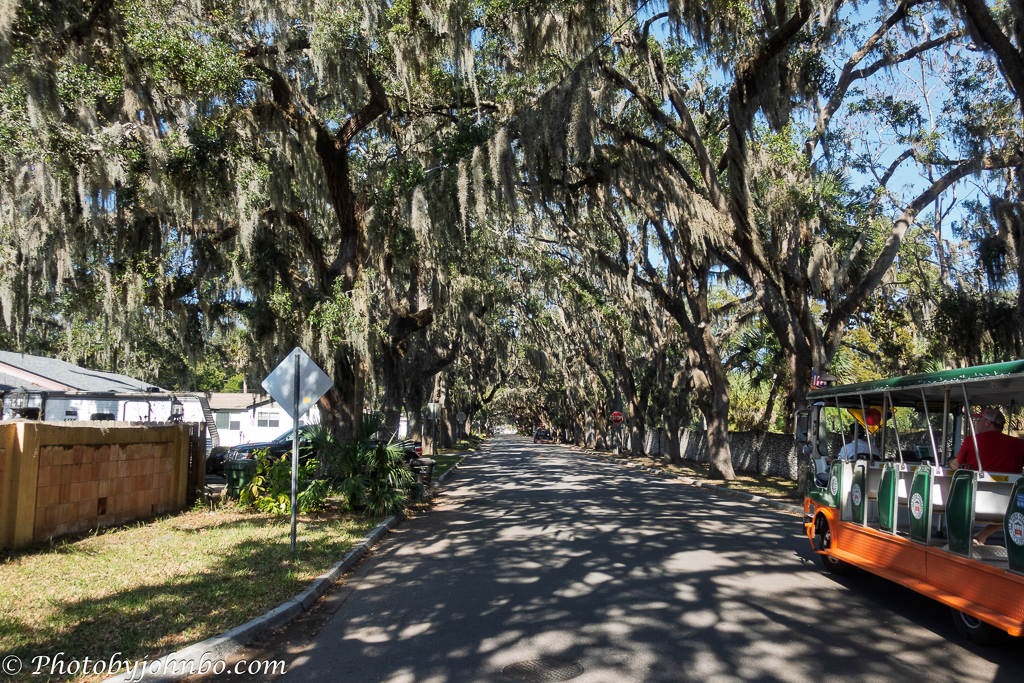
During our first winter hiatus in a city other than Buckeye, Arizona, we followed a friend’s recommendation to stay in a condo in Saint Augustine, the United States’ oldest continuously occupied city. One of the things we discovered in our travels is that many trolley tour companies compete for tourists in historic cities. Especially if we only have a day or two in the city, the trolleys have a couple of major advantages. They hit the highlights of a city, and their open sides or windows allow quick snapshots of places we choose to visit. Some trolleys, like this one, managed by Old Town Trolleys, are configured as a train. Other designs in other cities are more like buses with open windows or window areas where photographs can be taken without distortion or dirty glass.
In the photo above, our trolley is turning onto one of Saint Augustine’s many tree‑lined streets as we make our way toward the Fountain of Youth park. Most trolley companies allow riders to hop on and off at designated stops to explore nearby attractions, but we rarely use that feature. Instead, we prefer to ride the full circuit, snapping photos of places we might want to visit and jotting notes—usually right on the trolley map they hand out when you board. The next day, we return to the spots that caught our attention. This approach works best for a stay of at least two days, and many trolley companies offer discounted second‑day tickets. If you don’t have your own transportation or want to avoid parking in an unfamiliar city, that’s when the hop‑on, hop‑off option really shines, giving you time to explore more of the places that interest you.

On our way through the city center, I caught this perspective of the iconic Bridge of Lions. As our trolley crossed A1A at a right angle, I looked down the line of cars waiting for the drawbridge to reopen. The road sign on the right marks that intersection with A1A, which runs along the ocean and was recently designated the Jimmy Buffett Memorial Highway. The bridge itself is one of Saint Augustine’s most recognizable landmarks, a Mediterranean‑style span guarded by its famous pair of marble lions. Whether the drawbridge was up or down, it always felt like the main gateway between the busy downtown district and the beach neighborhoods across the bay.

Casa Monica is one of the many uniquely designed buildings in this old city. Built in 1888 by Franklin W. Smith and later purchased by Henry Flagler, the hotel became part of Flagler’s growing collection of grand Gilded Age landmarks. After changing hands several times over the decades, it was fully restored in the late 1990s and reopened as a luxury hotel, with its Moorish-style architecture remaining a central fixture of downtown. We rode the trolley several times during our stay in Saint Augustine, and this sequence was captured in late January while holiday decorations were still on display. One of our rides was at night and featured an abbreviated tour during the city’s annual Nights of Lights celebration. You can see views of that holiday tradition from the trolley here.

Henry Flagler is prominent in Saint Augustine’s history, but his name echoes throughout the state. A co‑founder of Standard Oil and later the driving force behind Florida’s early tourism boom, Flagler reshaped entire cities with his vision for grand hotels, railroads, and elegant public spaces. The Flagler Memorial Presbyterian Church is one of his most personal contributions. Built in 1889 following the death of his daughter, Jennie, the church was designed as both a place of worship and a family mausoleum. Built in the Venetian Renaissance style, the structure features a massive dome and intricate stonework, making it one of Saint Augustine’s most striking historic landmarks.

From the trolley, our view of the city’s oldest house at 14 Saint Francis Street was limited to the weathered brick wall, a prominent green arched door, and a historic-designation placard. The house itself sits just beyond that wall, part of a larger museum complex that preserves more than four centuries of local history. The high wall and heavy door definitely caught our attention as we rolled past, making it one of those spots we added to our list for a return visit. As it turned out, though, we never did make it back to see what was beyond that green door. As it turned out, we never did get back here to see what was beyond that green door.

The Lightner Museum is in Spanish Renaissance style, a reminder of the Gilded Age grandeur that once defined this part of Saint Augustine. Originally opened in 1888 as the Alcazar Hotel, it was one of Henry Flagler’s opulent resort properties, complete with the world’s largest indoor swimming pool, Turkish baths, and lavish public spaces meant to impress winter visitors from the North. After the hotel closed during the Depression, the building found new life when Chicago publisher Otto Lightner purchased it in the 1940s to house his extensive collection of Victorian‑era art and curiosities. Today, the museum occupies the former hotel’s grand halls and courtyards, blending architectural drama with an eclectic look at the past.

The city features so much of Henry Flagler’s influence on Florida, but mostly through his deep love for Saint Augustine. His efforts to make the city a destination for winter visitors who took the train south for a few days or a season brought many travelers to the area. Yet Flagler’s vision didn’t end with hotels and railroads. Though he didn’t live to see its academic second life, his grand Ponce de León Hotel eventually became the heart of Flagler College. The ornate towers, courtyards, and Spanish Renaissance details that once welcomed wealthy vacationers now frame a thriving liberal arts campus. It’s an interesting evolution for the property, moving from a winter playground for the Gilded Age elite to a functional campus where students live and attend classes.
Finishing the trolley loop gave us a great baseline for how the city is laid out. This story from the trolley includes several sights I photographed only in passing, glimpsed briefly as we rolled through the city. In previous Tuesday Treks, I’ve shared the stories of the places we visited after riding the trolley, but this tour offered a different perspective—one built on impressions, angles, and moments you catch only from the open-air seats. Over the next few months, I’ll be sharing more stories about Saint Augustine and nearby attractions; you can find them by searching “Saint Augustine” in the bar on the right. Between Flagler’s massive building projects and the older Spanish-era remnants, we quickly realized why Saint Augustine is such a popular destination. There was simply more to look at than we could easily fit into a single trip.
About the photos: All images were captured with my Sony RX100M5 point-and-shoot camera. The exposures were bracketed and rendered in HDR via exposure blending in Adobe Lightroom Classic and Luminar Neo. AI was used to remove distractions in a few frames. These images are shared in 2K HD via my Flickr gallery here.
John Steiner.


Awesome picture s thanks for sharing this post
Thanks for taking the time to comment.
Do get to my blog too https://Womanenabled.blog
Will do!
Nice work. Had one of the Sony RX100 mark 3. Nice little camera that produced some fine images, although I never liked the menus. Health issues kept us grounded last winter, but looking at some places for this winter. Spent 2 years in Gulf Shores, AL. Do you recommend St. Augustine? How about South Carolina? Best to you and Lynn!
I do recommend Saint Augustine. We had a great time in America’s oldest city. So much history there. In fact, I can recommend a place to stay for a month or two, Spanish Trace. It’s on Anastasia Island, a beachfront condo.
I forgot to comment about South Carolina. We have only stayed in a couple of port cities, and then only for a short time. Charleston was the most memorable, but Savannah has it’s own southern vibe.
Thanks for the follow-ups!Lowell+1 (701) 730-8154www.YoDreamcatcherImages.com
I agree, a ride like this can be a great introduction to a city, before planning your own explorations, or a useful option if you only have a very short time. St Augustine clearly has lots of interesting history and attractive architecture.
Those trolleys also help for photography, but my “drive-by” photos don’t create masterful compositions. >grin<
Thanks, Sarah!
Beautiful Trolley views, John. We usually do the same. Ride and then explore.
Thanks, Anne!
😎
That’s a very charming city. Beautiful photos!
It is charming, and historic sites abound. Thanks, Egidio!
Oh, John, this is another fabulous post and a stunning collection of photographs. Me? I enjoyed the history and your narrative best of all. Saint Augustine is on Cam’s bucket list so (gosh, I hope you don’t mind, p’raps I ought to have asked first) I let him read it and he enjoyed it even more than me. Thank you so much for sharing this with us. pp
Share away, Pam! Thank you for the kind words, and by all means take a trip to Saint Augustine. It’s a treasure trove of history.
I’ve always heard St Augustine is a pretty and historic city, but I’ve never visited. It looks like I’m missing out on some really interesting history and architecture.
Indeed, when you get the opportunity to journey, it’s a worthy place.
What beautiful images, John. If I had not read your post, I would not have guessed that this architecture was found in Florida. 😊
Thanks, Pepper! Saint Augustine has some beautiful and historic architecture.