October 2025.
New Orleans, Louisiana.
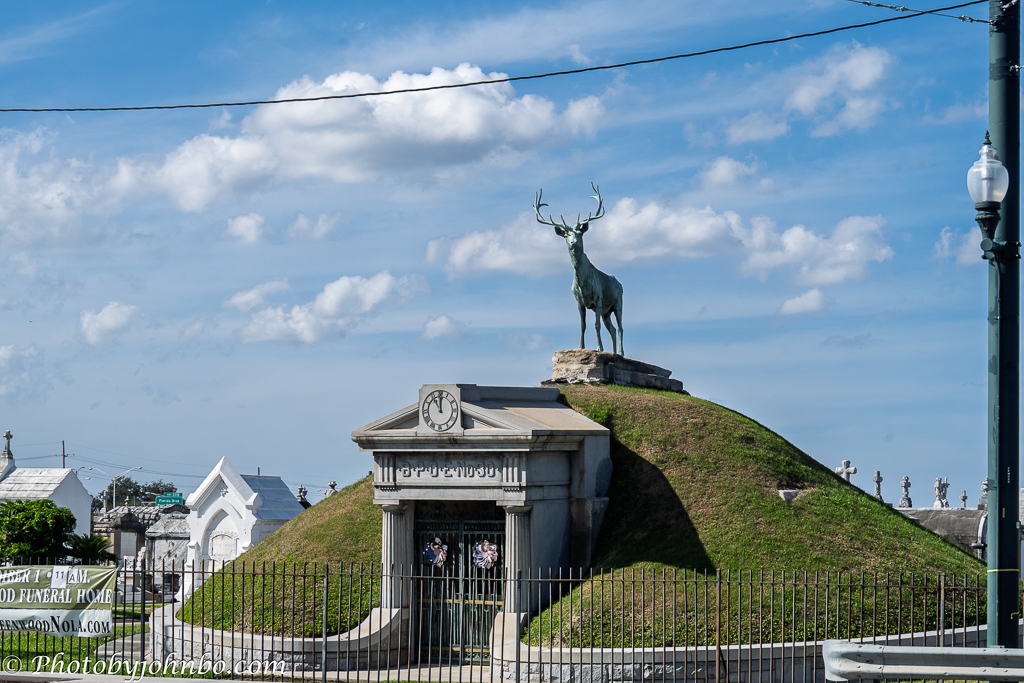
This week marks the 21st anniversary of Hurricane Katrina. In commemoration, I’m stepping outside our regular travel timeline to share one of the most moving and educational tours we’ve ever taken. On our walk to The Katrina Memorial, we passed the Elks Tumulus—a striking example of New Orleans’ unique cemetery architecture. In the background, the Greenwood Cemetery’s above‑ground tombs stand behind the Benevolent and Protective Order of Elks’ large mound and sculpture, introducing the solemn landscape we were about to explore.

The final cemetery we visited on our tour is the Charity Hospital Cemetery—the home of the Katrina Memorial since 2008. Our tour, which we booked through Viator, took us through four separate cemeteries and shared the deep history of New Orleans’ Cities of the Dead. If your time in the city is limited, the memorial itself is well worth a visit as a quiet space dedicated to the history of the 2005 tragedy.
The memorial is housed immediately behind the Charity Hospital Cemetery gates. The hospital has served New Orleans for well over a century and provided a burial ground for the city’s unclaimed, unidentified, or indigent dead—the Potter’s Field. Beginning in the mid‑1800s, the cemetery became the final resting place for thousands of people whose families could not afford private tombs or who died without next of kin. Burials were simple, often unmarked, and conducted by the city or by Charity Hospital itself, which cared for the poor and sick long before modern public health systems existed.

As we continued down the sidewalk, our tour guide began explaining the memorial’s purpose and the storm that shaped it—a space built to honor the many Katrina victims who were never identified. The site’s polished granite panels form a quiet enclosure, set apart from the surrounding cemetery and the busy streets beyond.

Our guide noted that our visit to the memorial occurred shortly after the 20th anniversary of the disaster. Hurricane Katrina struck the Gulf Coast on August 29, 2005, leaving devastation on a scale the city had never seen. In the chaotic aftermath of the storm, many victims could not be identified or reunited with their families, leading the city to eventually bring their remains here to the Charity Hospital grounds. The memorial was dedicated in 2008 to honor those lives—unclaimed and unidentified—and to give them a dignified resting place.

On the opposite side of the granite panel, a diagram features the memorial’s design. The layout mirrors a stylized graphic of Hurricane Katrina’s shape as it might be depicted on a weather map. Along the edges of the curved walkways, six mausoleums hold the remains of the victims. Choosing above-ground tombs rather than a mass grave directly reflects New Orleans’ long tradition of honoring the dead with visible, enduring structures. These structures provide a dignified resting place within the storm‑shaped layout, a deliberate contrast to the unmarked burials in the adjacent Potter’s Field.

Three of the six mausoleums are shown here, each holding the remains of victims who could not be identified or reunited with family after the storm. A total of 84 individuals were laid to rest within the structures. While most were unclaimed in the chaotic aftermath, nearly 30 remained entirely nameless. Forensic investigators continue to use DNA matching to identify the remaining unknowns, including a successful identification that returned a woman to her family in August 2025. The tombs remain unmarked by names or numbers, reflecting both the anonymity forced by the disaster and the commitment to giving each person a respectful final resting place.

For well over a century, this field served as the final resting place for the city’s indigent, unclaimed, and unknown residents. Long before the modern memorial was built, this quiet expanse received thousands of victims from the city’s 19th-century yellow fever and cholera epidemics, including the severe 1853 outbreak. Though the field is unmarked today, the lawn holds a long history connected to the city’s early public health crises.
In the background, the large steeple on the right belongs to St. Anthony of Padua Catholic Church, and to its left stands Canal Street Church: A Mosaic Community, formerly Canal Street Presbyterian Church. These two houses of worship sit along Canal Street and the city’s iconic streetcar line. The Mid‑City Neighborhood surrounding the memorial is a vibrant mix of everyday life and deep history—a place where the “Cities of the Dead” stand side by side with corner stores, cafés, and the rhythms of modern New Orleans.
Learning about the history of Charity Hospital and the events that have tested the city over the centuries left a lasting impression on us. The stories held in these grounds are not just about loss, but about resilience, remembrance, and a city that insists on honoring its dead with dignity. In late October, in honor of the Day of the Dead, our Tuesday Trek will return to these cemeteries for a closer look. In the meantime, several images from this tour appeared in a Lens‑Artists Challenge this past October, and you can revisit that post here.
About the photos: All of these images were captured with the Nikon Z7 II and the Nikkor Z 28–400mm f/4–8 VR lens. Most of the editing was done in Adobe Lightroom Classic, with Adobe Photoshop stepping in for a manual distraction removal after Generative AI attempts in both Photoshop and Luminar Neo fell short. I’ll be breaking down the editing process of that opening photo in an upcoming post on September 10, where I’ll share the story of that AI fail and the extensive manual cleanup it required. If it’s after September 9, 2026, you can find that post here. All of the images from this tour are available in my Flickr gallery here.
John Steiner.


Sobering stuff, John. I hadn’t realised that disaster was so long ago, but for many I’m sure the horror stays with them xx
It was a fitting reminder of what happened. For someone who’s totally unconnected with the area, I didn’t remember what a tragedy it was.
It was there I was reminded of someone taking a school bus, filling it full of victims and driving them to shelter in Texas.
What a beautiful memorial! I can’t believe its been 25 years since Katrina. Time has a way of reducing memories of pain and sorrow.
Time is a great healer, Anne. This memorial was a stark reminder of the tragedy.
😎
What a beautiful and graceful way to honour these victims John, it feels completely in harmony with the spirit and soul of the city 🙏
It is a beautiful memorial, Xenia! Our guide told the story respectfully and focused on the human tragedies of the unidentified.
I am curious as to why or what the relationship is with the B.P.O.E, I zoomed in on the clock and sure enough it is the 11th hour, so definitely related to the Elks for some reason
You’re right about the Elks symbolism on the clock. The Elks Tumulus is simply part of the historic cemetery we walked through on the way to the Katrina Memorial. I chose to share the photo because the elk was the first thing I noticed as we walked out of the memorial gates. There’s no direct relationship between the Elks and the memorial itself; they just happen to be neighbors. The memorial sits on land that was repurposed after the storm, while the Elks mound has been here for over a century.
Cool, thanks John, hope all is well!!
It is, indeed! I hope you are keeping cool!
Oh, John, this is lovely, and thank you! This was a very emotional read for me; we lost a very dear friend to Katrina and, all these years later, it still feels very raw and tragic – what an horrific way to die. I really like that the memorial site is in the round. One day we’d love to visit but ’til then, this is a lovely tribute. I hope you don’t mind but I let Cam read it and look at your pictures and he, too, had tears in his eyes. pp
So sorry for your loss, Pam. It was such a moving tour. I’m glad it was reflected in the way I honored the memory of those lost in the post.
You don’t ever have to be concerned about sharing the read with Cam. Thank you for following.
This seems a very fitting and respectful memorial to all those who lost their lives in that tragedy. I remember seeing the devastation in the news and hearing the stories of affected families but I hadn’t realised so many of those who died couldn’t be identified.
I remembered the news coverage, but the details learned in the memorial were sobering!
Humbling post and beautiful images, the hospital cemetery entrance is so beautifully inviting!
Indeed. The site, even before the monument, is quintessential New Orleans.
This is a beautiful memorial for a sad time.
Indeed!