October 2025.
Salina, Kansas.
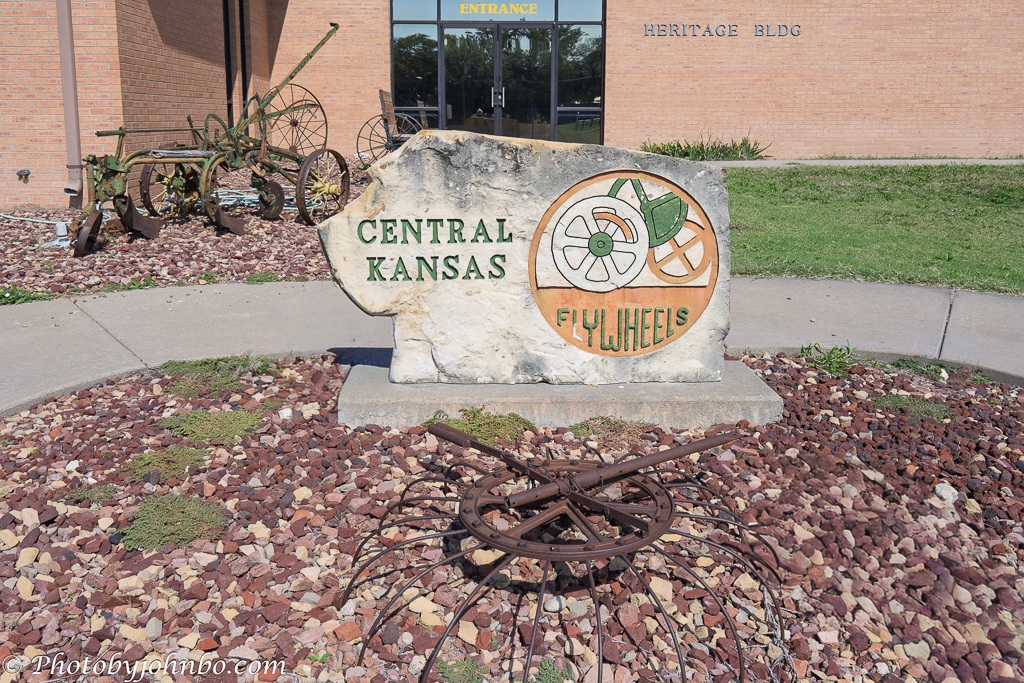
Last week, we virtually traveled to Europe while staying in Salina, Kansas. The Passport to Europe Exhibition featured classic European automobiles from Bugatti to Volkswagen. Today, we are back in Salina, where a museum captures rural life on the Kansas prairie in the early 20th century.
The Central Kansas Flywheel Museum traces its roots to a group of local collectors who began preserving early farm engines and machinery in the 1960s. What started as a small gathering of enthusiasts grew into a permanent museum dedicated to the tools, tractors, and traditions that shaped prairie life. Over the years, the collection expanded beyond restored farm equipment to include historic buildings, household artifacts, and community landmarks relocated to the grounds. Today, the museum offers a close-up look at the everyday tools and machinery that built these farming communities.

One of the earliest tractors on display was built in a Minneapolis factory. It represents a major shift in farm power as one of the first successful gasoline-powered alternatives to steam. Earlier steam traction engines were impressive but impractical for most Kansas farmers. They burned fuel at a prodigious rate, required constant water, required a crew to operate safely, and were far too large and expensive for the small family farms that dominated the prairie.
The Bull Tractor, introduced in 1913, offered a completely different approach. It wasn’t an overnight success, but it checked all the boxes that mattered to everyday farmers. It could be operated by a single person, run on a simple gasoline internal‑combustion engine, and plow, cultivate, and power belt‑driven equipment. Most importantly, it was sized—and priced—for the modest acreage of early 20th‑century Kansas. For many families, machines like this were the first practical step away from teams of horses.

By the late 1920s, American farming was shifting rapidly toward gasoline‑powered tractors, and John Deere was still relatively new to the tractor business. Deere acquired its first tractor, the Waterloo Boy, rather than designing it in‑house. The GP Standard, introduced in 1928, was one of Deere’s first attempts to create a machine that reflected their own engineering philosophy—simple, durable, and suited to the needs of Midwestern farmers.
The “GP” stood for General Purpose. Still, the early GP Standard was a transitional design: more advanced than the early two‑cylinder Waterloo tractors, yet less refined than the later Model A and Model B that would define Deere’s lineup for decades. This beautifully restored example holds a place of honor in the museum—it’s displayed in the main building rather than the farm building where the other tractors reside. It serves as a great bridge between early gasoline experiments and the highly successful row-crop tractors that would dominate American fields for the rest of the century.

In the large, well‑lit equipment barn, farm equipment of all types is displayed in various stages of restoration. This photo highlights three restored tractors: on the left is the Model 820 John Deere diesel tractor; in the center, the 1951 Oliver Row-crop tractor; and on the right, an Allis‑Chalmers model. While researching this post, I learned that a row‑crop tractor differs from both the 1929 GP Standard and the 820 diesel in two important ways. Row‑crop tractors were designed to work between growing plants, so they feature adjustable wheel spacing—the front wheels can be set narrow or mounted on an adjustable wide‑front axle, and the rear wheels slide in or out to match standard row widths. They also sit higher to provide additional ground clearance. All of these elements help the tractor straddle crop rows without damaging the plants while cultivating.

Also in the equipment barn, I saw an International pumper truck sitting next to an International Harvester Farmall tractor. Its design reflects the practical needs of rural America and the volunteer fire departments that protected small towns across the prairie. Trucks like this replaced the hand‑drawn hose carts and chemical wagons that many communities relied on well into the early 20th century. This style of fire engine served countless Kansas towns after World War II. Built on an IH K‑ or L‑Series truck chassis and fitted with a commercial fire body, it carried its own water supply and a front‑mounted pump—simple, rugged, and easy for a volunteer department to maintain. For many small towns, a custom body built on a truck chassis like this was their very first motorized fire engine.
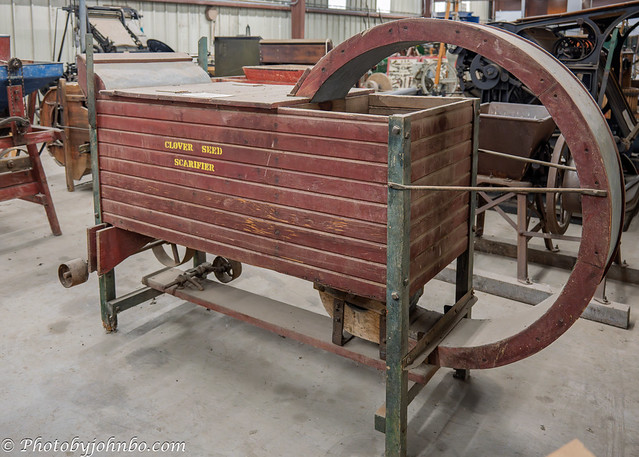
When I saw this piece of farm equipment named like a prop from a low‑budget horror movie, I couldn’t help but smile at the possibilities. Once I learned its real purpose, the jokes practically wrote themselves. This machine scares the husk off its little clover soul… because sometimes a seed needs the fear of God before it’ll sprout. In truth, a clover seed scarifier simply roughens the seed coat so moisture can get in—but where’s the fun in that? In practice, a wide belt connects the large wheel to a tractor’s power take‑off, giving the scarifier the muscle it needs to do its work.

As I noted in the introduction, what began as a collection of farm equipment preserved by mechanical enthusiasts has expanded to encompass the full scope of prairie farm life. Many of the artifacts in the main building document the typical farmstead, from a gas‑powered iron to early kitchen tools that once sat in the working corner beside a farmhouse cookstove. One section of the museum features a recreated parlor complete with a wood‑burning stove for heat, an early Singer sewing machine, a spinning wheel, and a 1930s‑era console radio—the core elements of daily life and entertainment in an early Kansas home.

Along the walkway to the equipment barn, visitors can detour to the Wells Methodist Church, relocated here from Wells, Kansas. Built in the early 1900s, it once served as the spiritual and social center of a small prairie community—a place for Sunday services, weddings, funerals, and the occasional town gathering. When rural populations declined and congregations consolidated, the little church eventually closed its doors. Rather than let it fade away, the museum moved the building here to preserve a piece of everyday prairie life. Inside, the simple wooden pews and modest sanctuary look exactly like countless other rural churches that once dotted the state.

Along the walk, we also stopped by the schoolhouse, where children were once beckoned inside by the bell mounted near the front door. Originally located in a small rural Kansas district, the building served generations of farm children before being moved here for preservation. The rural setting is unmistakable—tall corn rises behind the building, and the “necessary room” stands nearby, a reminder of school days before indoor plumbing. Just outside the photo frame to the left rests a set of historic playground equipment. There’s the old climbing gym that sent many a youngster crying to the teacher after a slip‑and‑fall, and the metal merry‑go‑round now frozen in time, having launched generations of smaller children when the older kids decided to give it a little extra spin.
I was the first of my siblings to be born in a hospital, but my older brothers and sisters all knew the life of a North Dakota farm family, first in Grenora and later in Williston. Having moved to the “big city” in California before I was six, I never experienced rural school life the way they did. When I returned to North Dakota in my twenties, I learned about the Bonanza farms that once dominated the prairies of North Dakota and Minnesota, and I spent a lot of time studying the rhythms of rural life there. Nothing I saw in this museum surprised me—well, almost nothing. There was that scarifier.
Rural America is disappearing in many ways; family farms have steadily given way to corporate operations, not unlike the Bonanza farms of the late 19th century. Those small tractors that once replaced the steam behemoths have themselves been replaced by high‑horsepower, air‑conditioned machines and combines that can easily top a million dollars. By focusing on the machinery that drove the transition from muscle and steam to gasoline, the Central Kansas Flywheel Museum preserves a distinct, mechanical chapter of prairie history.
About the photos: I captured all images with the Nikon Z7 II and the Nikkor Z 28–400mm f/4–8 VR lens. Processing was minimal: any image above ISO 100 received Lightroom’s Denoise treatment, along with straightening and cropping as needed. I finished the two exterior shots with Luminar Neo’s Accent AI, and several images used Lightroom’s AI removal tool to eliminate distractions. I’ve shared all the images and their metadata in my Flickr gallery here.
John Steiner.

