October 2025.
Salina, Kansas.
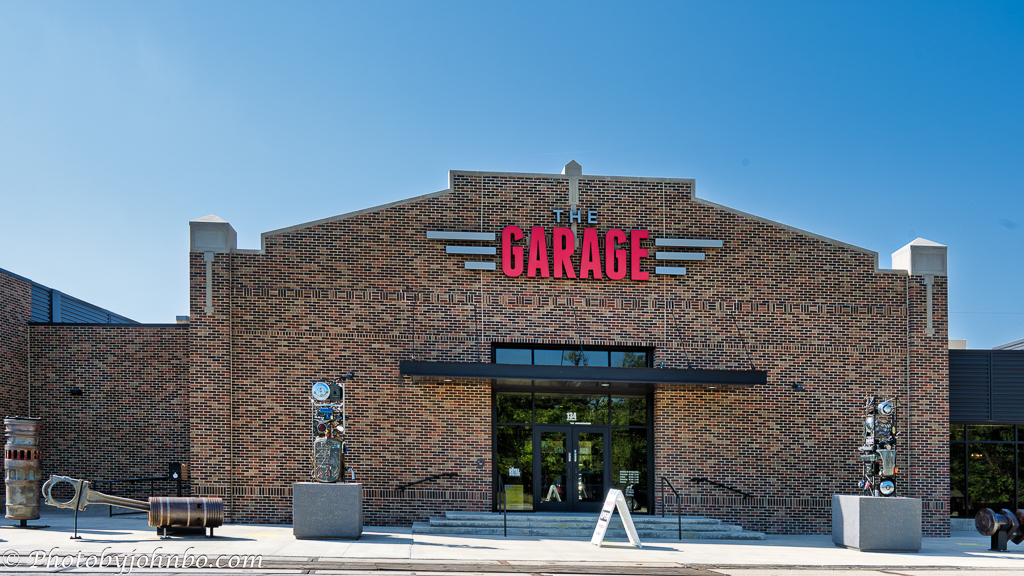
Our fall trip in 2025 brought us down U.S. 81 through Kansas, adding another state to our quest to visit all 50 states. An overnight stop in Salina allowed us to visit two museums. The Garage Automotive Museum opened in 2022 as part of Salina’s downtown revitalization. The museum occupies a repurposed industrial building and has built its reputation on rotating, story‑driven exhibits rather than a static collection. Each theme features vehicles from private collections across the Midwest, so the floor looks completely different every few months. When we visited, the current featured theme was Passport to Europe.

Scooters are a staple of European city life—not just because they’re fun, but because they’re cheap, nimble in narrow alleyways, and barely touch high-priced fuel. The mint‑green scooter and the gray unit behind it are classic Italian‑made Vespas, the iconic city runabouts that seem to fit into parking spaces no car could ever dream of. They’re a perfect fit for a “Passport to Europe” display.

Walking through the exhibit felt like exploring an eclectic European street where every car featured a great narrative placard. This green Porsche is a stunning example—one of the rare 1955 Porsche Continentals. For a single model year, Porsche used the “Continental” name on a special trim of the 356 aimed at the American market. Ford objected to the name shortly afterward, so Porsche dropped it and replaced it with the standard “356 A” designation the following year. That brief naming window makes surviving Continentals especially interesting to collectors, and seeing one in this condition is a treat.

Kansas is farm country, but I’d guess no Kansas farmer ever mowed hay or harvested soybeans with a Porsche. In Europe, though, small tractors like this were a common sight after World War II—compact machines built for the tight fields, narrow lanes, and mixed‑crop farms that defined rural life from Italy to Germany. Many European farmers worked small plots, often just a few acres, so they favored light, maneuverable tractors that could handle everything from vineyard rows to hillside pastures. Porsche built these practical workhorses long before the brand became synonymous with high-end sports cars. Seeing one here in Kansas feels a little unexpected, but I discovered that even the most glamorous brands sometimes have humble roots.

The placard notes that the Mercedes‑Benz SL‑Class debuted in 1954, and this clean red 1987 Roadster is a great example of that lineage. Like many of the cars on display, it has a story as interesting as the machine itself. The placards didn’t just list specifications and a brief history—they often included a note or two about the car’s journey or the owner’s search. In this case, the owner, Jim, had been hunting for an SL for some time and finally got lucky, spotting this one on eBay from a seller in McPherson, Kansas. Local connections like that kept me reading the signs from top to bottom.

As you might have guessed, I couldn’t pass up photographing a model train engine, especially one as detailed and accurate as this. The placard told me how these miniature trains were sold. The Ottaway Amusement Company in Wichita started out repairing small steam engines and building gas‑powered race cars, then shifted to producing its own miniature steam trains after World War II. A complete package—engine, tender, three coaches, a canvas cover, and 320 feet of track—sold for about $3,000. This particular engine, No. 1053, is one of only 100 built between 1946 and 1958. The museum staff found it in Enid, Oklahoma, and restored it in Wichita. It’s an American product through and through, but to fit the Passport to Europe theme, the museum displayed it as an homage to the great steam era across the Atlantic, tying local Kansas craftsmanship to the historic boat trains that once connected cities like London and Paris.

Sweden is home to both Volvo and Saab. The front license plate holder caught my eye as a pilot—Saab’s roots are in aviation, so the owner chose a front plate with a twin‑engine bomber as a nod to the company’s other line of work. Saab’s automotive division grew out of the same engineering culture that produced aircraft, and that heritage shows up in their cars. Even without checking my placard photos, this is an unmistakable Saab 900 Convertible, the only standard drop‑top Saab offered in 1991. It was a small detail in a large exhibit, but that little bomber image made me smile and reminded me how deeply Saab’s automotive and aviation histories are intertwined.

I could have photographed another British car; there were several in the exhibit. However, this little MGB brought memories flooding back. In the 1980s and 1990s, I owned a 1973 MGB—burgundy paint sprayed over the original blue—and it became my entry point into British motoring. The MGB itself is a bit of a legend: introduced in 1962, it was one of the first sports cars to use a unibody design, which made it lighter, stiffer, and more modern than many of its contemporaries. Over its 18‑year production run, it became one of the best‑selling British sports cars ever built, beloved for its simplicity, its balance, and the way it made even an ordinary drive feel like an event.
I joined Fargo’s British Iron Society and edited their monthly newsletter for several years, learning to live with the quirks that came with the territory: those eccentric Zenith-Stromberg carburetors and the ever‑mysterious Lucas electrics. I still miss those runs around Fargo, and the poker runs where the group would gather and enjoy the summer drives, top down and hair blowing in the wind (back when I still had hair to blow). Seeing this MGB in the exhibit wasn’t just a nod to British automotive history—it was a reminder of a chapter of my own.

The 1999 Ferrari F355 Spider needs no help drawing attention, but the placard reminded me why this model still has such a devoted following. According to that little sign next to the car, Jeremy Clarkson once called it “the best car I’ve ever driven,” and the numbers back up the enthusiasm: 0–60 mph in 4.7 seconds, a top speed of 180 mph, and a 3.5‑liter V8 that revs to an astonishing 8,500 RPM. That high-revving engine gives the F355 a distinctive, sharp Formula One wail. This particular car even spent time on display at Casa Ferrari during the 2023 Pebble Beach Concours, a fitting stage for one of the most celebrated Ferraris of its era.

When I first read the placard, I thought, “Oh, this is another replicar,” and a little digging proved me right. It may be a replica, but it’s a masterpiece of design. The Bugatti Type 35 is one of the most iconic racing cars ever built, and even the replicas tend to be lovingly crafted homages to the original Grand Prix legend. But this isn’t some cheap fiberglass lookalike; it’s a meticulously faithful recreation of the machine that dominated 1920s European racing with over a thousand victories. The real Type 35s were masterpieces of their era—lightweight, beautifully balanced, and instantly recognizable with their horseshoe grille and spun‑alloy wheels. Seeing how seriously this specific tribute was built made me appreciate it even more. It’s a reminder of how a century‑old design can still stop you in your tracks.

Of course, I can’t just take photos of cars—sometimes I have to go “artsy‑fartsy” and photograph just a design feature like the grille on this Ferrari Testarossa, complete with the badge and the slats that run straight across the taillight region. There’s something satisfying about isolating one clean detail on a car that’s otherwise full of 1980s drama. As we left the museum, I found myself regretting the current state of automotive design. Hide the badges on anything built in the last twenty years and, in the haze of 21st‑century sameness, you’d be hard‑pressed to tell who made it. Well… maybe I should have said “SUV,” because they barely make cars anymore.
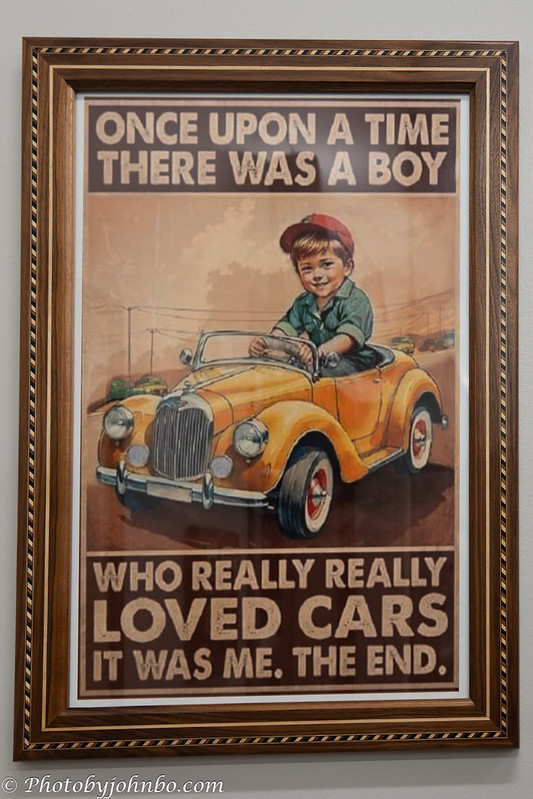
Though Passport to Europe has closed, I’d love to stop again to see what the museum has in store. The Garage Automotive Museum is open Tuesday through Saturday from 10 a.m. to 5 p.m., and Sunday from noon to 5 p.m., with adult admission at $12 and reduced rates for seniors, military, and children. They’re closed on Mondays, but their rotating themes make it worth checking back often. You can find current exhibits, special events, and updates on their website here.
About the photos: I captured all photos in this set with a Nikon Z7 II and a Nikkor Z 28-400mm f/4-8 VR lens. I processed most images only in Adobe Lightroom Classic, but I also tweaked a couple in Luminar Neo. I used AI in some images to remove distractions. I also shared several more photos in my Flickr Gallery. For a 2K HD view or to check out the Metadata, visit the gallery here.
A Little Mystery for the Road: Take a close look at the license plate on that Ferrari Testarossa in the gallery. Can anyone guess what CNTDR55 means? Drop your best theories in the comments!
John Steiner.


You had me at Garage Museum 😂 Fabulous scooters and cars. Great photos
Thanks, Brian! It was a perfect stop in Kansas. Next Tuesday, we visit another museum in Salina with a more home-town twist.
What a wonderful museum. Their changing exhibits makes it more interesting, and your pictures are great. Our auto museum is more static with some changes but not many. And, that closing sign is so you!
It was a wonderful discovery for an old “car guy” like me!
😎
Fabulous images, John. I love all things trains, so I was thrilled to see that rare model train, the 1949 Ottaway Steam Train. What a fun museum to visit. Thank you.
I had a lot of fun processing that photo. It was quite a bit of work, but it turned out well.
It looked great. I love seeing all the bolts and the textures on the tracks.
Gotta love that Porsche and its color.
Indeed! I didn’t know their history of farm equipment. Wonderful paint scheme. I don’t know if that was a normal scheme or an owner’s repaint.
Thanks for another fun tour John. I love old cars, especially those early Porsches. Who knew they made tractors! I’ve owned two Saabs, a 900 & 9-3.
My only classic was that MGB I mentioned, though I did have two classics as a young man… a 1957 Chevy and a 1959 Chevy… but those were “new” old cars when I owned them as a college kid. Oh, what I didn’t know then about how much they would be worth now. >grin<
Those were classic Chevys. We had a 61 as our family car.
I’m also attracted to motoring museums; I was surprised to see the Porsche tractor – I didn’t know anything about that part of their history either.
I love how the red paint on the tractor brings out its heritage!
Thank you! This is a great and very interestingly informative post. Thank you for sharing all the details with us, they made the images so much more meaningful. Great post! pp
Thanks, Pam! It’s a fun stop for “classic car nuts.”
😀 His nibs is challenging your use of “nuts” – he’s one of those! 😀
John, I’m sure you were in heaven as you walked around looking at all of these gorgeous cars! I love the Porsche tractor! My brother is a car guy, too. He would love that sign!
Indeed, it is a great museum!
This is so groovy, I love old cars, well loved jalopies! Thanks for posting. My favorite were the Vespas. 🛵
It is a great place for car enthusiasts!
Can’t Drive 55??? LOL, Adding this to my list of places to visit!! Thanks John!
That’s it, Kelly!
Well worth a visit.