It’s been a scorcher of a summer, and with September upon us, I think we’ve earned a cool change—shout‑out to Little River Band. This week’s Lens‑Artists Challenge takes a slightly different angle on water, focusing not on the waves or currents themselves but on the landscapes, structures, and stories that unfold around them. Every photographer has images shaped by water—a harbor lined with fishing boats, a wetland alive with reeds and wildlife, a boardwalk skirting a tidal marsh, or a cityscape mirrored in a quiet canal. This week, we’re celebrating waterscapes in all their forms, where places shaped by water serve as subjects in scenes that give them character.
The Challenge: Share up to six waterscapes—images where water shapes the scene. Choose your favorite places, your favorite photos, or a single location that inspires you. Natural or man‑made, peaceful or wild—if water helps tell the story, it’s fair game.
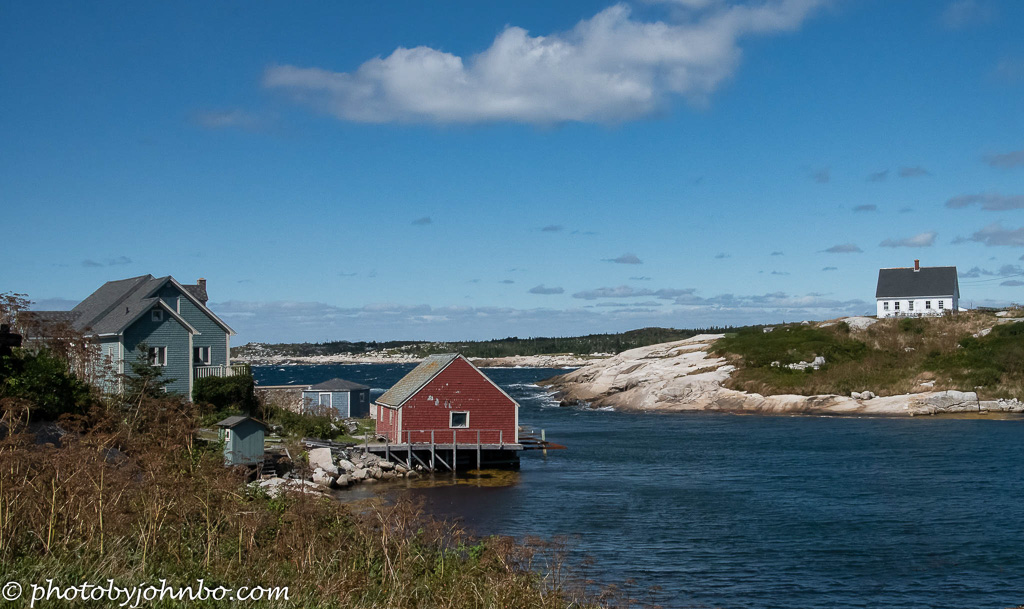
For my opening photo, I revisited a journey to Peggy’s Cove and reprocessed an image captured with my Nikon D500. The small fishing village has drawn photographers and visitors for decades. Peggy’s Cove sits on the edge of St. Margaret’s Bay, where the protected inlet gradually opens to the full reach of the Atlantic Ocean. The weathered buildings clustered along the rugged shoreline capture a classic Atlantic coastal setting and serve as my starting point for this week’s challenge.

Crossing the continent to Washington State, Lynn and I took State Route 525, which includes a short ferry crossing between Whidbey Island and Mukilteo. The highway runs down the southern end of the island and ends at the dock, where the road simply becomes the deck of the Clinton–Mukilteo ferry. From the upper deck, a moody morning caught my attention—low clouds drifting over Possession Sound, a distant ferry moving across the horizon, and the muted outlines of the mainland coastline. My “real” camera was tucked away in the car, so my Samsung S20 Ultra stepped in and captured a minimalist waterscape, which I later processed in Luminar 4.

In November, Sprague Lake’s shoreline offers a prelude to winter as the trail curves along the water toward a small bridge tucked into the trees. In black‑and‑white, the textures dominate—the frozen shallows, the rocky bank, the snow‑patched path, and the mountains rising beyond. The changing seasons shape this place, inviting visitors to follow the path and see what lies around the bend. I captured the image with a Nikon D500, processed it from a 3-exposure bracket, and converted it to black-and-white with Nik Efex 2. It’s part of a Colorado monochrome photoset I haven’t published before.

In 2022, our annual fall trip brought us along the North Shore of Lake Superior, where we headed toward Thunder Bay and eventually continued through Ontario until we re‑entered the United States in Michigan’s Upper Peninsula. Along the way, we noticed a sign for the Aguasabon Gorge and Falls, a roadside stop with a short walk to a boardwalk ending at a viewing platform overlooking the river’s plunge. From the high viewpoint, the river looks small, yet the tall cliffs reveal a landscape shaped by water—an environment carved over centuries by the force that created the gorge. I captured this image on my Samsung S20 Ultra and processed it in Lightroom Classic and Luminar Neo.

Back in 2019, a quick trip to Winnipeg for Civil Air Patrol business covered Friday’s duties, allowing Lynn and me to stay for the weekend. We caught a RedHawks/Goldeyes baseball game and visited FortWhyte Alive, a serene nature preserve on the city’s edge featuring walking trails, lakes, and prairie wildlife. As we walked along one of the trails, we passed close to Lake Devonian. Seeing a bright orange canoe tied to a dock almost tempted us to rent one from the park office. I settled for capturing the tranquil, tree‑lined scene with the D500, processed in Lightroom Classic and Luminar Neo from a three‑shot bracketed exposure set. The escape to FortWhyte Alive helped ease the sting of our team’s loss to the Goldeyes. >grin<

In October 2020, we visited Mount St. Helens, the mountain that “blew its top.” On our tour of the park, we found Coldwater Lake, a body of water that didn’t exist before 1980, formed when the eruption blocked Coldwater Creek and created a brand‑new basin. Surrounded by the blast zone’s scars and fresh regrowth, the young lake is barely four decades old. On that windless morning, its smooth surface held a crisp reflection of the surrounding landscape. I’ve shared this image in other challenges, but as one of my favorite waterscapes, I felt it was worth sharing again. Captured with the Samsung S20 Ultra and finished in Luminar 4, the image needed no further adjustments for this theme.
Thanks to Sofia for her “What Is It?” challenge. Next week, Beth will be ready with a new theme. Follow her here so you don’t miss her challenge on Saturday, September 12, at noon Eastern Time. I look forward to seeing your responses. Be sure to link to this post in the comments section and tag your entry with “Lens-Artists” so we can find it.
If you’re sharing a Lens‑Artists Challenge response for the first time, welcome—we’d love to visit your post. To participate, publish your take on this week’s theme, link back to this page, and add the Lens‑Artists tag so others can discover your work. You’ll find more details on how the challenge works here.
John Steiner.


Great theme, John. Your photos are exquisite. I appreciate the recommendation for Aguasabon River View, that’s not too far from us in Madison. Since I live on an isthmus, this is a great challenge.
I look forward to your post, Rebecca!
I’d like to think about which angles will be best to reflect the isthmus.
I love this theme, John. I’ll put on my thinking cap and come up with my post for early n the week. Your images are so beautiful. Although the entire gallery is breathtaking, it is the Sprague Lake monochrome that kept me still, admiring the beauty of Rocky Mountain NP.
Thanks, Egidio! Black-and-white has its own beauty, focusing on textures and tones rather than color. I love a good color landscape, but when a photo is right for black-and-white, it’s often so much more dramatic.
Coldwater Bay and your opening shot with all that sky and sea are my favourites, John. I’m sitting looking at a limpid blue sea right now- my rooftop view xx
Thanks, Jo. A limpid blue sea sounds perfect. Coldwater Bay had that same calm clarity when I was there.
Beautiful photos!
Thanks! I appreciate the compliment.
Great twist on a common theme. Your images are all gorgeous but my favorites are the black and white and the reflection.
Thanks, Dawn!
Lovely lovely post and theme…
Thank you, Katharine!
And I actually am not super late to the party this time!!!
Thanks, Katharine!
Wonderful challenge and images John. I especially like the first and last images.
Thanks, Brad! Looking forward to your response!
[…] contribution to Lens-Artists Challenge #412—Places Shaped by Water is this bird feeding from my bird feeder just steps away from its nesting place near the […]
Love the challenge theme this week John! Beautiful images, Sprague Lake is very cool! We loved Peggys Cove as well! So beautiful
Sprague Lake is beautiful in black-and-white or color. I’d like to go back to Peggy’s Cove again.
Oh my, John! What lovely shots. Can’t pick a favorite – they all take my breath away in their own special way.
Thank you, Lindy! I’m looking forward to your response!
[…] Lens Artists Challenge – Places Shaped by Water […]
This sounds fun. Going to hunt for images now.
I look forward to seeing them, Kirstin.
[…] hosts this weeks Lens-Artists Challenge #412—Places Shaped by Water. The brief is: Share up to six waterscapes—images where water shapes the scene. Choose your […]
[…] For the Lens Artists challenge by John. […]
Beautiful water scenes, John! I particularly like the last one. My entry here:
https://flightsofthesoul.wordpress.com/2026/09/05/lens-artists-412-shaped-by-water/
Thanks, PR!
Great theme John. I agree some cooling water is a perfect segue to the change in the season. Love your opening image of Peggy’s Cove. You captured the down-home charm of that landscape perfectly. Of course, I might be a touch biased since I am in Canada, eh.
Thanks, Suzette! I’m not from Canada, and I would love to return there someday. It’s such a beautiful destination, and the drive there is scenic, as well.
You are welcome, John. It is my dream to visit Peggy’s Cove there someday.
Great theme and photographs
Thank you!
[…] week’s challenge is by John Steiner (Journeys with Johnbo): Places Shaped by Water. John has some terrific pictures for this challenge and I urge you to check them out. The title of […]
What a great theme, John. Your examples provide plenty of inspiration for those entering the challenge. I love the B & W Sprague Lake although the Coldwater lake has to be my favourite.
Hard to believe that lake is only 46 years old. It’s not often I get to see a windless day and flawless still water on my side of the world so this was a winner for me.
Thanks, Vicki! That Coldwater Lake is interesting in its youth, despite its violent birth.
[…] Lens-Artists Challenge #412—Places Shaped by Water […]
Brilliant! I love the concept and I enjoyed working on my rendition. Mostly though, as always, I thoroughly enjoyed your choice of images and even more, your lovely narrative. Thank you John. pp
Pam, I saw your post already, and the story you told. Your photos are perfect for the challenge.
Thank you.
[…] Posted as part of Lens-Artists: Places shaped by water […]
Wonderful images!!! Love this challenge.
Thanks, Ana!
Your first picture, dear John, reminds us of the summer house we had in Sweden. We enjoyed it very much.
Your black-and-white picture we especially like.
Thanks
The Fab Four of Cley
:-):-) 🙂 🙂
Thanks, Klausbernd. Those buildings are distinctly Northern European in design. Thanks for the compliments. I need to post that gallery of black-and-whites that never got published.
[…] John’s Challenge: Share up to six waterscapes—images where water shapes the scene. Choose your favorite places, your favorite photos, or a single location that inspires you. Natural or man‑made, peaceful or wild—if water helps tell the story, it’s fair game. […]
Love this theme, and I can see why you love the Coldwater image, it is stunning. And the beauty of Aguasabon River View. Here is mine: https://sillarit.com/2026/09/06/lens-artists-challenge-412-places-shaped-by-water/
[…] dam and the locks in it, are part of the Delta Works, safeguarding The Netherlands against floods. LAPC #412 is ‘places shaped by water’. I think that applies exactly to the existence of The […]
Such a thoughtful and creative theme, John, and with some exquisite photos.
Coldwater Lake is the one that stopped me — a body of water that simply did not exist before 1980. Such a good reminder that landscapes are still being written. Peggy’s Cove opening out of St. Margaret’s Bay is a lovely place to start a water theme too. In our family the water is always what the kids remember longest from a trip, ferry decks especially, so the Mukilteo crossing shot felt very familiar.
I appreciate that. Coldwater Lake stopped me too—hard to imagine a whole lake appearing in our lifetime. And I love your note about the kids remembering the water. Ferry crossings have a way of becoming the highlight.
[…] LensArtists Photo Challenge: shaped by water […]
https://geriatrixfotogallerie.wordpress.com/2026/09/06/shaped-by-water/
[…] Posted for John’s Lens-Artists Challenge […]
[…] today’s post with a suggestion that you visit and link your response to his terrific original here. As always, please remember to use the Lens-artists tag to appear in our reader section. We offer […]
This is such a cool twist on water as a challenge and I love it, John. Your photos are stunning, your landscapes always are! Coldwater Lake is also my favourite, not just for the photo, which is stunning, but the story behind the place.
Here is mine:
https://photographias.wordpress.com/2026/09/06/lens-artists-challenge-shaped-by-water/
Thanks, Sofia… This morning, I got to thinking about my theme and the photo’s inclusion in this challenge. Truth be told, forces other than water shaped the Coldwater Lake basin in 1980, but had it not been for Coldwater Creek that ran through the area unimpeded, there would have been no source of water to create a lake, and no inflow or outflow. Now the water is continuing to write the next chapter in that landscape.
Fair point, everything played a part.
[…] Lens-Artists Photo Challenge – Places shaped by water […]
[…] Lens-Artists Weekly Photo Challenge #412: Places Shaped by Water […]
So many beautiful waterscapes John and such a lovely theme to play with 😊 Our contribution for this week’s lovely challenge comes from one place in Perthshire: https://tranature.com/2026/09/06/loch-ossian/
Thanks, Xenia! That loch is beautiful in your photos!
Thank you kindly dear John! 😊
Wonderful, John! This is a great challenge theme. I’m enjoying looking through everybody’s take on it. Your images are terrific. My favorites are the Aguasabon River View and the Coldwater Lake. The latter is perfect – Composition and framing, color, etc. I love it.
John, your waterscapes are all stunning. My favorites are Peggy’s Cove and Coldwater creek. Thanks for this great challenge.
Thanks, Beth! It’s been fun seeing everyone’s responses.
I have not been up to Mukilteo (I live in Washington)…I have been to Coldwater lake…so pretty and I love the boardwalk
https://troyerslovinglife.blogspot.com/2026/09/taking-in-life-around-me-lens-artist.html
Thanks, Kirstin! That lake is a beautiful addition to the landscape that was mostly destroyed in 1980.
[…] can see that water, and a lot of it, shaped the land in many ways. Our challenge this week is from John who asks us to share images of places shaped by […]
John – Thanks for another great topic and great images — the canoe and the lake images are my favorites. We are creatures of the water, originally, and are drawn to it almost as a pilgrimage sometimes. I have my contribution here: Lens Artist Challenge 412 – Shaped By Water – The View From Here
Original and refreshing theme. The water scenes bring a sense of tranquility. These must have been very relaxing trips.
Thanks, Dan! They truly were.
Great challenge – there is my submission https://yourlifeasartphotography.com/2026/09/06/lens-artists-challenge-412-places-shaped-by-water/
Thanks, Pamela!
[…] John has provided us with a very inspirational challenge this week with the theme of Places Shaped by Water! […]
[…] A Little bit about me Lens-Artists Challenge #412—Places Shaped by Water […]
[…] A polder landscape. Living below sea level water management is needed to keep us dry. Here you see a typical polder landscape.LAPC #412 is ‘places shaped by water’. […]
[…] The Challenge: Share up to six waterscapes—images where water shapes the scene. Choose your favorite places, your favorite photos, or a single location that inspires you. Natural or man‑made, peaceful or wild—if water helps tell the story, it’s fair game. […]
Your prompt took me back to my childhood, why it immediately came to mind, I don’t know, but I was happy it did.
https://dailymusing57.com/2026/09/07/lens-artists-challenge-places-shaped-by-water/
[…] Happy Sunday! This week, John is hosting Lens-artists photo challenge #412 and the challenge is show up to 6 photos where the landscape is shaped by water. […]