October 2024.
Cape Town, South Africa.
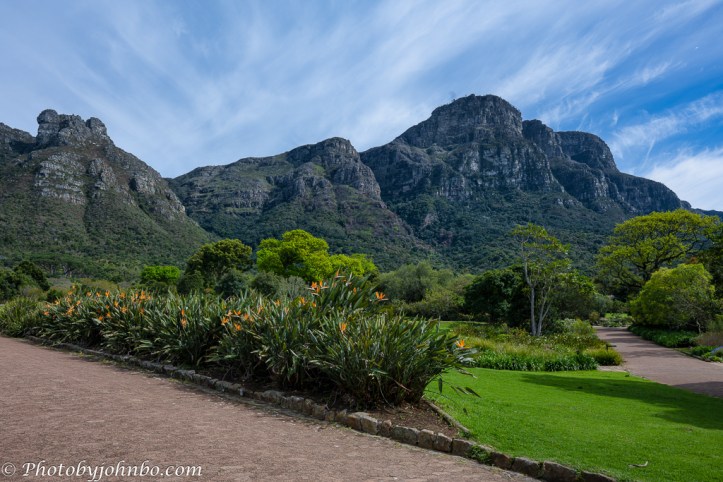
On our second full day of touring Cape Town, our guide, Dries, brought us to the world‑class botanical garden in the foothills of the iconic mountain. The day gave me my first opportunity to use the Nikon Z7 II for a full photo shoot, and both the camera and the garden brought out their best. Founded in 1913 to preserve the region’s unique flora, Kirstenbosch has grown into a world-class center for conservation and research. On this clear October morning, the spring weather gave us a perfect backdrop for exploring.

The Tree Canopy Walkway—affectionately known as the Boomslang (a tree‑dwelling snake) for its serpentine shape—opened in 2014 to celebrate the garden’s centenary in 2013. Designed to blend into the Arboretum, the steel‑and‑timber structure weaves through the upper canopy, giving visitors a rare chance to experience the forest from within. The gentle curves mimic the movement of a tree snake, creating an elevated path that opens up panoramic views of the forest below.

From the elevated curve of the Tree Canopy Walkway, Table Mountain feels almost close enough to touch. The bridge winds gently above the treetops, offering shifting views of forest, garden, and the rugged sandstone cliffs beyond.

The spring colors across the grounds were incredibly vivid. This field of African daisies (Dimorphotheca sinuata) offered a massive sweep of orange and yellow glowing in the morning light.

The bush lily’s (Clivia miniata) bold orange blooms are one of Kirstenbosch’s signature spring sights—a plant native to South Africa’s forested regions and long prized for its ability to thrive in deep shade. The clusters of trumpet-shaped flowers stood out brightly among the shaded beds. The rich hues were a perfect match for the then‑new Nikon Z7 II, which captured their depth and saturation with ease.

A nearby field of annuals created a vibrant foreground against the trees. The mix included blue Felicia daisies (Felicia amelloides), white Cape daisies (Osteospermum ecklonis), and the yellow‑orange tones of African daisies (Dimorphotheca sinuata)—classic spring jaarplante (annuals) that Kirstenbosch uses to deliver a variety of colors across its beds.

As we walked along the tree‑canopied Camphor Avenue, I happened to look up and see a Spotted Eagle-Owl completely unconcerned by our presence. Finding a Spotted Eagle-Owl roosting quietly in the tall trees above Camphor Avenue was an unexpected treat. It sat completely unconcerned by our presence, perfectly camouflaged against the branches.

Inside the Conservatory, the landscape shifts entirely to the arid-zone collection. The large, arching leaves on the right belong to a Krantz aloe (Aloe arborescens), while the rounded, glossy foliage on the left is a jade plant (Crassula ovata). In the foreground, the silvery mound is a cluster of Woolly Senecio (Caputia tomentosa), its pale color helping it reflect the sun in its native habitat.

The leaf belongs to a cycad (Encephalartos), its stiff leaflets spreading outward in a clean, geometric pattern that caught my eye as we walked through the Conservatory. Often mistaken for palms, these “living fossils” have been part of the landscape since the era of the dinosaurs.

Outside again, the path opened onto a small pond where a pair of Egyptian geese drifted along the edge while a trio on the bank debated whether they should get their feet wet. These birds are common across southern Africa, easily recognized by their chestnut eye patches and confident, upright posture. We ran into more of them on our way to the restaurant, where they commanded the full width of the sidewalk and left us to step politely aside.

The African coral tree (Erythrina lysistemon) is hard to miss when it’s in bloom—its bright red flowers standing out even at a distance. This species is native to southern Africa, where it’s valued both as a garden tree and as a natural landmark in the wild. The bright red blossoms appear before the leaves, giving the clusters a sharp, sculptural look against the bare branches. In this frame, a softly blurred background lets the color pop in the sunlight, turning a simple cluster of blooms into one of my favorite images of the day.

Nearby, a sour fig blossom (Carpobrotus edulis) caught the morning light. This hardy coastal succulent grows in sprawling mats, producing striking, daisy-like flowers through the warmer months. Up close, the bloom is all texture and light, a perfect subject as I was getting to know the new camera and its ultra‑sharp NIKKOR Z 24–120mm f/4 S lens.
When we first arrived, Dries mentioned that the garden offers guided tours led by volunteer docents. After checking at the desk, he was told to meet outside the Conservatory at the scheduled time, so we made our way there with about fifteen minutes to spare. We were the first to arrive, and a handful of other visitors gathered before the hour. When the docent didn’t appear, everyone waited patiently until a staff member let us know the guide wouldn’t be available after all. That may have disappointed some, but Dries simply shifted gears and walked us through the garden himself, answering our questions as we explored the paths that morning.

Even without the official guide, the garden was easy to navigate as the paths unfolded from one space to the next. The blend of cultivated beds and the dramatic rise of Table Mountain made the morning unforgettable. By the time we reached the restaurant, we’d gathered enough impressions for a full day’s visit, and the mountain backdrop made it all the more unforgettable.
But I digress… Now, for a true confession: I am a photographer, not a botanist. While I can tell a stunning landscape from a mediocre one at a glance, identifying the specific species of South Africa’s 20,000-plus indigenous plants is a different story altogether. To ensure I wasn’t just calling everything a “pretty orange flower,” I relied heavily on AI and digital field guides to identify the specimens in this article. I’ve done my best to be accurate, but if any of you have a greener thumb than I do and spot a misidentified succulent or a confused cycad, please let me know!
About the photos: I already mentioned the camera details—my full‑frame, 45.7‑megapixel Nikon Z7 II paired with the Nikkor Z 24–120mm f/4 S. This visit to Kirstenbosch proved everything the reviews promised about the camera-lens combination and its strengths as a landscape-photography kit. The camera handled every scene with ease, from wide‑angle garden views to close‑up textures, and the lens delivered the sharpness and contrast that made each frame a pleasure to work with later. I was still bracketing exposures at the time, but quickly learned that the sensor’s wide dynamic range made HDR processing unnecessary; I simply chose the best of the three frames and processed it in Lightroom Classic and Luminar Neo. Lightroom’s AI Remove tool came into play only a couple of times to clear small distractions. There are 29 photos in my Kirstenbosch Gallery on Flickr, where you can view the images and associated metadata in 2K HD here.
John Steiner.


😍
Just fabulous, John. I’d love to go there. Love the sour fig photo xx
That was a beautiful blossom. Thanks, Jo.
What a beautiful tour and collection of photos John. The spring flowers and sour fig especially caught my eye.
Thanks, Brad! It was a perfect day for visiting that magnificent botanical garden, being stood up by the docent not withstanding. >grin<
John, thanks for taking us along on this tour. What a beautiful place.
It is, indeed! It was a great time of year for the garden visit.
What beautiful gardens! The Boomslang walk looks great and I love all the flowers, especially the coral tree and sour fig 🙂
Thanks, Sarah! Spring near the Cape of Good Hope is amazing.
What gorgeous pictures.. Enjoyed seeing them. Judy Peterson
Thanks, Judy!
What a beautiful walk, John, especially along the Boomslang. You brightened my morning with amazing colors.
Thanks, Anne. That was a gorgeous garden, truly world-class.
Thanks for taking us there!
Lovely pictures, as always, but I mostly enjoyed your narrative again. Thank you John! pp
Thanks, Pam!
Wow! I can’t get over how beautiful the area is. The flowers, the gardens, and the views are breathtaking. Your photographs captured impressive sights.
I was so busy taking photos and enjoying the beautiful place. Thanks, Egidio!
Beautiful place, and great photos!
Thanks, Diana! It was hard to leave at our appointed time. It was such a beautiful day.