April 2025.
Kaua‘i, Hawai‘i.
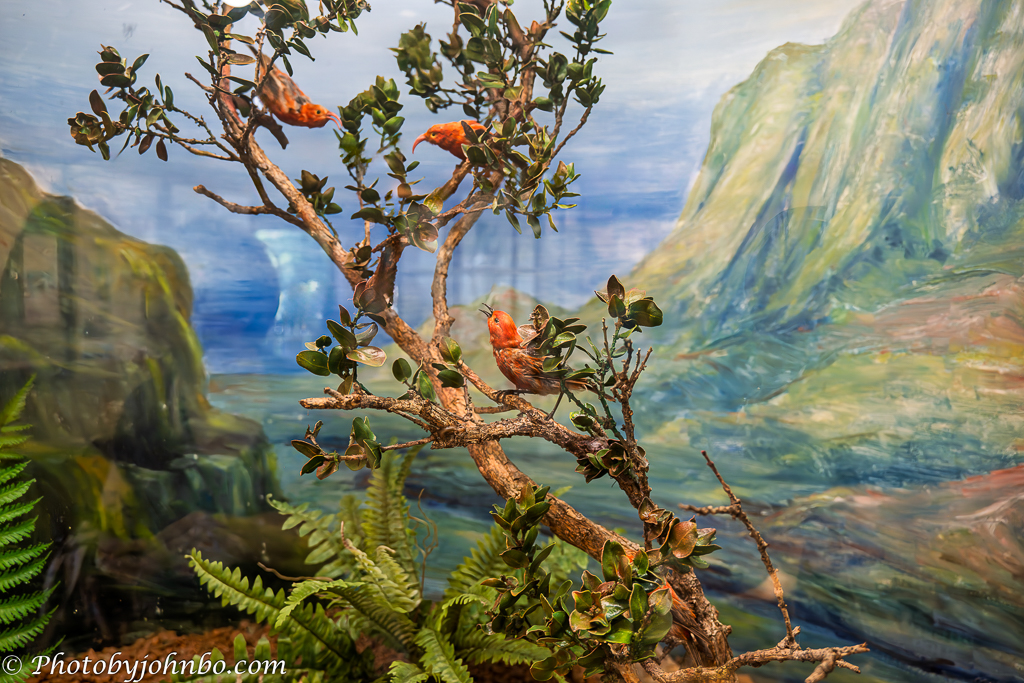
In an earlier post, I shared the journey on Waimea Canyon Drive and mentioned our stop and lunch at Kōkeʻe State Park and Museum. This post expands on our museum visit and shares some stories from Hawaiian history. Probably the most striking diorama in the museum features the ʻIʻiwi against a backdrop of Waimea Canyon views.
These brilliant red honeycreepers—ʻIʻiwi—are more than just eye-catching. Their curved bills evolved to sip nectar from native Hawaiian flowers with long, tubular blossoms—plants like ʻōhā wai and ʻākōlea—that once flourished across the upland forests, a relationship as specialized as it is fragile. Once abundant across the islands, ʻIʻiwi populations have retreated to higher elevations, where cooler temperatures help shield them from avian malaria, a disease spread by introduced mosquitoes. The museum’s diorama quietly underscores the ecological pressures these birds face. The painted ridges and layered foliage evoke the upland forests of Kōkeʻe, where the real ʻIʻiwi still flit among ʻōhiʻa blossoms, if you’re lucky enough to spot one.

The entrance provides a wealth of information: hiking trails, canyon maps, and even an AED for emergencies…. and the contact information on the large sign notes “CAR PROBLEMS / Call your rental agency”. That might be a problem, though. There are no public phones, and cell service was nonexistent for much of the Waimea Canyon Drive. The museum itself doubles as a kind of base camp for the park—offering trail advice, weather updates, and a dose of local history before you head into the wild. Operated by Hui O Laka, the Kōkeʻe Natural History Museum is open daily from 10 to 4 (except Christmas and New Year’s); while admission is donation-based, the insights are priceless. If you’re planning to hike, it’s worth stepping inside first.

One exhibit in the museum maps the global origins of birds introduced to Kaua‘i—some brought for aesthetic “ornament,” others for insect control or hunting. Among them are the Red-crested Cardinal, a South American native now common in Hawaiian gardens, and the Common Myna, a bold, vocal species introduced from India in 1865 to combat armyworms. The exhibit quietly invites reflection on how these introductions—intentional or accidental—have reshaped Kaua‘i’s ecosystems, often at the expense of native species like the ʻIʻiwi. It’s a compelling blend of biology, history, and a cautionary tale about the fragile balance of island life.

Having never heard of Queen Emma, I found the museum’s placards especially moving, given the deep affection the people of Hawai‘i felt for her. Born Emma Naʻea Rooke, she was a woman of remarkable grace and resilience. After the tragic loss of her young son and her husband, King Kamehameha IV, she sought a path of personal healing. In January 1871, she undertook an extraordinary trek into the rugged uplands of Kōke‘e and the Alaka‘i Swamp.

The museum’s display, subtitled “Traveler of the Mountains,” brings this journey to life. Accompanied by nearly one hundred followers, dancers, and musicians, the Queen braved misty ridges and fern-laced trails to reach the summit of Maunahina. One panel describes how she was so moved by the vista of the Wai‘niha Valley that she broke out into an impromptu hula performance—a spot now remembered as Hula Pili-kai. Her title, Kaleleonālani, was taken in honor of her departed loved ones, but it was here in the high forests that she demonstrated the strength that defined her reign. Today, her mountain pilgrimage is celebrated annually at the museum with hula and music, ensuring her legacy as a champion of Hawaiian health and spirit remains woven into the very landscape of Kaua‘i.

One exhibit introduced me to Laka, a deity of fascinating duality whose presence infuses the native landscape and the movements of hula. According to the museum display, Laka can be female or male, invoked as the “queen of the voice” in sacred chants, yet also honored as the “patron god of the hula.” Laka represents the reproductive energy that sustains the forest, embodying the life force of plants such as ʻōhiʻa lehua, maile, and lama. Hawaiians honor this spirit by asking permission before entering the forest or gathering greenery, recognizing the sacredness of the natural realm.
In hula schools (hālau), shrines called hula kuahu are adorned with forest plants that symbolize spiritual growth and connection. This sacred bond is rooted in deep history; while many modern visitors associate hula primarily with female dancers, ancient tradition identifies the dance as a rigorous religious practice often led by men. During a performance, the dancer and Laka become one: the dancer serves as the physical vessel—the body that is moved—while Laka provides the inspiration and the movement’s soul.
By the time we stepped back outside, the Kōkeʻe Museum had done what the best small museums always manage to do: it quietly expanded the world around us. What began as a simple stop for lunch became a window into Kaua‘i’s deeper stories—its birds, its forests, its queens, and the people who work to keep those histories alive. Each exhibit, from the brilliant ʻIʻiwi to Queen Emma’s mountain journey to the forest god Laka, added another layer to the landscape we’d been driving through all morning. It reminded us that these ridges and valleys aren’t just scenic—they’re storied, lived-in, and loved.
About the photos: I captured the images with either my Samsung S23 Ultra or my Nikon Z7 II, using the Nikkor 28-400/f4-8VR lens. Processing tools combined Adobe Lightroom Classic for cataloging and basic settings, and Luminar Neo for final touches. All images are available in 2K HD for pixel peeping or metadata checking on my Flickr site here.
John Steiner


Thanks for sharing your informative visit and beautiful photography with us John.
Thank you, Anne!
A fascinating glimpse into aspects of Hawaii’s history and ecology that I had never heard of – thanks John 🙂
It was an educational visit that entertained as well, Sarah! Thanks.
John, thanks for sharing this interesting Hawaiian history. I’m sorry I missed this museum when we were there.
Beth, that’s too bad. You’ll have to put it on the list when you next visit Kauai! I’d been on the Waimea highway twice before, and I didn’t know of this museum either until this trip.
beautifull 💯
It is, indeed, and so full of history.
That’s a very interesting post, learnt more about Hawai’i than I knew before. Lovely leading photo
Thanks, I.J.