January 2014.
Waddell, Arizona.
Note: We are traveling again with limited Internet access. Feel free to comment, but I may be slow to respond.
For over a decade, Lynn and I spent winters in a house in Buckeye, Arizona. We became avid hikers and enjoyed spending many miles hiking in the Estrella and White Tank Mountains, both within a 30-minute drive. Our favorite park became the White Tank Mountains Regional Park. The range gets its name from the “Tinajas Blancas,” the deep natural depressions in the white granite that collect and hold rainwater. Historically, these tanks were vital for survival in the desert, but they are completely dependent on the weather—during a dry summer, a natural tank can dry up completely. There was a time when the area was inhabited by the indigenous people, the Hohokam—”those who have gone”—who disappeared several centuries ago, leaving only petroglyphs as a trace of their existence.
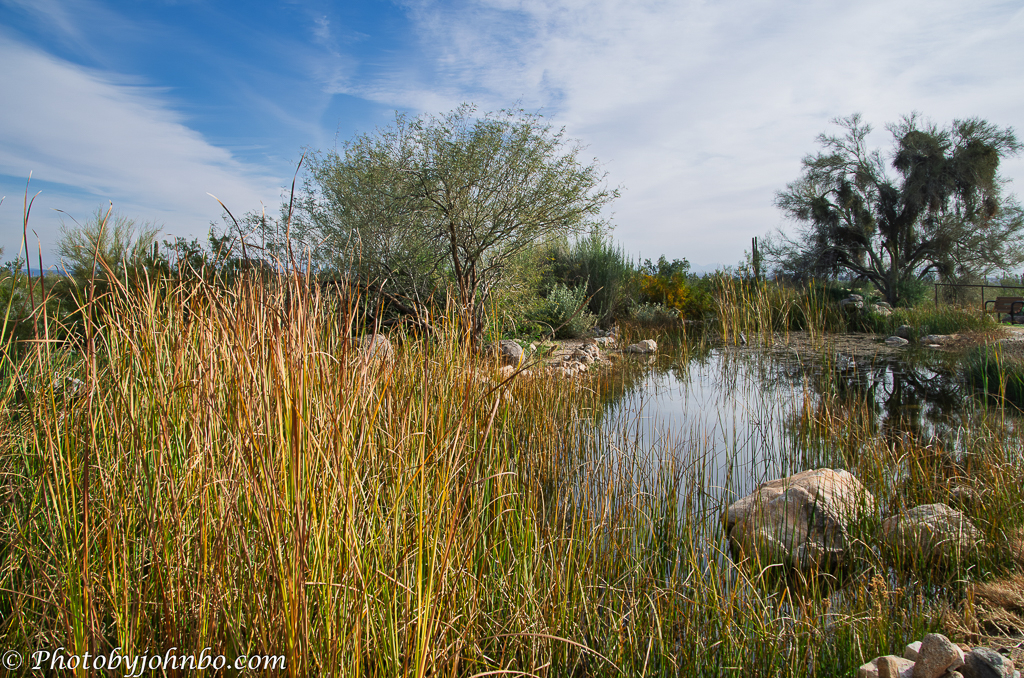
One of the park’s more popular trails is the Waterfall Trail, which leads to a natural waterfall and a typical tinaja. But its water source depends on the rains in the world’s wettest desert. It’s always had water in the tank when we’ve visited, but we’ve never been there in summer when the tank is only bare rock. When in the park, we often bypassed this trail and took other trails that led higher up and further into the canyons. On the trail map, the 0.2-mile (0.3 km) Wildlife Trail leads to the pond shown in the opening photo. For local wildlife, it’s a life-giving resource. Nearby, a 1930s-era windmill still stands, indicating that before this area was a park, this lowland water source, an underground aquifer, sustained cattle or other farm animals. Today, it is a “watering hole” for wildlife—javelina, mule deer, and other residents.

Stepping back and to the right reveals the secret behind why this water source doesn’t dry up in the heat of the summer. Behind that tree, there seems to be a small structure. Looking more closely, modern solar panels face south, aligned with the solar arc across the sky. It turns out the oasis uses a modern submersible pump powered by solar panels, hidden away to provide a year-round water supply for the local wildlife.
It’s a clever setup. We usually think of conservation as leaving nature completely alone, but here, a little human intervention is what keeps the habitat working. That little pump house is doing the work the “Tinajas Blancas” simply can’t do during a drought. It shows how modern tools can support the natural world, creating a dependable water source for animals when natural tanks fail.
About the photos: Captured in 2014, these were shot with a Nikon D7000 and a Tamron 18-270mm f/3.5-6.3 lens. For this post, I reprocessed the photos from the original RAW files using modern processing tools. Adobe Lightroom Classic’s workflow was simple—Denoise, Upright Perspective, and Adaptive Color Profile. Then, to Luminar Neo for a touch of Accent AI. The gallery is available in 2K HD with metadata on my Flickr site here.
John Steiner.


Where does the water come from for the solar pump to send water to that waterhole?
According to the White Tank Mountain Regional Park Master Plan, there is an active, deep well at that location. The 1930s-era windmill is actually marked by a working historic replica windmill that taps into this well to supply the small, constructed nature pond. During the driest part of the year, the solar-powered pumps keep the water level at the surface at a minimum level.
Thanks John. I thought it may have been a groundwater source.
I have friends who live in Wadell. I may need to get to this area to see this. Does the water come from the underground Agua Fria?
Yes, it does. I should have made that clearer in my text.
Stepping back and spotting the solar panels behind the tree is such a good reveal — I went in expecting a story about a natural tinaja and came out thinking about a little pump quietly doing the work the rock can’t do in a drought. That line about conservation not always meaning leaving nature completely alone stuck with me. Also, “those who have gone” for the Hohokam is a hauntingly good name to sit with.
Thank you! I waited too long to tell this story.
That’s a really clever and lowkey solution to helping the wildlife here. And like the previous commentator, I was struck by the name of the Hohokam: those who have gone 😔
Thanks, Sarah!
What a great piece of history and story of how we are currently helping natural areas to survive.
It is, indeed!
Great story to accompany these beautiful photos.
Thanks, Egidio!!
What a beautiful spot. Thanks for the photo and interesting information that goes along with it.
It is,, indeed! Thanks, Pepper!