This week, Beth looks back on a challenge I hosted in 2021 that I called “On the Water.” In her challenge, Beth writes, “For this challenge, I look forward to seeing your interpretation of ‘On the Water.) The water can be rivers, creeks, lakes, ponds, oceans, puddles, swimming pools, or water parks. Think about scenic views of water, people having fun on the water, watercraft on the water, macros of water drops, or animals, birds, and plants floating on the water.” You can view her challenge here.
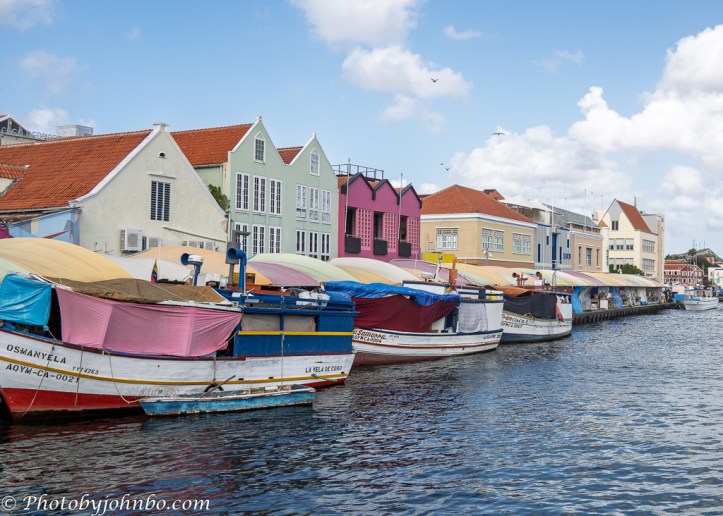
In her original response to my challenge, Beth focused on boats. I am turning the tables on Beth by focusing on working vessels for my response. This week I’m highlighting a range of working vessels—some small boats, some true ships—all of them busy with their own tasks on the water. The colorful boats in my opening photo arrive in Curaçao from the nearby Venezuelan coast, a short crossing that fishermen and produce vendors have made for generations. Once tied up along the Punda waterfront, the vessels become floating market stalls, selling fruit, vegetables, and fish directly from the decks or under the awnings on shore. Because this photo was taken on a Saturday, it reflects the lighter weekend turnout typical here—weekday mornings are when the market is at its busiest, with more boats making the trip and more vendors filling the quay. It’s a small‑scale but vital commercial route, and these boats remain an unmistakable part of Willemstad’s working harbor.

Many small watercraft are engaged in tasks for the public good, ensuring the safety of people and vessels in the harbors and waterways within their jurisdictions. This police boat was photographed in the waters of Tampa Bay, Florida, where marine patrol units regularly monitor traffic, assist boaters, and respond to incidents on the water.

As the Norwegian Star came into the harbor at Oranjestad, Aruba, a tugboat came alongside. The KTK Barakuda’s job that morning was to help guide the large cruise ship into position at Oranjestad’s cruise port. Like many modern harbor tugs, the Barakuda is powered by a pair of diesel engines delivering over 4,000 horsepower, giving it the strength to push and pull vessels far larger than itself with steady control.

I have shared many photos of the cruise ships I’ve sailed on over the years, but those ships need “care and feeding” from much smaller vessels. In most ports I’ve visited, when a cruise ship needs fuel, a tugboat pushes a bunker barge—a floating fuel tank—into position alongside the ship. The Zeta I, shown above, is a bunker ship: a self‑contained floating fuel supply that tied up next to our ship while we were docked in Aruba. In the background, another working‑boat crew is completing a containment ring around the bunker ship to ensure that any accidental spill is captured, protecting Aruba’s clear water and pristine beaches.

On a Panama Canal crossing in 2019, I spotted this bright orange‑and‑white ship, complete with a forward helicopter pad and a small crane in the low‑slung aft area. The Normand Reach is a special kind of working vessel, large enough to be classed as a ship. Its typical assignments involve offshore construction and subsea support work—tasks like laying undersea cables, deploying remotely operated vehicles, and assisting with deep‑water energy projects. It’s essentially a floating toolbox built for complex jobs far from shore.

On that same trip through the Panama Canal, about five minutes later, I saw this vehicle‑transport ship. The Höegh Traveller appears small in comparison to the Normand Reach, but that’s only a result of the distance between our ship and these vessels when I snapped the shutter. In reality, modern auto‑transport ships are enormous—floating parking garages capable of carrying thousands of vehicles across oceans. The Höegh Traveller is typical of the class, with a tall, box‑like profile and multiple internal decks designed for roll‑on/roll‑off loading. Up close, ships like this easily rival or exceed the length and height of many cruise ships.
That’s all I have for this week’s Look Back and my response to Beth’s challenge. With so many photos of boats, ships, lakes, rivers, and oceans in my archives, I knew I needed to narrow my focus. Working vessels come in countless forms, so I limited myself to three boats and three ships. For those who like to pixel‑peep or explore the photo metadata, my gallery of working vessels is available on my Flickr site here.
Thanks to Beth for this week’s Looking Back. Last week, I hosted “History Through the Lens” and was delighted by the many responses featuring historic sites from around the world. Thanks to everyone who participated. Next week, Ann‑Christine hosts; her challenge goes live on Saturday at noon Eastern Time. Be sure to follow her here so you don’t miss it.
If you’re sharing a Lens‑Artists Challenge response for the first time, welcome—we’d love to visit your post. To participate, publish your take on this week’s theme, link back to this page, and add the Lens‑Artists tag so others can discover your work. You’ll find more details on how the challenge works here.
John Steiner


The sea is full of various boats and ship’s and I am more drawn to the color of the water
Indeed, the water reflects the mood of the day in ways that draw out the emotions.
What a great assortment of ships and boats John! I loved all the color you captured.
Thanks, Anne! Fun reboot of the challenge!
😎
John, this is a great response to the challenge! I love all of these working boats. My favorites are the Venezuelan boats and the Police Boat. Living in an area with lots of waterways we frequently see law enforcement boats and Coast Guard boats on the rivers, especially on busy weekends. I really like the tugboat, too.
Thanks, Beth! It was fun looking for potential photos. All of these were freshly processed for the challenge.
Fun response to the challenge and collection of working boats, John.
Thanks, Brad!
So many different ships on the water! You really made it a gallery of sorts!
thanks, Ann-Christine!
Love your take on the challenge, John and my favourite this week is your opener.
Thanks, Sofia!
A clever idea to focus on working boats John. I really like the colours in your Venezuela shot!
The Nikon really nailed the palette of these colorful boats. Thanks, Sarah
I would love to ride on all of the above, but my favorite is definitely Höegh Traveller 🙂
That’s certainly one of the largest ships I’ve ever seen. It’s too bad there wasn’t another ship nearby to compare sizes.
This is a very interesting boat collection. Lovely photos! That Höegh Traveller looks so odd.
Those car carriers are floating boxes on the ocean. I’ve seen YouTube videos of them loading and unloading cars, trucks, and rolling construction equipment. It’s quite a dance.
Great look at the behind the scenes of cruising!! The opening image is beautiful
Thanks, Nora! The colorful buildings behind the boats add to the palette!
Beautiful collection of images John, I really like the tugboat!
Pam, those are some serious engines on a tugboat, and it’s a great-looking boat. Thanks!
Wonderful response John! Images are wonderful and I learned several new things – what could be better than that?!
Thanks, Tina!
John, thank you for taking me on a tour showing some boats going through the Panama Canal, I enjoyed learning a little about the job each one was responsible for. And the floating market area in Curaçao is so colorful!
Thanks, Sylvia!