May 2025.
Kaua‘i, Hawai‘i.
It’s been a year since we got off the airplane at Līhu‘e, Kaua‘i, Hawai‘i. We still have stories to tell about our stay on Kaua‘i. On our way to visit another attraction, we happened to drive by the entrance to the National Tropical Botanical Gardens near Po‘ipū Beach. Not sure what it was, we opted to take a look. In 2013, we visited McBryde and Allerton Gardens on a tour. We discovered that the garden entrance serves as the starting point for both self-guided and bus tours of the two gardens. As the bus tours were full for the day, we had to skip the entire garden tour, but we took a few minutes to explore the entrance site. I digress to this story from a year ago.
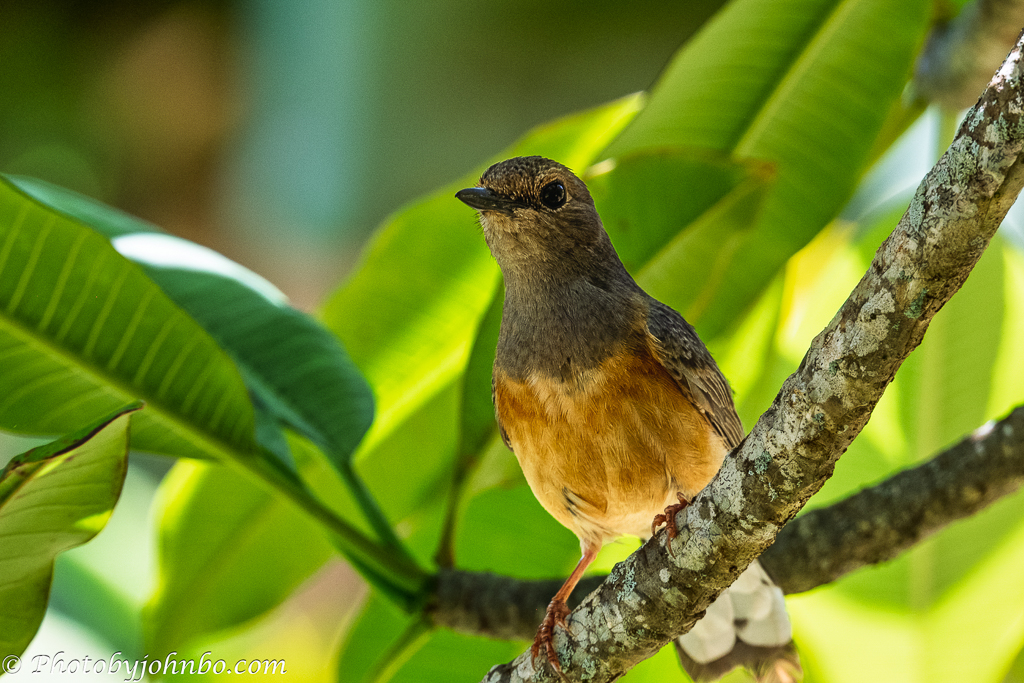
As I write this post, the day after our visit, and we prepare to leave Hawai‘i tomorrow, we’ll have to wait until we return to Kaua‘i for the whole tour. As we walked along the path, I spotted a bird in the shadows of a tree. I was busy getting ready to take a photo when another park visitor asked me what I was seeing. The bird in the shade was hard to see because of the strong backlighting through the trees. When she saw the bird, she identified it as a white-rumped shama and commented that it had a melodious, beautiful voice. Unfortunately, this bird was silent. I only got two photos before it flew away, so I’m opening this post with the better of the two.

I noticed these blossoms on a tree that I’d only learned about on a tour of a coffee plantation a couple of days ago. These hardy blossoms are commonly used in Aloha leis, the flower necklaces presented to visitors arriving at the islands.

Plumeria flowers come in a vast array of colors, from white and yellow to various shades of pink, red, and multi-colored combinations. This allows for colorful and vibrant leis. I didn’t know the name of the tree until I asked the tour guide to identify the tree that produced the white and yellow blossoms. I asked Google AI to confirm the species of the pinkish Plumeria Rubra.

As we walked the path, I noticed these two tropical plants. Google AI helped me identify them. I knew the plant on the left was a hibiscus by the distinctive red flowers. “It’s often referred to as Snowflake Hibiscus or similar names due to its leaves, which are heavily mottled or splashed with white, cream, or pale pink, giving it a predominantly white or light appearance.”
The plant on the right is a pink ball tree, also known as a Tropical Hydrangea. Their flowers are “pale pink, clustered in a somewhat pendulous, ball-like fashion, and are quite substantial.“

As we wandered through the garden path, I saw this beautiful tree with the vast Pacific Ocean in the background. According to AI, Rain Trees are large, wide-canopied trees with a symmetrical, umbrella-shaped crown, making them popular shade trees in tropical regions. They are common here on Kaua‘i. Although the flowers aren’t readily visible on this tree, when I examine a section of the tree at 200% magnification in Lightroom Classic, I can see the distinctive “powderpuff”-like flowers with pinkish-white stamens, which Google notes are typical of the Monkeypod tree.

I am sorry I didn’t take a photo of the beautiful flowers on this tree when I had the chance. I didn’t notice them until I started processing the image in Adobe Lightroom. This view is about a 200% enlargement.
Since this is being written in late May, it’s time to close this post. We have work to do. Our rental needs to be cleaned, towels and bedding washed, and prepared for the walk-through with our landlord before we head to the airport and home tomorrow.
John Steiner


Wonderful wander about John, thanks for taking me along
Thanks, Brian!
It looks like a magical place xx
Indeed! Tropical beauty on display.
Thanks for taking me back to Kauai John. Beautiful images, especially the bird.
Thanks you, Anne!
Thanks for another lovely tour John. My brief visit to Hawaii was amazing.
It is a beautiful state!
Agreed!
Lush and beautiful.
So true, Egidio!
So much beauty in this post! Great capture of the bird, and the flowers are fabulous.
Thanks, Beth. It was a beautiful day!.
Great pictures of the Plumeria blossoms, John. They are one of my favorites because of their appearance and their heavenly scent.