May 2025.
Kālaheo, Kaua‘i, Hawai‘i.
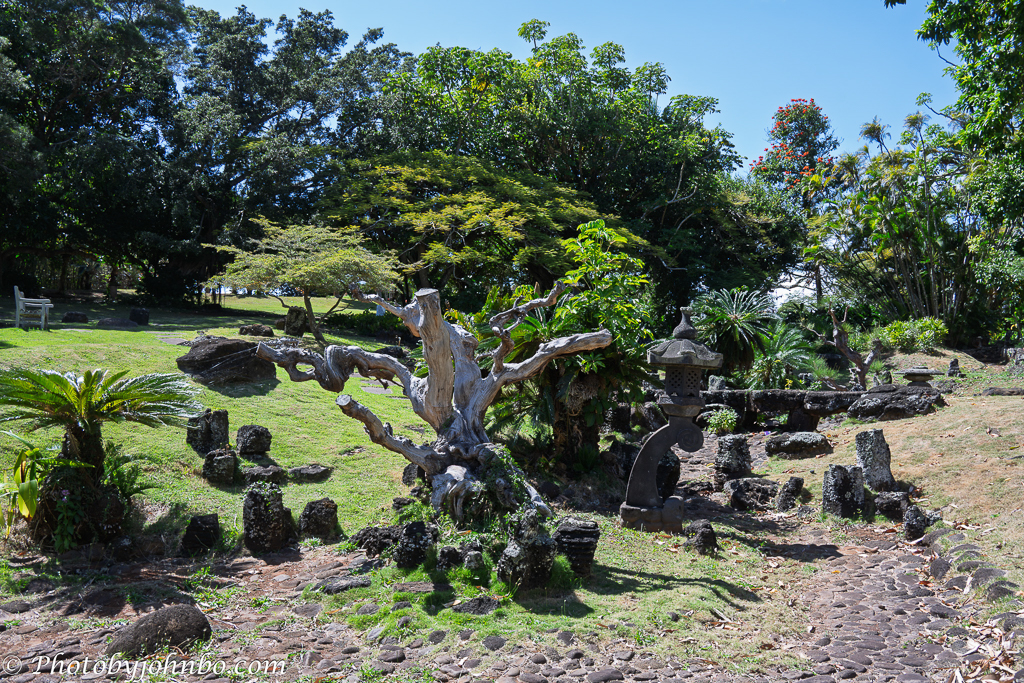
On Sunday, I shared a Cellpic Sunday photo featuring a path winding through Kukuiolono Park, hinting at where it leads. For today’s Tuesday Trek, Lynn and I follow that trail into a pair of gardens that blend traditional Hawaiian stonework with Japanese‑inspired design.
The small gardens honor both the Japanese influence that came to Kaua‘i in the late 1800s and the older island practices that long preceded it. Much of what stands here today grew out of Walter McBryde’s early 20th‑century vision for the park, later shaped and maintained by local volunteers who added Japanese‑style elements and preserved the Hawaiian stone features.

Unlike the Japanese gardens I’ve visited elsewhere—usually centered on water, koi ponds, and shaded walkways—Kukuiolono’s version leans toward a more traditional dry‑landscape style. Stones take the lead here, arranged in deliberate groupings that echo older Japanese garden traditions where rock forms represent mountains, islands, or guardians. The lanterns scattered throughout the space are tōrō, the classic stone lanterns found on temple grounds and in tea gardens. Paired with the surrounding tropical foliage, the stone structures blend traditional Japanese aesthetics with Kaua‘i’s natural landscape.

As we wandered through the Japanese garden, a small sign marked “Hawaiian Rock Garden” caught my eye. Following the short path, Lynn and I stepped into a quiet clearing where a collection of ancient stones sits with placards explaining their traditional roles in Hawaiian culture. Created during Walter McBryde’s stewardship and later expanded by community volunteers, the rock garden brings together eight culturally significant stones—each with a small interpretive plaque describing its use or meaning.
Pōhaku Hunaʻahuʻula carries a story of strategy and survival. Its name translates to “the hiding place of the chief’s feather cloak,” a reference to the prized ʻahuʻula worn by Hawaiian chiefs. In battle, capturing a chief and his cloak was like seizing the enemy’s flag. According to tradition, a chief and his men were on the verge of defeat when he hid his feather cloak beneath this stone, covering it with sweet potato vines to keep it from falling into enemy hands.

Another stone, also relocated from the McBryde estate, tells a story of conservation rather than conflict. Awa, a native fish able to live in both fresh and brackish water, once thrived in Nomilo Pond, drawing fishermen to its shores. After catching awa, fishermen stopped at Pōhakuawa and placed their fish in the freshwater held in this stone bowl. The next day, they carried the fish into the mountains and released them into a large stream‑fed pool to replenish the stock. It is a fascinating look at how traditional conservation practices helped sustain the island’s natural resources.

I’d be remiss not to mention the biggest draw to Kukuiolono Park—the four golf courses. Just beyond the parking lot, a hedge separates the fairways from the gardens. The park includes a 9‑hole regular course, a 9‑hole par‑3, plus both minigolf and disc golf, all of which attract far more visitors than the two quiet gardens.
Our favorite corner of the park’s 180 acres (roughly 73 hectares), though, is the restaurant near the golf facilities. Its location just minutes from our retreat meant we found ourselves at Paco’s Tacos Cantina several times for lunch—often enough that the wait staff began to recognize us as soon as we walked in.

Kukuiolono Park owes its existence to Walter McBryde, whose family estate once stretched across the surrounding hillsides. A plantation manager, philanthropist, and lover of Kaua‘i’s landscapes, McBryde developed the grounds as a place where workers and residents could find beauty and respite. After he died in 1930, the land was gifted for public use and eventually became the gardens, trails, and open spaces enjoyed today. A stone’s throw from the Japanese garden, a memorial wall marks his final resting place. Placed right near the Japanese garden, the memorial wall is a fitting tribute to the man whose original vision created these public grounds.
About the photos: After hearing about the park, I learned of the gardens and decided to bring the Nikon Z7 II with the Nikkor Z 28–400mm f/4–8 VR lens for an afternoon visit. The gardens were only a short walk from the parking lot, and I came away with eleven images worth processing. I edited all of them in Lightroom Classic with minimal adjustments—perspective alignment, denoising, and the Adaptive Color preset applied to the RAW files. Only two photos needed AI‑based distraction removal to clear small elements, such as a fallen palm branch, that pulled attention from the scene. The six images in this post, along with the full set from the visit, are available in my Flickr gallery here.
Note: We are traveling this week. I read all comments, but my response may be delayed.
John Steiner.


I absolutely enjoyed looking at those amazing gardens, John! Especially the Hawaiian traditions and Japanese design. 👍☺️
It is a beautiful and restful place to walk, or just sit and contemplate.
Exactly 👍
You weren’t wrong John, it is a fabulous place
I love this blend of Hawaiian planting with Japanese tradition in garden design!
It was an amazing discovery, though so typically Hawaiian.
Interesting about the more traditional dry Japanese gardens. I’ve only seen the lush kind with plants and ponds.
This was a first for me, too, Brad!
Traditional dry Japanese gardens are new to me and I’m glad to know about them. Thank you for expanding my world.
Thanks for taking the time to comment. They were a new discovery for me as well.
Beautiful gardens!
Thanks, Anne!
😎