May 2025.
Kālaheo, Kaua‘i, Hawai‘i
On our previous visits to Kaua‘i Coffee Company, we stopped at the museum and gift shop, always taking away some of their wonderful products—decaf for Lynn and bold beans for me. Until now, that was the extent of our experience: a quick browse, a few samples, and a bag or two to bring home.
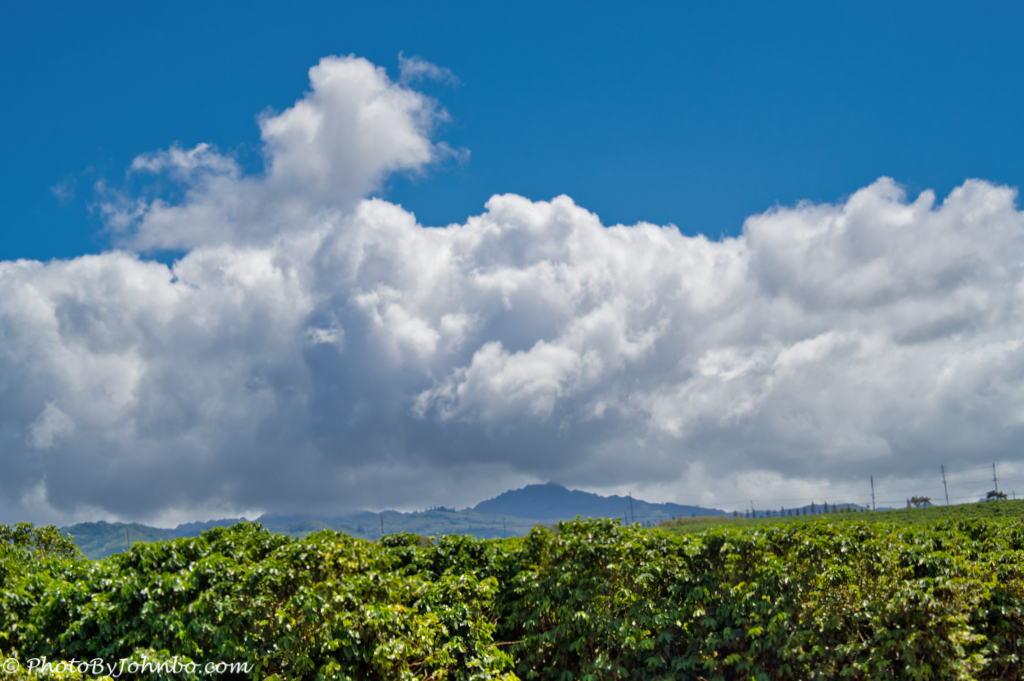
This time, we decided to go deeper. Kaua‘i Coffee offers a guided look at the plantation, beginning with a short walking tour near the visitor center and continuing with a curated bus ride through the fields. It’s a chance to see where those beans actually come from, how they’re grown, and what it takes to keep the largest coffee farm in the United States running day after day. With the weather cooperating and the clouds building dramatically over the mountains, it felt like the perfect day to explore the farm beyond the gift shop.

The tour began with a short walk around the visitor center, where our guide introduced us to the history of Kaua‘i Coffee and its place in Hawai‘i’s agricultural history. Truth be told, I didn’t always pay close attention to the narration. Plumeria bloomed along the path, coffee cherries hid among the trees, and there was plenty of space to wander while I captured quick photos. Even with my photographic distractions, I still learned how the company grew from a sugar plantation into the largest coffee farm in the United States.

Near the fence enclosing the area around the museum and walking tour, I spotted this rooster, an iconic symbol of Kaua‘i’s wandering fowl. Don’t get me wrong, there were plenty of real chickens around as well.

A little farther along the path, the focus shifted from artwork to agriculture. Clusters of green coffee cherries hung close to the branches, still weeks away from ripening. Up close, it was easy to see how tightly they grew together and how the leaves showed the wear of life in the open fields. This was the first real glimpse of the crop itself, a small preview of what we would see on a much greater scale once we boarded the bus for the field tour.

The walking tour set the stage by teaching some basic coffee facts before we boarded the open‑air bus for a closer look at the fields and the operations that kept the plantation running. The bus was big enough to hold the twenty or so people in our tour group, and I appreciated the open‑air “windows” that didn’t interfere with taking clear photos, even when my camera lens edged slightly past the opening. I also made sure to follow the safety warning to keep my hands and arms inside the bus at all times.

We soon found how vast the plantation really is. Stretching from the ocean on the south end of Kaua‘i, the estate covers roughly 3,100 acres (1,255 ha)—making it the largest coffee farm in the United States. Plants begin their life in the greenhouses, where young coffee starts are nurtured until they’re strong enough to replace older, declining plants out in the fields. The cycle of renewal and replanting continues, ensuring the farm maintains healthy, productive trees across its sprawling acreage.

It wasn’t long before we reached the heart of coffee production, the center of the plantation where harvesting and packaging converge. The farm is packed with modern gear, from tractors to the heavy-duty harvesting equipment you see in the photo above. During harvest, mechanical pickers move through the rows, harvesting cherries from acres of coffee trees and delivering them to this facility. From there, the cherries are pulped, washed, and dried before being roasted and packaged. Seeing the machinery up close gave me a better appreciation for the scale and coordination needed to keep an operation this size running.

From the outside, we could see how much emphasis the operation places on safety. Signs, railings, and clearly marked access points surrounded the processing buildings, reinforcing the message long before anyone stepped inside. This part of the plantation is where harvested cherries arrive during the season, and the equipment housed here handles the intensive processing stages that transform raw cherries into green coffee beans, ready for roasting. Moving from the rows of trees into this busy, safety‑focused area really showed how many moving parts it takes to keep the plantation going.

As we continued past the processing buildings, a sprawling monkeypod tree stood off to the side, offering a surprising burst of shade in an otherwise utilitarian corner of the plantation. It wasn’t part of the tour, but its broad canopy and sculptural branches caught my eye—a nice reminder that nature still holds its own, even in the middle of a working farm. It made for a quick snapshot as we returned to the museum.

At the far south end of the plantation, our guide made one final stop. The view suddenly opened onto the ocean, a sweep of blue that demanded its own photo before we headed back toward the museum and gift shop. The Visitor Center is open daily and offers complimentary tastings, a self‑guided walking tour, and scheduled guided tours throughout the day, all of which are detailed on their website here. It was a great way to wrap up the visit—taking in that expansive coastline view before heading back to the visitor center. Of course, we visited the gift shop, picked up some coffee, and even had it shipped home for free with a qualifying purchase. Too bad, right? We simply had to buy a little extra to enjoy after our return to North Dakota. >grin<
About the photos: All images in this post were captured with my Nikon Z7 II and Nikkor 28–400mm f/4–8 VR lens. This was the first time I processed an entire set exclusively in Luminar Neo. Given the bright, sunny day, I didn’t need Lightroom Classic’s superior noise‑reduction tools—or even Neo’s. Aside from cropping to highlight the subject, I didn’t rely on any of Neo’s generative tools to remove distractions. Along the way, I learned that Neo’s watermarking option—a layer that can’t be pre‑sized and must be positioned manually—is far less sophisticated than Lightroom’s watermarking in the Export panel. Neo also lacks Export Presets, making the workflow more manual overall. The experiment confirmed that while I appreciate Neo’s streamlined AI editing and masking, I’m not ready to give up my Lightroom subscription just yet. To view the photos in 2K HD or check out the metadata, visit the gallery on my Flickr site here.
John Steiner.


Your photos remind me of how beautiful and lush Hawaii is.
It is, indeed. No plans to return… yet we love Kauai… >grin<
Thanks for the tour John. We didn’t visit the plantation when we visited, so you filled in the gap.
Next time… it’s worth the stop when you’re on Kauai.
😎
How could you NOT buy some coffee? I did the same thing when we visited the tea farm in Japan not long ago, although I bought tea, not coffee. Sounds like a fascinating tour.
It was, and we enjoyed the coffee. So did our kids, though it was expensive, even with “free” shipping. >grin<