May 2025.
Līhu‘e, Kaua‘i, Hawai‘i.
While eating lunch with a view of Nāwiliwili Bay, a chance sighting of a lighthouse led us into an unexpected afternoon detour. It turns out this working corner of Līhu‘e blends a resort golf course, a busy shipping harbor, and the edge of the airport runway—all watched over by a pair of coastal beacons. As I mentioned in last Sunday’s Cellpic Sunday, I first spotted the Kuki‘i Point Lighthouse while we were enjoying a meal with a view of Nāwiliwili Bay. Aside from bridges, lighthouses are my favorite architectural subjects, so on a day when we were looking for something to do, we set out to see if we could visit one. That’s when I discovered that Kuki‘i Point isn’t alone—there’s a second lighthouse just a short distance away, and both are easy to reach for a close-up look.

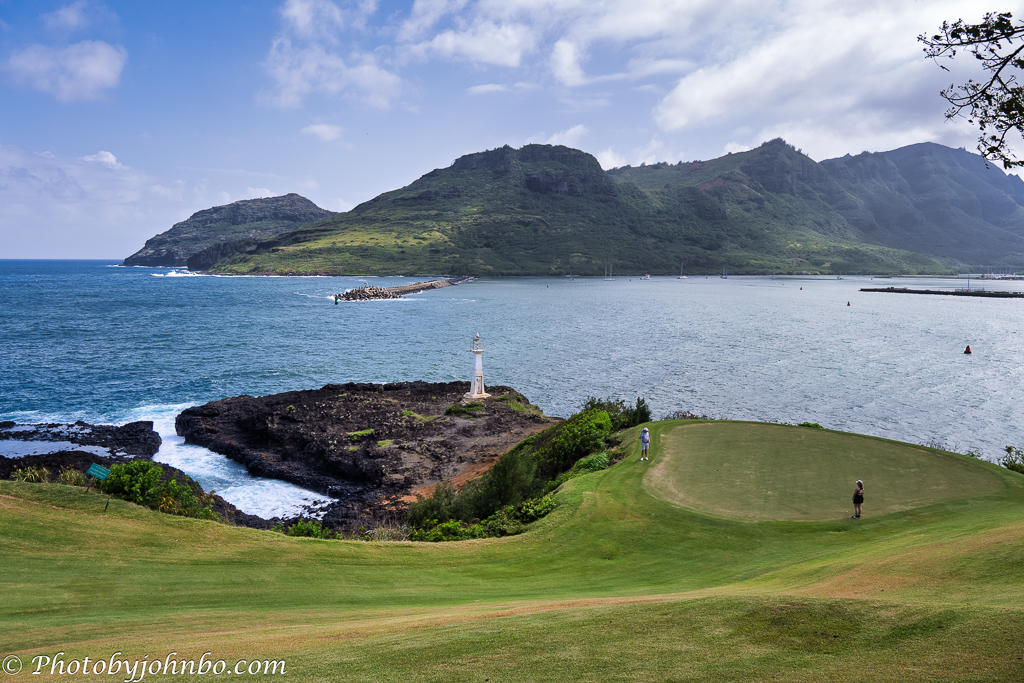
Passing through the gates of Timbers Kaua‘i, part of the larger Hōkūala resort development, we found ourselves driving straight through the Ocean Course at Hōkūala, the resort’s beautifully manicured links that wrap around the shoreline between Kuki‘i and Ninini points. The vibrant blues of the water against the deep green of the fairways made for an incredible backdrop as we drove through.

The resort paths are entirely open to the public. Clear signage pointed us toward a small public parking area set aside specifically so visitors can walk right up to the lighthouse.

Being careful not to interrupt the golfers—and keeping a sharp eye out for any unexpected projectiles—we stepped across the fairway toward the small beacon at the point. Up close, I learned that this structure is far more modest than the word lighthouse suggests. Standing only about 20 feet (6 m) tall, it feels almost ornamental, a simple navigational light mounted on a slender tower rather than the classic full‑scale lighthouse profile. Even at only 20 feet tall, the modest tower is fully functional, guiding boat traffic directly into the bay at night.

From my vantage point—fairway behind me and the small beacon just a few feet to my right—the view toward the mouth of Nāwiliwili Bay pulled my attention away from the golfers. For lighthouse enthusiasts, this spot carries a bit of history. Looking out at the mouth of the bay, there is a lot of maritime history; early navigational lights have marked this spot, guiding inter-island ships into port for generations.

The drive to Ninini Point wasn’t long, but it wasn’t on a paved thoroughfare either. Leaving the parking area, we passed the Kaua‘i Lagoons Marina and followed a road that turned unimproved somewhere near the fenced runways of Līhu‘e Airport. Though this stretch looks decent at first glance, there was a need for plenty of pothole‑dodging before we reached the lighthouse, which sits almost directly south of the airport. The unpaved road required plenty of pothole-dodging as it tracked the airport fence line, surrounded by thick vegetation and the bright red soil characteristic of the island.

The lighthouse grew steadily larger in the windshield as we approached. Our first view revealed the west‑facing side of the tower—a smooth, tapered concrete shaft rising about 86 feet (26 m). The concrete tower features clean Art Deco lines and narrow vertical windows. Up at the lantern, a metal shield blocks the light on the landward side—a deliberate feature designed to keep the rotating beacon from blinding pilots landing on the adjacent runway.

One of my rules when photographing a new location is simple—always look behind you. When I rotated 180 degrees, I found a cruise ship dominating the harbor, another reminder of the island’s deep connection to tourism. Norwegian Cruise Line’s Pride of America was docked at the Nāwiliwili Cruise Port, the only U.S.-flagged cruise ship offering regular inter‑island itineraries. Nāwiliwili also sees occasional visits from other lines—seasonal repositioning cruises and the odd one‑off itinerary—but Pride of America is the island’s weekly regular. I grabbed my cellphone, pinch‑zoomed to frame the floating hotel against the tropical greens behind it, and noticed the afternoon weather shifting. Mist softened the mountains, and low clouds began to gather, eventually bringing the rains that often sweep in from the interior.

Stepping a few feet to my right—and switching back to the Nikon—I got a sharper look at the cruise ship and its close relationship to the working cargo port served by Matson Shipping. There were no container vessels in port that afternoon, but on a typical day, you might see one of Matson’s blue‑and‑white ships offloading everything from construction materials to groceries to new cars. Standing by the Matson Shipping yard, the massive cranes and stacks of containers framing the cruise ship perfectly captured Līhu‘e’s intersection of everyday commerce and tourism.

Stepping to the south side of the lighthouse, I captured a view of the rugged shoreline at Ninini Point. The sound of waves hammering the rocks was nearly deafening, and from this vantage point, it’s easy to understand why mariners needed a light here. Hearing the waves hammer the rocks below makes it obvious why a light was needed here. Early inter-island steamships relied heavily on a fixed beacon to navigate the heavy swells at the harbor entrance.

I stepped around to the entrance of the lighthouse, where keepers once climbed the circular cast‑iron staircase that winds up through the hollow concrete tower. Before automation, tending the light meant daily trips up those stairs to clean the lens, refill the fuel, and later maintain the electrical equipment. This current tower was built in 1932 by the U.S. Lighthouse Service to replace a 1906 wooden-frame structure, though a simple beacon has marked this point since 1897.
Standing at the base of the tower with the surf pounding below and planes roaring overhead, it was a striking spot to end our hunt. These two lighthouses—one a modest modern beacon and the other a historic concrete tower—make a unique pair of guardians for the bay.
About the photos: Most of the images from this outing were captured with the Nikon Z7 II paired with the Nikkor 28–400 mm lens. The Pride of America, shot in Nāwiliwili Bay, was captured with the Samsung S23 Ultra. Though I photographed the scene with both cameras, I opted for the cellphone version—it had a more scenic, tropical‑destination feel, while the Nikon’s sharper rendering felt a bit too sterile for the mood I wanted. But don’t take my word for it. All of the photos in this post—including both versions of the Pride of America composition—are available in my Flickr gallery here. Post‑processing for this series was done primarily in Adobe Lightroom Classic, with a few finishing tweaks in Luminar Neo. Only a couple of images needed AI distraction removal.
John Steiner.


I’m so glad you added the rest of the story of the lighthouse, John. Your last image paints an entirely different picture of what I originally thought the lighthouse looks like from the distance versus your Cellpic Sunday image. 😉📷
Thanks, Donna!
Just beautiful in both images and narrative. I appreciate the research you do for each blog.
Thanks, Anne! I enjoy the process.
Envy!!
The scenery is fabulous, isn’t it? Are golfers blind, do you suppose? And I’m sorry but that cruise ship is a blot on the landscape for me. Great photos, John xx
Great view wow!
Thanks!
This looks like a beautiful trip. The storytelling is excellent. Hope to see Hawaii next year.
Thanks! Safe travels!