February 2026.
West Bay, Grand Cayman.
Last week, our tour of distilleries concluded with a short ride along the western coast and continued north into West Bay, the district that occupies the island’s northwest region. This began our journey into Hell, a tiny but famous geological site with its own postal drop. Part natural phenomenon and part tourist attraction, the name reflects a rugged geologic outcropping that is rare on the island.

As we stepped off the bus, our guide pointed us toward the fenced viewing area at the back of the surprisingly small property. Walking past the big red gift shop, I paused for a photo—already suspecting that before we left Hell, we’d make the classic tourist’s final stop: the obligatory walk through the gift shop.

There are two small platformed viewing areas, and since most of our tour group headed for the closest one, I took a few extra steps to give myself better camera angles. Of course, that meant missing part of the guide’s narrative—something that happens more often than I’d admit. I can always research the details later, though sometimes that independence comes at a cost. As it turns out, the unique geology here deserves a much closer look than a quick glance from the platform allows.

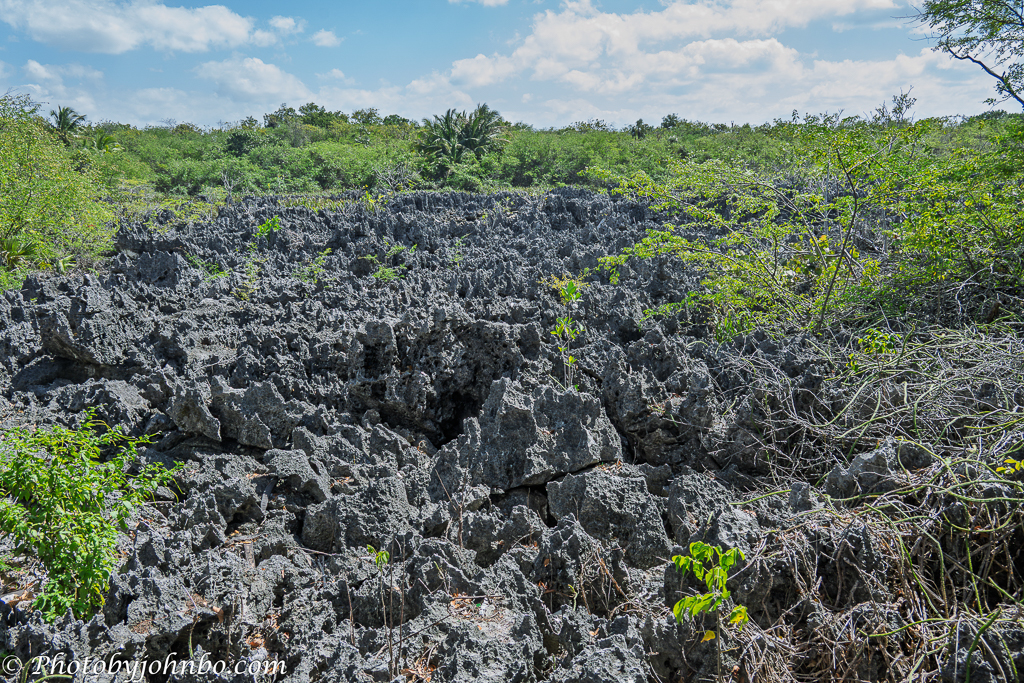
From the platform, the first thing that stands out is the sheer roughness of the terrain. The dark, jagged limestone stretches out in a chaotic pattern, broken only by pockets of hardy vegetation clinging to the rock. What looks at first like volcanic debris is actually ancient limestone that has been weathered into sharp ridges and cavities over thousands of years.

A closer look reveals just how intricate these formations are. The limestone has been carved into sharp ridges, pockets, and needle‑like points by centuries of weathering in the island’s tropical climate. Up close, the tiny cavities and thin edges reveal the slow, persistent work of erosion, leaving a texture that feels both fragile and impossibly rugged.

Geologists classify this formation as phytokarst, a type of limestone weathered into jagged shapes over centuries. The island’s tropical rain, slightly acidic from carbon dioxide, slowly dissolves the rock, creating those sharp ridges and needle-like points. This slow, chemical carving leaves behind a terrain so otherworldly that even Lucifer feels right at home among the rough edges.

Of course, you can send a postcard from Hell if you buy it inside the gift shop along with a legal Cayman Islands postage stamp. The Hell Post Office is an official branch of the Cayman Islands Postal Service, meaning that battered, flame-painted mail drop is far more than a tourist prop. Once you’ve penned your greetings, the staff applies the coveted “Hell” postmark right there in the complex before a regular mail carrier whisks it off to the main processing center in George Town. One practical note: only Cayman Islands stamps will get your card on its way, so buy yours before you drop it in. It’s a seamless hand-off from the “postal demons” to the local authorities, ensuring your “Wish You Were Here” reaches its destination with the official stamp of (un)approval.

Our half‑day excursion concluded with a slightly different route back to the ship, taking us along the coast and through George Town proper. The drive back through George Town stitched our shore excursion together, offering glimpses of everyday island life before delivering us back to the ship. It was a good reminder that travel rarely follows a single theme—sometimes the sweetest spirits and the sharpest rocks end up sharing the same afternoon itinerary.
About the Photos: All images were captured with the Nikon Z7 II and the Nikkor Z 28–400mm f/4–8.0 VR lens, then processed in Adobe Lightroom Classic. I start with Lightroom’s Denoise whenever the ISO is above 125, though it’s seldom required for images at ISO 1,000 or lower on the Z7 II. Adaptive Preset is something I try on most photographs, though it sometimes misses the mark. If necessary, I set it back to the standard Adobe Profile and head over to Luminar Neo and Accent AI, especially if the foreground needs a lift and requires more than a simple selection mask in Lightroom.
John Steiner.


There are parts of that limestone where it also is being eroded from the bottom by seawater entering from underground fissures, and if you hang around during high tide, you can supposedly see the water level rise in those areas even though you aren’t directly on the beach.
That’s a tidbit our guide didn’t mention.
I was surprised to read that this is weathered limestone as I would have assumed that it was lava from a volcano – how interesting! But like you I often find myself wandering off to take photos and missing a guide’s talk. After all, as you say, you can usually research the sight later but you will probably never be there again to take photos!
I thought lava, but seeing it close did tell me it wasn’t quite the same. Thanks, Sarah!
John, thanks for taking me to Hell. It’s one tour we missed on our visit. Now I didn’t miss it!! Great photos,
Glad to help, Anne! 😃
😎
What a fascinating post! I liked the info you shared here with us. Somehow, I keep thinking I’ve seen something similar in Texas, but not quite that large as the area you photographed.
You made me look it up. >grin<
From Copilot: Edwards Plateau, Texas — Extensive karst with pitted, eroded limestone outcrops similar in process (though not as blackened).
What a fascinating account of Hell in Grand Cayman! The vivid descriptions of the unusual limestone formations and the story behind the famous post office make this a delightful read. I especially enjoyed the blend of geology, local history, and travel humor. A memorable stop on any Cayman Islands visit! 📸🌴
Thanks, RNP!