January 2026.
Tucson, Arizona.
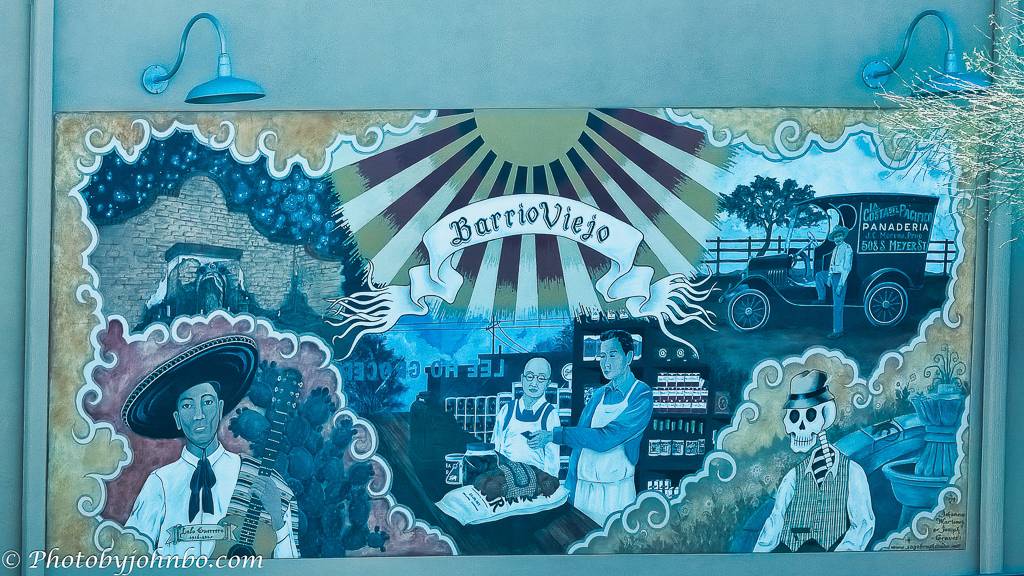
The mural on the Tucson Small Business Center makes a fitting introduction to Barrio Viejo—an illustrated reminder that this neighborhood carries more than a century of stories in its adobe walls. Located just south of downtown, Barrio Viejo holds one of the largest surviving collections of 19th‑century adobe homes in the United States. Its roots run deep into Tucson’s Mexican and Indigenous heritage, and the streets still reflect the character of an earlier city: low‑slung buildings, vivid color, and long shadows cast by the desert sun.

We parked on Meyer Street and were immediately drawn to a bronze statue standing at the corner of W Kennedy Street and S Meyer Avenue. The figure—Aztec Emperor Cuauhtémoc—stands with a raised shield and an extended arm, a symbol of resistance and perseverance. Sculpted by Indigenous artist Luis Mena, the statue was intentionally placed here, marking a quiet corner of Barrio Viejo with centuries of cultural memory. I took a few photos, but the afternoon sun created lens flare across the frame. On our way back, with the sun tucked behind the building, I captured this clearer image: Cuauhtémoc poised against adobe walls and bare branches—a sentinel watching over the neighborhood.

At first glance, the shuttered window on 432 Meyer looked like a privacy screen over glass. But the next building down revealed something more: the shutters were open, and behind them, a quiet courtyard came into view. I suspect the first building hides a similar space—tucked behind adobe walls, just out of sight.

What I noticed most was the wide variety of treatments on the doors—some like this historic look, others more modern, colored in traditional Southwestern hues, or finished with unexpected textures and details. Each one seemed to reflect a different chapter in the neighborhood’s story. Some were weathered and quiet, others bold and freshly painted, but all felt intentional, as if chosen to match the rhythm of the street and the character of the building behind them.

As we turned the corner and crossed Kennedy Street, I noticed that not all the buildings looked freshly stuccoed and painted. This section of the neighborhood shows its age. The stucco is cracked, the paint faded, and the windows covered in mesh. It’s a subdued stretch, less curated, but still part of the story—one told in wear and texture rather than color.

Turning another corner onto Convent Avenue, I was surprised and delighted to see a couple of historic automobiles. The yellow Barracuda has historic plates; the white Plymouth has standard Arizona plates, telling me it might be a daily driver. These first‑generation Barracudas, built from 1964 to 1966, are known for their distinctive wraparound rear glass—the largest ever used on a production car at the time. It’s not something I expected to find parked in a quiet Tucson neighborhood, but it felt right at home.

As we concluded our walk, we came upon the Carmen Theater. The historic building directly behind the van with the open hatch proudly carries the year it was built—1915—beneath its name. At first, I was disappointed to see a car parked in front of the building, blocking a clean shot. I considered waiting, hoping the person with the open hatch was making a quick delivery. As it turned out, behind that vehicle, artist Barbara Mulleneaux was busy creating the painting I featured in Sunday’s Cellpic Sunday post.
Teatro Carmen isn’t just a historic landmark; it’s also the focus of an ongoing restoration effort. A local arts group is working to bring the 1915 theater back into use, with funding already secured for structural repairs and façade work. If the project moves forward as planned, the building will eventually reopen as a small performance venue, returning a piece of Barrio Viejo’s cultural history to active life.

As we approached our car, I spotted one more adobe building with a tiled entry and twin yellow doors. It was a quiet reminder that Barrio Viejo’s 19th-century roots still hold their place, even as modern Tucson rises around them. Overhead wires, a rental scooter, and the downtown skyline all framed the scene—proof that this historic neighborhood lives alongside the present, not apart from it.
About the photos: All images were captured on my Samsung S25 Ultra using the Expert RAW app. This was the first time I photographed an entire series in Samsung’s RAW format, allowing full access to the camera’s dynamic range during processing. Edits were made in Adobe Lightroom Classic and Luminar Neo, with some distraction removal powered by Adobe’s AI in Photoshop 2026. The full gallery, including metadata, is available on my Flickr site here.
John Steiner


John, I love these adobe buildings and those two classic cars. My favorite is the closeup of the door.
Thanks, Beth! It was a beautiful day and a truly photographic journey.
That looks an interesting area for a wander – I do like the adobe buildings 🙂
A historic walk on a beautiful Arizona day, it was. Thanks, Sarah.
John, thank you for this rich cultural presentation. The town seems part of its history with great pride and respect for the past. The 1964–66 Twin Plymouth reminds me of movies from that era…with fond memories. Thank you!
It is a worthy stop for those interested in Southwestern history.
Most excellent. Thanks again John.
John, I loved this post and the neighborhood you featured.
Thanks, Anne!
😎
This was interesting and fun to see what caught your eye, John. I can see the seediness in the area judging by the chain link fence, but the stucco buildings and other treasures look inviting enough to check out. Your last pic of the white building with modern Tucson looming along with the rentable scooter show many contrasts.
Thanks, Terri. It’s a nice walk on a sunny winter or spring day.
Great storytelling with each block adding to the story. There’s something so soothing and so simple about adobe architecture. The old Plymouth Barracuda was a great find.
Thanks, Dan! There are so many stories in the barrio and so much history.