October 2024.
Rotterdam, Netherlands.
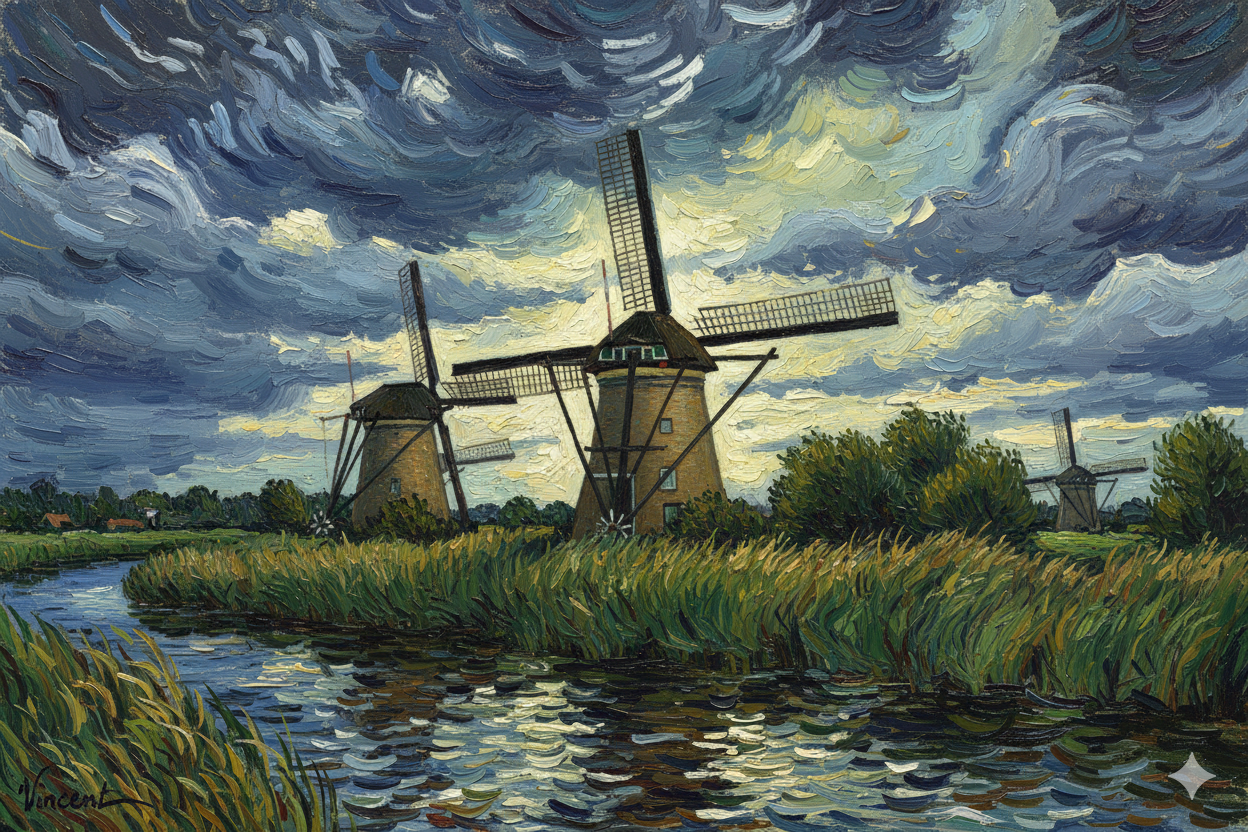
Our one full day in Rotterdam was punctuated by a Viator walking tour of the city, along with a visit to Kinderdijk, which I’ve previously featured here. For this post, I’ve chosen an experimental opening image: a photo I took at Kinderdijk, reimagined through Google’s Nano Banana filter to evoke the brushwork of Vincent van Gogh. The result captures the spirit of the Dutch landscape in a way that feels like Van Gogh might have interpreted the scene. I thought it was a way to bridge 18th-century windmills with 19th-century brushwork using 21st-century tools. One of the first things our guide clarified—something I’d long misunderstood—is that the Netherlands is the country, while “Holland” refers only to two provinces: North Holland, home to Amsterdam, and South Holland, where Rotterdam stands.

After a short walk from the Hotel New York, we boarded a metro with our tour guide, heading toward the business district and our first views of the city reborn. The RET system—Rotterdam’s efficient and well-integrated public transport network—whisked us from the waterfront into the city’s core. Sleek silver trains with red and blue accents glided into modern stations, their design echoing the city’s preference for clean lines and practical elegance. Rotterdam Centraal, the main terminal, was our destination. In that short ride, we witnessed the choreography of daily life in a city built for the 21st century.

Emerging at Rotterdam Centraal, the city’s sleek central terminal, we stepped into a space that felt like an entrance to a modern European city—its overhanging roofline and glass façade echoing the city’s commitment to bold, functional design. Across the boulevard at Weena 505, a striking black-and-white mural stretched across the building’s side, responding to the terminal’s steel geometry with artistic expression.

Rotterdam, like much of the Netherlands, is built on lowlands and canals that provide both beauty and necessity. As we continued our walking tour, we paused along one of these serene waterways—a mirror of sky and steel framed by leafy branches and bicycle rails. Flanked by a mix of modern and older buildings, the canal reminded us that beneath the city’s bold reinvention lies a centuries-old relationship with water. Bridges span these arteries linking neighborhoods and eras. Our guide noted how Rotterdam’s urban planning reflects its maritime heritage.

The Gothic spire of the Laurenskerk (Saint Lawrence Church) rises defiantly above a city reborn, its stone silhouette anchoring centuries of resilience. Just steps away, glass-clad towers and sleek façades reflect a future built atop the ashes of destruction. This juxtaposition is no accident: the Laurenskerk, the only medieval structure to survive World War II’s bombings, now stands beside bold, modern architecture that tells a story of reinvention. Throughout our tour, our guide revealed how Rotterdam refused to vanish—choosing instead to rebuild with vision, daring, and design.

A five-minute walk brought us to this imposing building—Rotterdam’s City Hall—one of the few structures to survive the devastating bombings of 1940. Its ornate façade, crowned by a central clock tower and flanked by arched windows and stonework, stands as a testament to the city’s pre-war grandeur. You can see our guide speaking to the group by the lamppost, offering context on how this civic landmark endured while much of the surrounding city was reduced to rubble. To capture the full breadth of the building, I stepped across the street and took five vertical slices, later stitching them into a panorama using Lightroom Classic. Because the final image wasn’t perfectly rectangular, I asked Nano Banana to extend the sky—filling in the dramatic clouds and matching the light in the Z7 II image that framed this monument to resilience.

As we walked east, this striking building blocked the morning sun, allowing my camera to capture the details of its unique structure. Locally known as “The Pencil,” the Blaaktoren rises like a sharpened tip above the plaza, its conical roof and cylindrical base giving it a whimsical silhouette. Designed by Piet Blom in 1984—the same architect behind the neighboring Cube Houses—it reflects Rotterdam’s postwar embrace of playful modernism. Red balconies wrap around its geometric façade, echoing the modular rhythm of Blom’s urban village concept. Though residential in function, the building’s theatrical form makes it a visual landmark, anchoring the eastern edge of the city’s architectural experiment zone. I featured a story about the Cube Houses in an earlier post here.

The Witte Huis (White House), completed in 1898, stands as Europe’s first skyscraper and one of Rotterdam’s few architectural survivors of the 1940 bombing. When the Luftwaffe devastated Rotterdam’s historic center during the Rotterdam Blitz, the Witte Huis endured, scarred but standing, its bullet-pocked façade a quiet testament to resilience. To the left, the Willemsbrug (Williams Bridge), a striking red cable-stayed bridge completed in 1981, links the city center to Noordereiland and Feijenoord. The old merchant dwellings and warehouses that survived, or were rebuilt after the war, have been converted into trendy cafes, bars, and restaurants.

Near the building known as The Pencil, this large structure, comprising residences and a shopping mall, reflected the morning sun onto the street below. Known as the Markthal, it features a dramatic grey-stone-and-glass arch that houses apartments along the curve, while beneath the soaring interior, a bustling market unfolds. The transparent façade acts like a lens—drawing in light, color, and movement from the plaza outside. The cafés and restaurants inside spill out onto the square, where we marveled in the sunlit glow of another iconic example of modern architecture.

As we stepped inside, the ceiling exploded into a kaleidoscope of fruits, flowers, and insects—a massive digital mural that hovered like a surreal sky above the market stalls. It was part gallery and part grocery. As it was early, only a few shops were open, and visitor numbers were sparse. We found an open coffee shop and paused for hot coffee and a light snack, savoring a moment of rest from our walking tour.

As our walking tour came to a close, we found ourselves in a quiet plaza framed by high-rise buildings and autumn trees. Sensing our fatigue, our guide took pity on us—rather than sending us on a long walk to connect with public transportation to Kinderdijk, she arranged a vehicle while we waited. We traveled by car to the final attraction of our tour, grateful for the reprieve and the chance to reflect on all we’d seen. I’ve tried to capture the spirit of a city that continues to reimagine itself—layering resilience, innovation, and beauty in every corner. For those curious to explore further, additional photos from our Rotterdam tour, including 2K HD versions of this gallery, are available on my Flickr site here.
About the photos: All photos in this gallery were captured with my Z7 II with the Nikon 24-120 mm Z-mount lens. Adobe Lightroom Classic was used for basic adjustments, and most photos were transferred to Luminar Neo for the final touches. As I mentioned in the text, two of the images were then processed in Google’s Nano Banana as an experiment. I leave it to you to judge whether the edits were successful.
John Steiner


All beautiful images, John. The architecture is amazing. 😊
Thanks, Pepper! The city has truly been reimagined in architecture.
Wonderful description and pictures John! Incidentally, I was in Rotterdam over this Easter but I think I missed a lot of wonderful spots. For instance, I was on my way to the Hotel New York, but then felt super cold on the bridge and completely forgot why I was going over that bridge and turned back midway! Here’s a bit about my exploration 🙂 – https://reflectionsontheriver.wordpress.com/2026/04/09/a-day-in-rotterdam/
PR, I see from your post that you visited several places we saw on our guided tour. Rotterdam is a beautiful city.
Great! Yes, it is a nice city.
What a wonderful tour John. I especially enjoyed the buildings like Pencil and Markthal, and canals. Now, I want to visit.
I found the city to be fascinating, and the trip to Kinderdijk to be icing on the cake!
It’s very interesting to see the mix of modern and a few older buildings here. Some of the modern architecture is very striking. I was intrigued by the Markthal in particular. Do the residents living in the apartments have some windows on the market side, opening through that colourful ceiling to the market below?
I think some residents do. The shots I took of the cubes were from the center courtyard that I believe all residents can see. The windows on the opposite side of the cube should show exterior city views in whatever direction they are facing.
What an amazing city John! Thanks for the tour and history. It is beautiful.
Indeed, it is. I’m looking forward to visit Amsterdam this summer for a similar tour.
😎
Thanks for sharing this wonderful visit and beautiful photos. The featured image is a fantastic edit!
Thanks, Egidio! It was a wonderful tour topped off by a knowledgeable and friendly tour guide.
What a lovely tribute to Rotterdam John. I was never impressed with the town, mainly because of the modern centre before they developed the architectural renewal. But when I saw the skyline on a morning from a hihg rise at the Maas, overlooking town in the fog, i understood what they were doing and was impressed. Thanks for the lovely photos and attention you gave to this remarkable city with remarkable people.
Rotterdam shows the resilience of the people who live there, and their willingness to break the mold in reimagination.
Thanks, Chris!
Oooof! Where to begin. First, your shots, as always, are stunningly perfect. I like the header shot – Kinderdijk reimagined – and the Van Gogh-style brush strokes. Gosh, I wish you lived nearer (and taught classes) – I’d be registered for sure! Not being able to travel, your beautiful essays and accompanying photos are almost as nice as being there myself. My favourite of these is the “Urban Canal” shot. I could imagine floating along it on a tour…
Such great work John, especially your writing, and thank you for sharing this with us. pp
Thanks for the kind words, Pam! I enjoy seeing old places renewed. This summer, I plan a similar tour of Amsterdam.
Very cool technique used with that first photo! Just love the moodiness.
Thanks, Linda! I was surprised how the AI captured the style of the old master in my photograph.
Strange though they are, I kind of like the pencil building and the giant arch building. Also, thanks for clarifying the difference between Netherlands and Holland – I didn’t know this either.
Thanks, Diana. They have some fascinating architecture.
Great architecture photos and I love the windmills
Rotterdam is a beautiful city!
Definitely a city that looks to the future. I enjoyed walking with you, John xx
Thanks, Jo!
[…] Around that time, Google’s Nano Banana AI Illustrator was getting a lot of press. It occurred to me that I could take the photo of the three windmills a step into artistic interpretation. I decided to test Nano Banana. My goal was simply to let AI stylize the photo as if it were a Van Gogh painting. My first prompt referenced the photo of the three windmills I uploaded and asked it to edit and modify it in the style of Vincent Van Gogh’s work. Astonished by the result, I used this stylized version as the lead image for my post on Rotterdam here. […]