February 2026.
Tucson, Arizona.
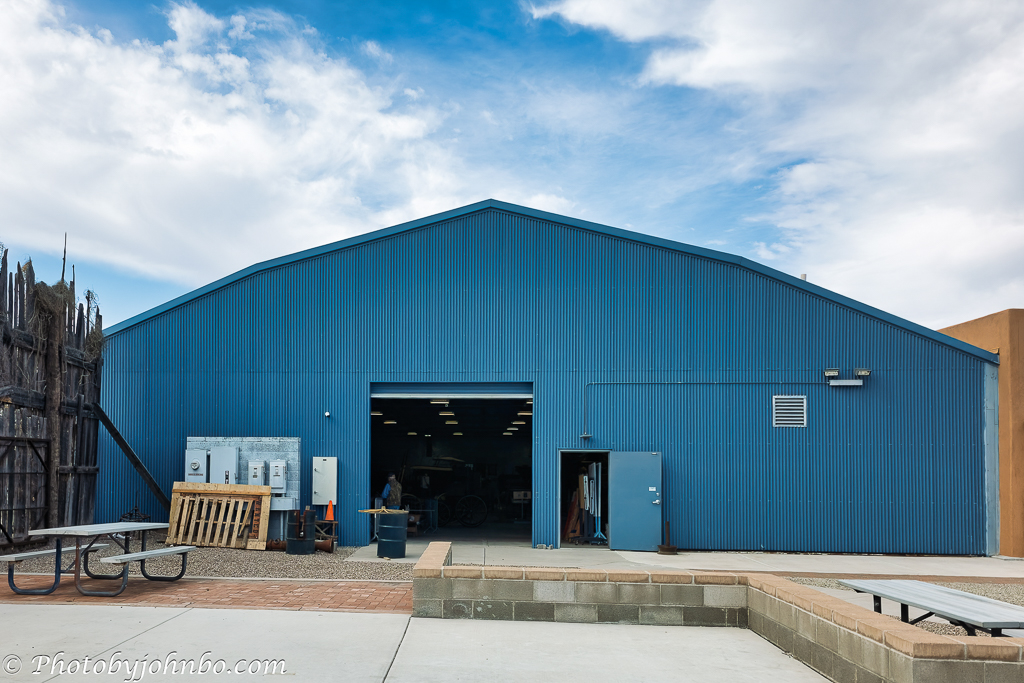
Despite its plain, utilitarian look, Hangar Number One carries a remarkable distinction. This unassuming metal building is widely recognized as part of America’s first municipal airport, built at a time when cities weren’t yet in the business of running airfields. Military posts and private companies already had their own hangars scattered across the country, but a city‑owned airport was something entirely new. Tucson stepped into that role early, and this structure—now housing museum artifacts—was the first shelter built for the city’s pioneering field. A century later, it’s a survivor from the very beginning of city‑owned airfields, its history sitting right out in the open.
It was 1916, and Pancho Villa’s gang was raiding the Arizona Territory. The military had been using Curtiss JN‑3 “Jenny” aircraft for reconnaissance along the Arizona–Mexico border. Leaving these planes parked out in the open desert left them vulnerable, so the military needed a secure shelter. In 1919, Tucson was asked to establish a municipal airport for safe aircraft storage, leading to the construction of what became the first municipal airport hangar in the United States.
After the first airplane took off in November 1919, the little airfield on the edge of town evolved, moved, and eventually disappeared as Tucson grew. As aviation needs grew, the hangar was relocated in 1925, repurposed, and adapted to new uses as the region outgrew its humble beginnings. Two years later, in 1927, commercial passenger flights arrived when Standard Airlines inaugurated service. Through these transitions, the hangar endured. What began as a simple shelter for early biplanes became a durable piece of early‑20th‑century infrastructure, sturdy enough to outlast the very airport it once served. Today, it’s one of the few physical traces left from a time when city-owned aviation was a brand-new experiment.
Today, that survivor has been assigned to a new role. The old hangar now serves as a main exhibition space at the Tucson Wagon & History Museum—a change of pace from its aviation days, but a perfect fit for its large interior. Instead of biplanes, it shelters wagons, carriages, and artifacts from Tucson’s early transportation history—a second life that preserves the structure while allowing visitors to walk through a rare remnant of America’s first municipal airport. It’s an unexpected second life for the building, one that keeps a rare piece of America’s aviation history intact.
About the photo: Captured with my Samsung S25 Ultra, I used the Expert RAW app to generate a DNG file for a wider dynamic range and to provide a more functional editing experience in Lightroom Classic, where I used the Guided setting in the Transform tool and set the Profile to Adaptive Color. I then cropped the image to put that hangar front and center. Final tweaks were provided by Luminar Neo’s Enhance AI. Click on the photo to view the image in 2K HD on my Flickr site.
I invite fellow bloggers to join in by creating their own Cellpic Sunday posts. There’s no set theme. The first rule: your photo must be captured with a cell phone, iPad, or other mobile device. The second rule: link your challenge response to this post or drop a comment here with your link so others can find it. And remember, despite the name, there’s no penalty for sharing on a day other than Sunday.
John Steiner.


Summer solstice – Ladyleemanila
[…] John’s Cellpic Sunday […]
That’s a cool place and great history John.
Here’s my Cellpic Sunday
You never know what you can learn in a museum. I need to spend more time there. I’m sure there is a lot more to learn.
Yes they are wonderful places. It’s amusing that we both posted museum photos
Indeed!
So interesting! I had no idea of Tucson’s link to the history of aviation. If I ever get back to Arizona, I will visit Hangar Number One. Thanks, John.
That museum is well worth the stop. You won’t regret taking a walk through their buildings.
[…] John’s Cellpic Sunday – 5 July […]
[…] Cellpic Sunday […]
Another history lesson – thank you, much appreciated. Here is my cellpic: https://picturesimperfectblog.com/2026/07/05/hiking-in-summer-ice-hockey-in-winter/
Thanks, Elke!
A sturdy and historic building. I love that blue hue. Thank you, John, for the excellent retrospective on this hangar’s place in America”s aviation history. Glad to see it kept in service now as a museum… perfect.
Great processing details. I like your cropping on this image.
Thanks, Suzette!
I’ve been to Tucson a few times, I really like it.
https://junkboattravels.blogspot.com/2026/07/tall.html
John, thanks for sharing the history of this little hanger.
Here’s mine https://wanderingdawgs.com/2026/07/05/cellpic-sunday-patriotic-fire-hydrants-for-america-250/
You’re welcome, Beth. Who’d have guessed that it would be part of a rodeo arena and museum complex?
[…] Shared with John’s Cellpic Sunday […]
I spent quite a bit of time in and around Tucson, and never knew this history. Thank you for the education.
I thought I was just going to a rodeo wagon museum. It was a fun bit of history to learn, along with the mural/photo of the El Conquistador Hotel as it existed in the early 1950s.
[…] sharing this week for Bird of the Week, Johnbo’s Cellpic Sunday, and Kym & Sadje’s WQ […]
This was so fascinating about the original hangar, John! I’m glad it was repurposed into the museum. Tucson sure has a lot of things to check out! Hope you had a great 250 celebration! Here is mine today:
https://secondwindleisure.com/2026/07/05/sunday-stills-monthly-color-challenge-saturated-in-red-white-and-blue/
Thanks, Terri! It was a pretty quiet 4th for us this year. We are busy getting packed for our upcoming river cruise, so we stayed pretty focused on that… but we got all the fireworks noise from the neighbors throughout the evening to remind us what day it was. >grin<
We thought ours would be quiet but the new neighbors bought the fireworks the reservation sells and the booms were spectacular! We just got our flight itinerary for our October cruise! So exciting, when is yours again?
We are on a river cruise next week, and another ocean cruise scheduled for October.
Interesting history for this hangar. Happy 5th. Hope your 4th was great.
Thanks, Anne!
Very interesting! My entry here:
Thanks, PR!
Thank you, thank you, thank you! Where I grew up, there was a municipal airport not 3 miles from our home and I loved watching the small planes take off and land. Great history lesson, thank. you John! pp
You are welcome, Pam! These historic airports have disappeared or grown in stature, but their beginnings are not often forgotten.
[…] Shared with John’s Cellpic Sunday […]
Thanks, PR!
[…] John’s Cell Pic Sunday-2026.07.12 […]