October 2024.
Rotterdam, Netherlands.
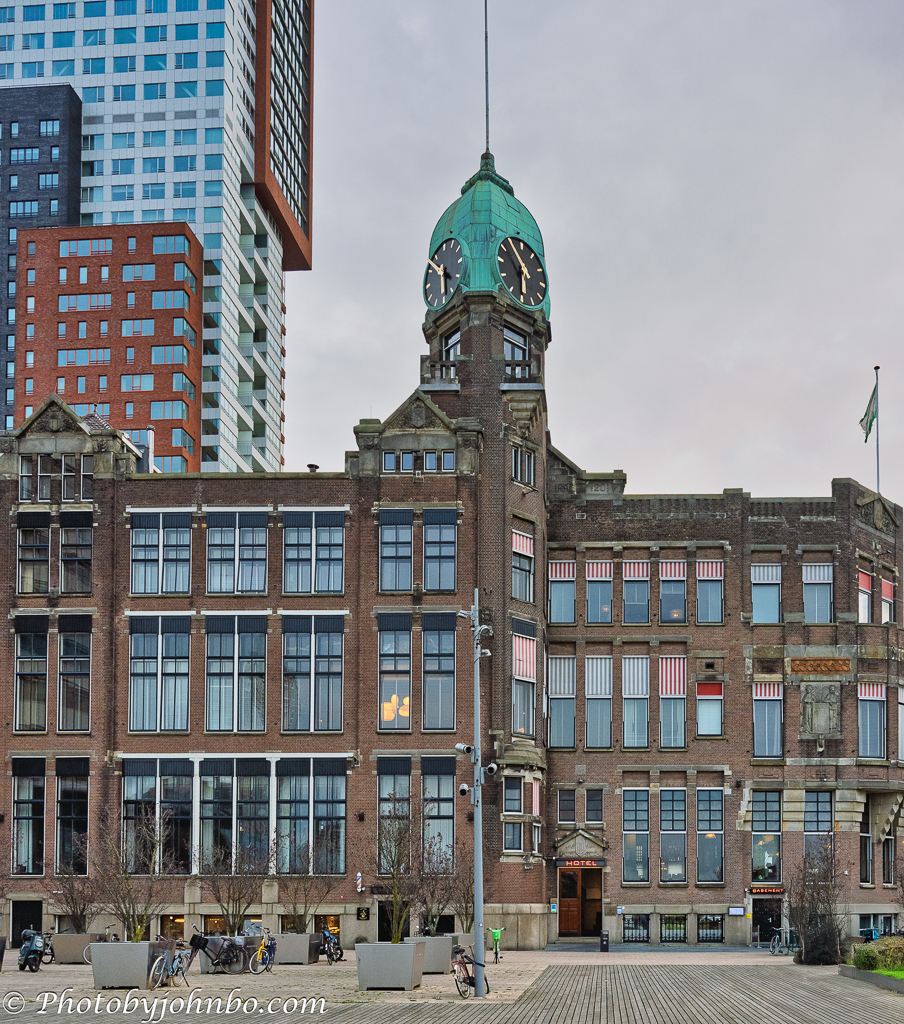
Our brief visit to the Netherlands was punctuated by our stay in the historic Hotel New York. In the foreground, the clock tower of Hotel New York rises with quiet authority—its green dome, brickwork, and maritime ornamentation a testament to Rotterdam’s transatlantic past. The building was once the nerve center of the Holland-America Line, a place where emigrants stepped into the unknown, bound for New York by sea. But now, the skyline tells a different story: glass towers like De Rotterdam and Montevideo surge upward, symbols of a city that has rebuilt itself with bold vertical ambition. The juxtaposition is striking—the Hotel New York anchors the Kop van Zuid, a redeveloped waterfront district that fuses Rotterdam’s industrial past with its architectural future. But what exactly is Kop van Zuid?

Initially a stretch of disused port land on the southern bank of the Maas, Kop van Zuid has been transformed into a showcase of urban renewal. Here, historic landmarks like Hotel New York share the skyline with modern giants—glass towers that reflect the city’s forward-looking spirit. From behind Hotel New York, the Erasmus Bridge appears as a graceful counterpoint to the hotel’s brick-and-stone façade. Where the hotel evokes the transatlantic age of steamships and migration, the Erasmus Bridge embodies Rotterdam’s reinvention—connective and modern.

The Kop van Zuid project doesn’t hide its industrial roots. Just behind Hotel New York, the Watertaxi pier hums with movement, yellow boats skimming the Maas and reminding me that this is still a working harbor. Amidst glass towers and cultural landmarks, this utilitarian dock showcases how industry and innovation continue to coexist on the waterfront.

Viewed from the historic Hotel New York, the sleek lines of Pakhuismeesteren, a large, terraced residential and commercial complex built on former port land, dominate the skyline. On the left, the green glow of the World Port Center, a global business hub, illuminates the night. Reflections ripple across the Maas as water taxis idle below, their yellow hulls catching the last glimmers of city light. The promenade is quiet, framed by trees and the soft movement of boats at anchor.
Our stay at Hotel New York provided a historic perspective on Rotterdam’s transformation into a modern city. Watching Watertaxis skim the river and tracing the lines of the Erasmus Bridge, Rotterdam is a city of contemporary and historic contrasts. And from our window, we had a bird’s eye view. In a future Travel Tuesday post, I’ll share photos from our walking tour of the city. Stay tuned for more about the city’s reconstruction into a modern metropolis following the devastating bombing during World War II.
About the photos: All images were captured with the Nikon Z7 II and cropped in Adobe Lightroom Classic, with a brief detour through Luminar Neo for exposure and Accent AI adjustments. I typically use SnapBridge—Nikon’s mobile transfer tool—to review images quickly and geotag them with the camera’s location. Unfortunately, due to operator error, it wasn’t working during this trip, so the GPS fields are all blank. I used AI to help identify buildings and remove minor distractions in a few frames. If you spot any location errors, feel free to note them in the comments. All photos are posted on my Flickr site in 2K HD here for those who enjoy pixel-peeping or scanning the metadata.
John Steiner


What a great view to have from your hotel! I love how so many cities have transformed their historic industrial waterfronts into something relevant to the present day, bringing activity back to these once-busy places. My favourite Newcastle-upon-Tyne Quayside is another good example 🙂
It was a beautiful view of a modern yet historic waterfront.
What beautiful views from your hotel and your hotel itself. I loved the bridge.
I really appreciated the view, and enjoyed the history of the place, especially since it tied in with the Holland America cruise we took, our first time on the cruise line.
I love night shot from your hotel. Thanks for the interesting backstory John.
Thanks, Brad!
interesting…you’ve got me thinking my tiny NIKON or my iPhone are no longer good enough…
No camera is ever not good enough… well, maybe those old 8-mm Super-8 film cameras. >grin<
oh all those years with my dad and that super 8 (but with all those memories I’d glad me did)…a few years ago I sold off my Canon AE1 and AT1 and miss those, miss film…
I had a Nikon 8mm (not Super-8) when I was a teen. A few years ago, I had them all digitized and gave the family videos to those who wanted them on a CD at a family reunion. It was a fun look back some 40+ years at the time.
That hotel view is beautiful.
It is, especially at night!
Beautiful photos and memories, the view from your hotel room is spectacular!
That was a fun journey! Thank you, Pamela. !