January 2023.
St. Augustine, Florida.
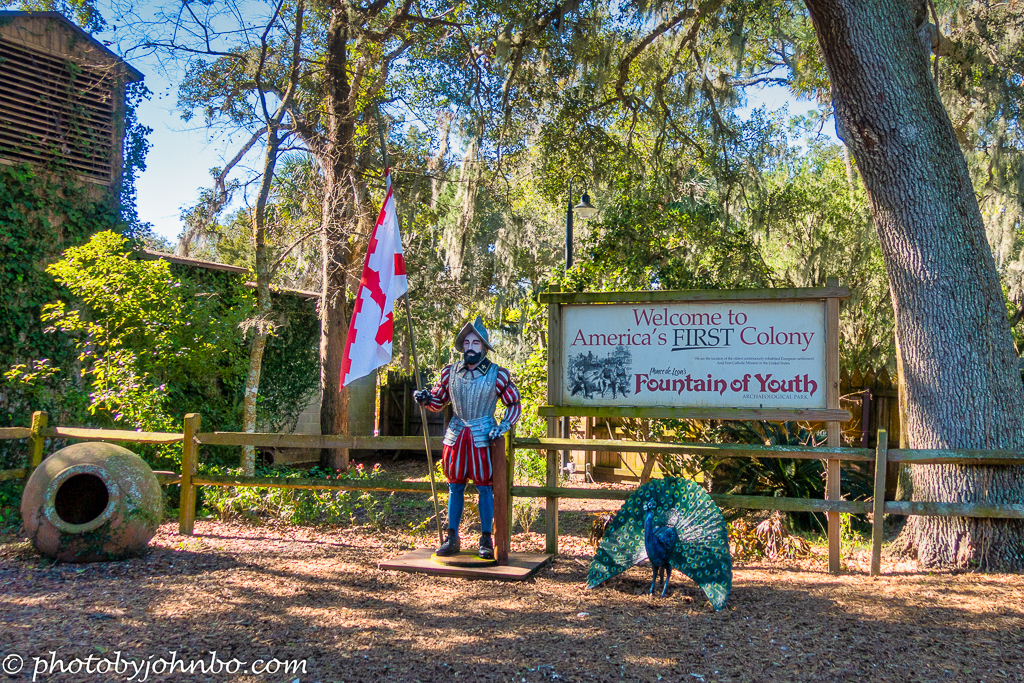
During our winter stay in St. Augustine, we explored the Fountain of Youth Archaeological Park and, in the process, learned about the myth and reality of Spanish explorer Juan Ponce de León. Born into a noble Spanish family around 1474, he began his career as a royal page at the court of Aragon and later fought in the final campaigns against the Moors in Granada. In 1513, he sailed westward from Puerto Rico, landing on the shores of what he named La Florida. Through the centuries, the name Florida persisted, and in 1845, when the territory became a state, the name he’d given 300 years earlier was adopted.
Though his official mission in 1513 was to expand Spain’s territorial claims and search for new wealth, later legends would recast his voyage as a quest for the mythical Fountain of Youth, a spring said to restore vitality to those who drank from it. Ponce de León, a veteran of Caribbean conquest and former governor of Puerto Rico, became forever entwined with this tale, though no contemporary records mentioned such a pursuit.

Long before European ships appeared on the horizon, these lands were home to thriving Timucua communities. Among them was Chief Saturiwa, an influential leader whose village, located near the mouth of the St. Johns River, played a pivotal role in early encounters with French and Spanish explorers. His legacy, commemorated in sculpture within the park, reminds us that Florida’s first chapters were written by its native peoples, whose stories often stand in quiet contrast to the myths that followed.

In 1565, more than half a century after Ponce de León’s arrival, Spanish admiral Pedro Menéndez de Avilés came ashore and established the first permanent European settlement in what is now the United States. Placards at the newly established settlement tell the story of welcome by the Timucua village of Seloy, whose leaders, like the powerful Chief Saturiwa to the north, had already navigated alliances with French explorers. Menéndez and his forces built a fortified encampment that would become St. Augustine. Today, the quiet field within the Fountain of Youth Archaeological Park marks the site of that original settlement. The modest space anchors the mythic spring to a deeper, more complex history of diplomacy, displacement, and colonial ambition.

While the myth of the Fountain draws visitors, the park’s reenactments offer glimpses into the real rhythms of 16th-century life. Beneath the canopy of live oaks, interpreters shape wood with hand tools, echoing the labor that built shelters, carved tools, and sustained the earliest European foothold in Florida.

As we walked the interpretive trail, we saw these cannons and the placard with their description. I thought they were misplaced. The cannons flanking the trail once belonged to the USS Constitution—“Old Ironsides”—a warship launched nearly three centuries after Ponce de León’s arrival. Google told me they were brought to the park in the 1930s, so they are more theatrical than historically accurate.

As Spanish settlers fortified their new outpost, defense became as essential as diplomacy. We were lucky to be at the park at the right time for the cannon firing demonstration. We arrived a few minutes too late for the beginning of the weapons demonstration. However, we were in time for the roar of cannon fire, which still echoes across the park during scheduled demonstrations. Although the artillery on display dates from a later era, the spectacle evokes the tension and uncertainty that characterized Florida’s earliest colonial foothold.

At the center of the park stands a statue of Juan Ponce de León, cast in a heroic pose, gazing outward as if still searching for the elusive Fountain of Youth. It’s a fitting centerpiece for a site built on legend—elevating the conquistador to near-mythic status. Yet beneath the bronze statue lies a more complicated truth: Ponce never set foot in St. Augustine, and the Fountain of Youth was never part of his documented mission. The monument is a reminder that history is often shaped as much by what we choose to remember as by what actually occurred.

As the statue of Ponce de León stands watch over the park’s interpretive core, a placard behind him refers to the legend. Beyond the monument lies a marshland boardwalk—where the myth fades, and the real Florida begins. That quieter edge of the park, with its oyster beds and wading birds, deserves its own story. I’ll share that in Part II.
As of this writing, the Fountain of Youth Archaeological Park in St. Augustine is open daily from 9:00 a.m. to 6:00 p.m. Visitors can explore a mix of historical exhibits and natural beauty, including the legendary spring, a Timucuan village, a celestial navigation exhibit, and a scenic boardwalk overlooking the marsh. Be sure to check their website here before your visit.
About the photos: All images were captured with my Sony RX100M5 point-and-shoot camera. The exposures were bracketed and rendered in HDR via exposure blending in Adobe Lightroom Classic and Luminar Neo. AI was used to remove distractions in some images. These images, along with more from our visit to the park, are shared in 2K HD via my Flickr gallery here.
John Steiner
 Journeys with Johnbo
After a promising beginning, it all went horribly wrong, John. They were met with friendship, but that isn’t the nature of conquerors. As we still see today. I always thought this would be a nice town to visit so I look forward to Part 2 xx
Indeed, Jo! We enjoyed our stay in Saint Augustine. It is a historic city!
A great reminder that history isn’t always the pure truth we sometimes mistake it for – and that it is usually told by the victors. I’m glad the park acknowledges the native people who once called this area home.
Indeed, I learned a lot about the indigenous people during my visit to the park. Thanks, Sarah!
John, thanks for the tour of the park and for sharing this history.
I’m glad you enjoyed, Beth!
What a wonderful history lesson and pictures. Our historical legends are seldom what word of mouth stories depict them. In Sacramento, we have Sutter’s Fort. During the last restoration, the truth about Sutter was brought forth. He wasn’t a nice person! But he accomplished a lot. I’m so glad the truth is being told historically.
Hopefully, telling the truth in these times is not a lost art. 🙂
Hi John! Once again, lovely pictures and a thoroughly engrossing tale of the park’s history. You know, John, you really ought to consider putting together a book about your American rambles – stories and photographs – it would be a best-seller, you know! pp
What a nice compliment, Pam! I’m glad you enjoyed the read.
Thanks for another fun and factual tour John. History is typically written by the winners of war and conquest to the detriment of losers and aboriginals.
So true, Brad So many of our stories end in this fashion, it seems.
Excellent info and great photos.
Thanks, Egidio!
Fountain of Youth – you’ll be blogging for a long long time ; )
Gee, I wonder what Photoshop 2076 will be like! 😃
We await your report in 50 years. : )