March 2026.
Tucson, Arizona.
My grandson, Owen, is a Lego fan and has transformed my wonderful wife, Lynn, into one as well. Looking for something to do in Tucson, she came across a note on Facebook about a special Lego exhibition. Reid Park Zoo is hosting Sean Kenney’s Nature POP!, a traveling exhibition featuring over 40 LEGO sculptures—from large‑scale LEGO polar bears to clusters of rabbits—crafted from more than 800,000 bricks. The show runs in Tucson through May 12, 2026, giving local visitors a limited window to wander the zoo’s pathways and encounter these larger‑than‑life creations tucked among the habitats. Nature POP! tours nationally, so readers in other parts of the country may find the exhibit appearing at a zoo or botanical garden closer to home later in the year.
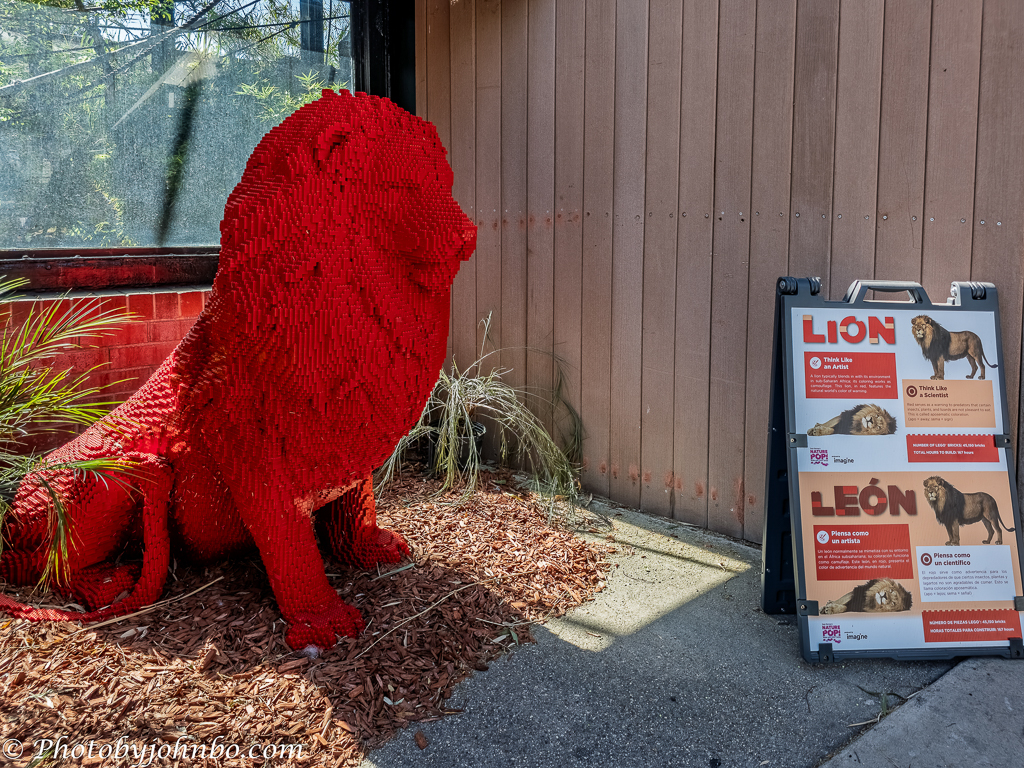
My opening image for this week’s Cellpic Sunday is a lion—though not the tawny, earth‑toned king of the savanna you might expect. This one sits proudly in a brilliant, saturated red, its form built brick by brick with sculptural precision. Composed of 45,150 LEGO bricks and requiring 167 hours to complete, this lion is a testament to the meticulous craftsmanship behind the exhibit. The placard beside it grounds the piece in the show’s educational mission, but the lion itself steals the scene. It’s bold, unexpected, and it sets the tone for a collection in which wildlife is reimagined through color rather than realism.

On our walk around the zoo while photographing real African animals, we came across this zebra, who clearly understood the assignment. While most of the exhibit’s animals rely on bold color to make a statement, this one goes for pure charm: a classic black‑and‑white coat paired with a bright orange bowtie. According to the placard, the piece is composed of 73,500 bricks and took 279 hours to build—proof that even a formal accessory requires serious commitment in the LEGO world. He stands there with quiet confidence, as if greeting guests or perhaps heading to a gala, refusing to be outdone by the lion’s dramatic entrance.

Our next stop was one of the exhibit’s most unusual residents: the pangolin. Many people have never seen one in person, and I’ll admit I didn’t notice the baby riding on its mother’s back until I reviewed the photo later. Often described as a “scaly anteater,” the pangolin is the only mammal covered head to toe in keratin scales—something the artist captures beautifully in this brick‑built pair. According to the placard, the sculpture uses 28,650 LEGO bricks and took 139 hours to complete. The slight color variation between mother and pup reinforces their connection while still giving each a distinct presence, making this one of the exhibit’s most quietly compelling pieces.

The polar bear was one of the most striking pieces in the exhibit, its blue striping giving the impression that it was carved straight from a glacier. Only later did I notice the small LEGO cub tucked against its side, echoing the surprise I had with the pangolin. According to the placard, the sculpture uses 112,450 bricks and required 389 hours to build. The artist’s choice to mimic the layered look of blue ice ties the piece to the real Arctic, where compressed, older ice reflects blue light and signals the changing habitat polar bears depend on. It’s a clever blend of art and science, and one of the exhibit’s most quietly powerful works.

Among the exhibits is a portrait of a tree frog. It’s one of several animal portraits, an artistic technique I hadn’t seen in any LEGO displays before. This one captures the iconic red‑eyed tree frog in a burst of color—green body, blue legs, orange feet—set against a bold yellow starburst background that makes the whole piece feel almost cartoonish. According to the placard, the portrait uses 18,432 bricks and took 36 hours to build. It’s a playful, unexpected shift from the three‑dimensional sculptures, and a fitting finale for a collection that celebrates wildlife in every possible form.
Lynn and I enjoyed our first visit to Tucson’s Reid Park, a facility that features much more than a zoo. Our visit was limited to the zoo, which is open daily from 9 a.m. to 4 p.m., and the Nature POP! sculptures are included with regular admission. We tracked a little over 1.5 miles (2.4 km) on our walk through the exhibits—both real and LEGO‑style—and it took us just under two hours to see the many sections of the grounds. If you’re bringing the kids, expect a longer experience. The zoo also scheduled a pair of special after-hours Builders and Bricks Nights, offering visitors a chance to see the sculptures in a more atmospheric evening setting. On March 14 and March 21, a night walk through the zoo remains a fun option for local readers who want to experience the exhibit after dark. As I noted above, the Lego exhibits are available for daytime viewing through May 12, 2026. More details, including admission prices, are at the zoo’s website here.
If you’re not in Tucson, Nature POP! continues its national tour over the next few years. After Reid Park Zoo, the exhibit opens at the Fort Worth Botanic Garden on May 22, 2026, followed by stops at the Omaha Zoo on January 16, 2027, and the Museum of the Shenandoah Valley in Winchester, Virginia, on May 27, 2028. Past cities have included Charleston, Vero Beach, Wichita, Tulsa, Fort Lauderdale, Los Angeles, Atlanta, West Palm Beach, and Nashville, giving the exhibition a wide footprint across the country. A full list of current and upcoming locations is available on the exhibition’s schedule page, which you can find here.
About the photos: I carried two cameras into the zoo on our visit. For the live animals featured in a future post, I used my Z7 II with the Nikkor 28-400 lens. Knowing the Lego exhibit would be a Cellpic Sunday topic, I used the always-handy Samsung S25 Ultra with the Expert RAW app. The DNG photos were imported into Adobe Lightroom Classic and processed in a similar fashion. I started by cropping and leveling the images as necessary and used the Adaptive Profile to set a starting exposure point. Then I ran through the sliders for Highlights, Shadows, Whites, and Blacks. Holding the Shift key, I double-clicked the mouse pointer on each slider so Lightroom could automatically pick the best level for it. Because of the “blocky” nature of a Lego sculpture, I increased the clarity slider on each image to bring out the contrast between the blocks and their lines. I was surprised how much that tiny adjustment improved the contrast and visibility of the sculpture’s structure. In one image, the lion, I removed a distracting object using Lightroom’s Generative AI. All of the images are in 2K HD at my gallery here.
John Steiner
 Journeys with Johnbo
Love it!
Thanks!
lovely!
Alfonso, Cavite – Ladyleemanila
Fun exhibition!
[…] John’s #Cellpic Sunday – 7 March […]
[…] Cellpic Sunday in Hirschberg-Leutershausen […]
I agree about the polar bear. Although the zebra has an interesting quality about it.
Here is my cellpic of today: https://picturesimperfectblog.com/2026/03/08/hear-ye-hear-ye-hear-ye-2/
I was really impressed with the artistic workmanship and, like in the polar bear, how the artist integrated the science of polar ice in his sculpture. I’m glad there was a detailed placard beside each piece.
Surprised?
I saw some of the Lego Masters episodes, so I know how sophisticated construction can be.
A fair answer, John. To a comment that was meant for a different posting (my fingers slipped). But your answer is fitting! 😄
Absolutely enjoyed your share and the explanations of each piece, John. It is awesome what they did with Lego! I love them all.
Thank you for your processing insights. I always learn something new. Much appreciated.
Thanks, Suzette! I’m happy to share.
What a fabulous exhibition John, the polar bear and cub sculpture is especially amazing! 😊
Those are amazing Lego sculptures.
They are, indeed!
[…] Cellpic Sunday 8 March 2026 […]
Wow.
My reaction, exactly, Judy!
What a great exhibit! It seems that it will be traveling away from the west coast–darn. So that makes your post extra special!
Check their website. I didn’t list the places that are currently exhibiting. I’d love to know if each concurrent exhibit features different animals, or if there are duplicates of the ones in Tucson.
I checked their website and the furthest west they get is to Reno, and we will miss it when we visit our son.
Bummer!
Those are amazing Lego creations. Thanks for another fun tour John.
Thanks for sticking around, Brad!!
My pleasure!
[…] John’s Cellpic Sunday […]
John, these are amazing Lego structures. When our grandson was little, he loved Legos. We took him to the Lego Store at Disney Springs and he loved it.
My grandson is 15, and he’s still a fan, asks for Lego sets still for Christmas!
[…] Shared with John’s Cellpic Sunday […]
[…] John’s Cellpic Sunday […]
It is amazing what they can do with Legos. Great pics. Here’s an entry for me:
https://throughbrazilianeyes.com/morning-glory/
Thanks, Egidio! The exhibit was fascinating, showing dedication to craft and artistic design.
[…] John’s CellPic Sunday-2026.03.15 […]