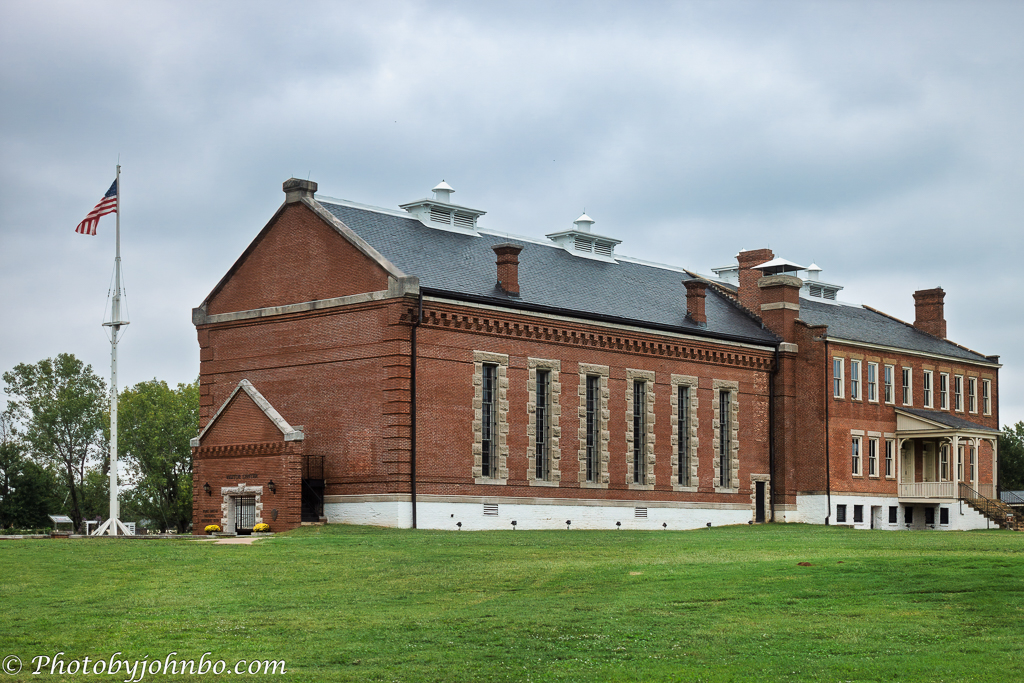
September 2023.
Fort Smith, Arkansas.
We visited the Fort Smith Historic Site on a dreary autumn afternoon. The Fort Smith, Arkansas, facility has served multiple roles in its tenure. It was established as a military fort in the early 19th century. Later, it became a federal courthouse and prison, where Judge Isaac C. Parker presided over cases in the U.S. District Court for the Western District of Arkansas.

Upon entering the main building, we encountered an architect’s display of the grounds of the original fort. The original Fort Smith layout included 14 structures, but only a few remain. The Commissary is the oldest surviving building, dating back to the 1850s. In the opening photo, the Barracks, which later became the courthouse and jail, serves as the Visitor Center.

Fort Smith was established in 1817 as a military fort, but the army abandoned it in 1871 and withdrew from the site. After that, the barracks were repurposed into a federal courthouse and jail, which became infamous as “Hell on the Border” due to its harsh conditions.

This room was a historical prison cell holding area. The stone walls, barred windows, and wooden door with metal bars indicate confinement. The mats with folded blankets suggest it was used for sleeping arrangements for prisoners awaiting trial or sentencing.

This room is a representation of the infamous “Hell on the Border” jail, which was known for its harsh conditions and overcrowding. Prisoners endured poor ventilation and extreme temperatures, making it one of the toughest places to be locked up in the late 19th century.
The jail operated from 1872 to 1896, housing prisoners under the jurisdiction of Judge Isaac Parker in the Western District of Arkansas. Overcrowding and poor conditions led to reforms, and a new jail was constructed in 1887, with prisoners moving in by March 1888. The original prison served as an overflow facility until it closed in 1896.

This jail wagon at Fort Smith National Historic Site was used to transport prisoners between the federal jail and the courthouse in the late 19th century. The wagon, marked “U.S. COURT”, features barred windows and wooden wheels, ensuring secure transport for inmates awaiting trial.
During Judge Parker’s tenure, law enforcement had to move prisoners from the old jail to the new courthouse on Sixth Street, and this wagon played a crucial role in that process.

There are many placards describing conditions in the jail. This placard describes some of the jailers on staff. The jailers played a crucial role in maintaining order. These men had a tough job, overseeing prisoners in harsh conditions while earning just $50 a month. They had to interact daily with criminals, ensuring security and preventing escapes.

During the day, prisoners could move within a confined space, but at night, they were ordered to return to their cells using a jingling rod before being locked in via the large lever at the end of the row. This setup demonstrates the challenges of managing a crowded and often unruly jail.

This detail shot shows a cell door and a mechanical system that opens all cell doors simultaneously. The door is constructed of sturdy metal, with a crisscross pattern reinforced by rivets, ensuring security.
To the right of the door, there’s a lever and gear system—a crucial part of how guards managed prisoners at Fort Smith. This mechanism allowed jailers to lock or unlock multiple cells simultaneously, making their job more efficient and minimizing risk when dealing with unruly inmates.

George Maledon was known as the “Prince of Hangmen” for his role as executioner at Fort Smith during Judge Parker’s tenure. Maledon worked as a guard, special deputy, and executioner for the federal court, carrying out over 60 executions. He was known for his precise, methodical approach, ensuring executions were carried out swiftly and professionally.
After retiring in 1894, Maledon took a traveling exhibit showcasing relics from his time as executioner, including ropes and photographs of the men he had hanged.

The original gallows in Fort Smith were destroyed a year after the last execution, but a reproduction of the 1886 gallows was later constructed as a historical reminder. This replica stands at the site, marking the location where executions once took place.

Judge Isaac C. Parker was the U.S. District Court judge in Fort Smith from 1875 to 1896. He became known as the “Hanging Judge” due to the 160 death sentences he handed down, with 79 executions.

This placard focuses on Judge Parker. He was known for overseeing thousands of criminal cases, particularly disputes between Indians and non-Indians. His court was unique in federal history, as he sentenced over 150 people to death, with no right of appeal.
Despite his reputation as the Hanging Judge, Parker aimed to create a “moral force of a strong federal court.” The placard also includes a quote from Parker in 1896, stating that his motto was to “do equal and exact justice” and to ensure that “no innocent man be punished, but no guilty man escape.” Parker advocated judicial reform and humane treatment for prisoners, demonstrating that his vision extended beyond mere punishment. His rulings influenced federal law, and his legacy remains a complex but critical part of American legal history.

The Fort Smith National Historic Site is a testament to the complexities of frontier justice, military history, and westward expansion. From its origins as an army post in 1817 to its role as a federal courthouse, the fort shaped the legal and cultural landscape of the American West.
Today, the site preserves the stories of justice in the American frontier, allowing visitors to explore its courthouse, jail, and historic grounds. It serves as a reminder of the struggles and triumphs of those who lived and worked at the edge of civilization, embodying the enduring spirit of justice and resilience in the Old West.
As of this writing, the site is open year-round except for three major holidays. You can check visitor center hours and holiday schedules here. As of this writing in December 2025, there are no fees to enter the facility; however, in 2026, changes to fees for U.S. non-residents are planned. Check here for details.
One final administrative note: Lynn and I are currently on a cruise that severely limits my Internet access. If I don’t respond to comments as quickly as usual, rest assured I’ve read every one and will reply when I can.
John Steiner
 Journeys with Johnbo
I find the US preserves and curates such historical sites so well – there’s always so much to be learned from a visit as you’ve demonstrated here!
Thanks, Sarah! Some states are better than others in this regard, but all seem to highlight their historic places.
Your images are great, as always, and my favourite was the “Jail Wagon”. Mostly, though, I always enjoy and appreciate the depth of your research and detail in the story-telling. I shall probably never get to this site but now I wish I might. Thanks ever so much! pp
Thank you, Pamela, for the kind words!
Gruesome but intriguing backstory. Once again you’ve taught me about my own region John!
Thanks, Brad!
I love history and I loved this post.
Thanks, Anne. I enjoy exploring historic sites, and they are always better with a quality docent.
Thanks, Anne!
😎
Very interesting! We weren’t able to make it here on our recent trip to Arkansas, so I appreciate the virtual tour and history lesson.
Thanks, Diana!