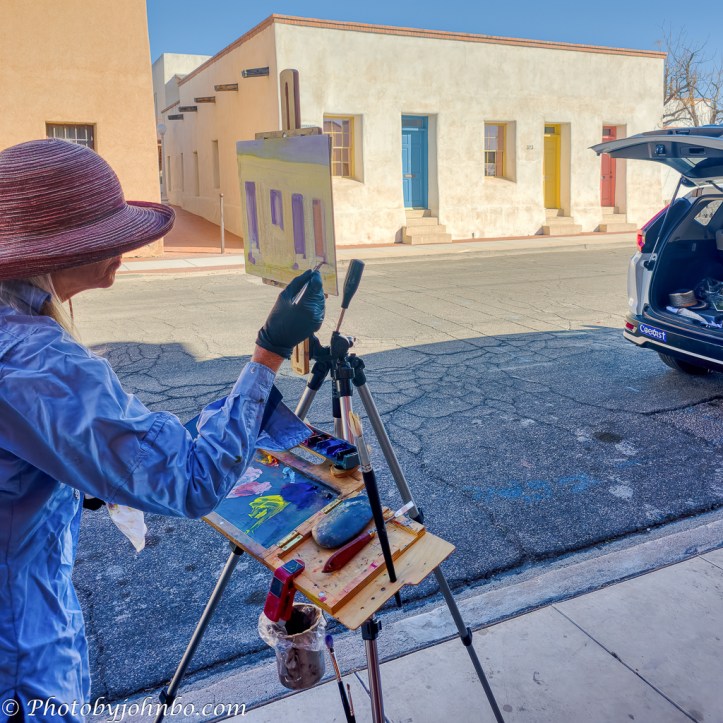
This week, Beth asks us to share our astonishment in our responses. She writes, “What have you seen or experienced that has astonished you? The challenge is to include photos about things that astonish you and tell us why you are astonished.” You can read her entire challenge post here. At first, I wondered whether I’d have any images that genuinely reflected my own sense of astonishment. After more than three-quarters of a century on this planet, I sometimes think I’ve seen it all… well, except perhaps the political state of the world. It’s a shame I’m not a news photographer—now that would provide endless material.
Then I started reviewing my Flickr gallery and discovered that, over the last year or two, I’d actually encountered several moments that genuinely astonished me—none of which had ever made it into a Lens-Artists response. One of them happened while wandering through Tucson’s Barrio Viejo, where I met a plein air artist who had just begun interpreting one of the adobe buildings in the country’s largest surviving adobe neighborhood. Even in those first strokes, Barbara Mulleneaux’s work astonished me. With practiced ease, she layered color onto the canvas, translating the scene in front of her into something both familiar and entirely her own.

In Hawaii, we stayed for a time in Kalaheo on Kauai Island. We discovered that only a few minutes west, the largest coffee plantation in the United States shared a seaside view. The 3,000‑acre (1,214-ha) facility is the largest coffee operation in the 50th state, and Hawaii is the only state that is a major coffee supplier. I knew coffee from Hawaii was a “thing,” but I had no idea of the scale of the plantation or how much coffee they produce. The tour presented one astonishing fact after another about how coffee is grown, harvested, and processed in Hawaii. From our tour bus, I captured a sweep of green coffee fields stretching toward distant mountains, with those iconic Hawaiian clouds rising above the landscape—an unexpectedly grand backdrop for a crop I’d only ever seen in bags on a store shelf.

This photo encompasses two of my astonishments. First, I learned that sugar cane is no longer produced in Hawaii. In 2016, the last sugar cane producers closed in favor of different crops and land uses. Later that same year, we found ourselves driving through Louisiana, discovering where sugar cane is still grown in the United States. Though the market is small compared to beet sugar, it remains significant—especially for Louisiana farmers whose livelihoods depend on it. Driving from Texas to New Orleans, I noticed the harvest in full swing: tall green cane fields, trailers heaped with freshly cut stalks, and tractors working under a bright sky—a vivid reminder that while Hawaii’s cane fields have gone quiet, the tradition continues elsewhere.

In 2025, Skylum Software introduced a Restoration module that cleans up and even colorizes older photos. From my first experiments, I was astonished at the power of the technology. The AI tool fixes scratches and blemishes in old images, whether they were scanned or simply photographed with a camera or phone and uploaded for processing. The results can be surprising, but I quickly learned that if the AI “improves” the composition a little too enthusiastically, I can just run the restoration again. Most of the time, it simply removes damage and colorizes when asked. The triptych above centers on the original black-and-white photo from the 1940s. On the right is Neo’s colorized version, cropped to focus on the hunters. The image on the left is my final edit, where I replaced the sky—another astonishing tool—and removed a few distractions from the background.

My wife’s family lives in Fairmont, Minnesota. On a recent trip, we toured the Pioneer Museum, which highlights the history of Martin County. On one wall, I stumbled upon a fact I never expected: Paul and Linda McCartney once forged a business relationship with a local food production facility right there in Fairmont. I was genuinely astonished—not only by the museum display but also by what I uncovered in my follow-up research regarding Linda McCartney’s vegetarian food line. If you’d like to learn more about the city’s improbable connection to the McCartneys, you can find the details here.

I’m always astonished by the power of simulation software to entertain and educate. At the GulfQuest Museum in Mobile, Alabama, one of the exhibits is a simulator model used to train cargo-ship pilots in navigation. This particular setup was modified to offer a ten‑minute simulator tour of Mobile’s harbor. When the docent finished describing the equipment and gave us a quick demonstration, he asked whether anyone wanted to take the helm. Of course, I volunteered. Who wouldn’t want to drive a fully loaded 50,000‑ton (about 45,000 metric tons) cargo ship?

The simulator itself is impressive—an immersive, wraparound display paired with a full bridge console, radar screens, throttle controls, and a ship’s wheel. Sitting there, surrounded by ocean, sky, and the hum of virtual engines, it was easy to forget I was in a museum gallery rather than approaching the Port of Mobile. At one point, the docent even tried to distract me by pointing out the skyscraper skyline on the left just as a large red cargo ship was bearing down on us from the right. I managed to steer clear of the hazard, and we continued on our way. The ten‑minute tour was far too short for my taste, but others were waiting for their turn.
As I reviewed my photographs, I was surprised by how quickly I identified images I’d never used in a challenge response that genuinely amazed me for their subject matter. From the artist at work to the ship simulator, each moment fit perfectly with Beth’s invitation to share our moments of surprise.
Last week, Tina’s challenge on shapes and designs sent me down an unexpected rabbit hole of geometry—a big surprise, considering vectors and angles were not my strong suit back in high school. Next week, Ritva hosts the challenge, which goes live on Saturday at noon Eastern Standard Time. Be sure to follow her blog here so you don’t miss her post.
If you’re sharing a Lens‑Artists Challenge response for the first time, welcome—we’d love to visit your post. To participate, publish your take on this week’s theme, link back to this page, and add the Lens‑Artists tag so others can discover your work. You’ll find more details on how the challenge works here.
One final administrative note: Lynn and I are leaving late this week for a cruise that will severely limit my internet access. If I don’t respond to comments as quickly as usual, rest assured I’ve read every one and will reply when I can.
John Steiner
 Journeys with Johnbo
John, educational choices about agricultural places in US and personal photography editing tools, I like the angle you took with this challenge.
Beautiful post for his theme, the ship simulator would be very cool to experience!
It was, indeed! Wonderful museum about sailing the gulf.
John, I really enjoyed your amazing images and informative descriptions. I too am astonished by artists who can create beautiful pieces of art. I learned a lot about the coffee and sugar cane production in the U.S. from your post. I didn’t know that Louisiana still produces sugar cane. I like the way you showed us the results of some of the advances in photo editing. The McCartneys in Minnesota! Astonishing! I like the way you ended with your experience using the simulator to guide a cargo ship. Thanks for this great response to the challenge.
It was fun finding all of these “astonishments” in the last year or so!
You have some amazing astonishments in this post–educational too!
Thanks, Anne!
😎
I loved this post, thank you. I live in an agricultural region and am always learning something new and fascinating about that sector! (I married a farmer.) What I really admired was your comment, “Then I started reviewing my Flickr gallery and discovered that, over the last year or two, I’d actually encountered several moments that genuinely astonished me” – I think if most of us are honest, we’ll admit that a review of our images often does that for us. Treat post! pp
Thanks, Pam… and you are right, photographers find astonishing things to photograph. “That’s their job!!”
>grin<
Yep, but some photographers are much better at it (you!) than others (me!). 🙂
Thanks for a fun and educational response to Beth’s challenge. I had no idea Hawaii grew that much coffee.
I enjoyed sharing the photos and researching the background. Thank you, Brad.
What a testament to your life! These photos show a lot of great moments. I can see why they astonished you.
Thanks, Egidio!
How fun that you found images to share for the first time John! Happily Beth’s challenge allows us to feature images that have little to do with each other yet fit the challenge perfectly. Well done!
Thanks, Tina! I really enjoyed this challenge.
Wow – your opening photo looks like a painting!
Thanks!
Wonderful images.
Thanks, Rupali!