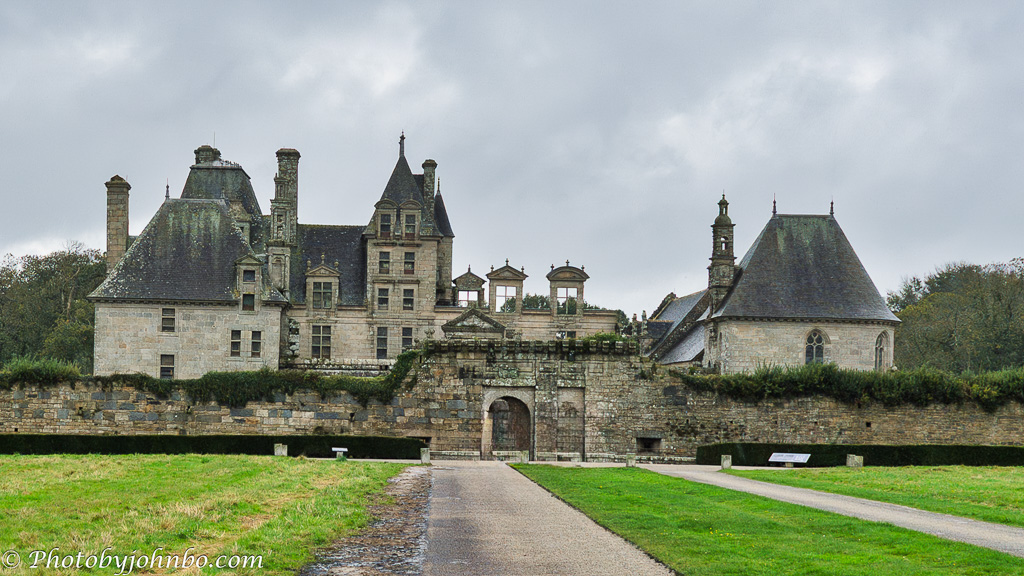
Brittany, France.
Our last stop in Brittany was a Renaissance castle. The 16th-century fortified château is near Saint-Vougay, in Finistère, Brittany, France. The route to the castle from Morlaix is only about a 30-minute drive. Unfortunately, our trip to the castle on the tour bus was extended by a detour that required us to backtrack several miles, then take a much less modern road. The driver, however, knew the area and got us there as quickly as possible. As a bonus, the tour guide provided commentary about the unique route of our excursion. We were dropped off near the entrance, and after some introductory remarks, the tour guide left us to explore the castle on our own. The view in the opening photo is the castle entrance.

Though the opening photo hides the moat, a substantial area was once filled with water. As you can see by the image above, the moat has been replaced with a lawn. The château was built for the Barbier family between the 1540s and 1590s.

The château experienced damage during the French Revolution in the 1790s and fell into disrepair in the 19th century. The French state acquired the building in 1911 and restored it between the 1980s and early 2000s.

In one area of the courtyard, an effigy marks the tomb of Jean Barbier, the lord of Kerjean. He was a member of the Barbier family, the original builders and owners of Château de Kerjean. In medieval and Renaissance times, it was common for noble figures to have such elaborate effigies placed over their tombs.

We explored several rooms, some with period furniture and other accessories identified by placards. This area is a kitchen. The functional nature of a medieval or Renaissance kitchen highlights the importance of the hearth in daily life.

The most prominent feature of this bedroom is the enclosed bed, or “lit clos,” in the center. This is a traditional Breton feature. The curtains would have provided privacy and warmth in the drafty castle. While simple, the tapestry on the left wall indicates some level of comfort and decoration. Tapestries were expensive and often used to insulate walls.

Hélène du Vorsent is the artist who created the tapestry in the photo above. The contemporary work is titled “The Tree.” I couldn’t find a definitive biography of the artist, but I did find that she appeared alongside her work in an exhibition at the Château de Kerdurand in 2021.

The well in the foreground is a prominent feature in the courtyard. It would have been an essential water source for the castle’s residents. Wells were necessary components of castles and manors, so the well was probably constructed around the same time as the original Château de Kerjean between the 1540s and 1590s.

The courtyard’s sandy floor allows runoff from the common maritime rains to drain. Surrounded by the castle’s protective walls, it is an area of privacy and security. From here, we can see that the château’s architecture reflects the Renaissance style, characterized by symmetry, classical elements, and decorative details.

The area in this view is the inner courtyard of the Renaissance-era château, which shows the main building entrance. Its combination of architecture, history, and the well gave me my first impressions of opulence as we visited a real French castle. This is probably my favorite photo of the castle’s distinct design.

It was time to leave the castle, and with our detour, we would be a bit later than estimated for our return to the ship. As we walked toward the bus, I turned around and took one more shot of the castle. These images (plus a couple more) are posted on my Flickr site in 2K HD here.
John Steiner
 Journeys with Johnbo
What a lovely old place to ramble around, John xx
It was my first visit to a chateau. Fascinating, but a guided tour would have been nicer. The story had to wait until I did my research at home. 🙂
What a great place to visit.
My first Chateau visit. The cloudy day gave the outside images a little more gritty feel.
Sometimes cloudy days give more interesting results in my opinion. These were good 👍
Thanks!!
Beautiful images John.
Your shots are, of course, lovely and so is your narrative – I learned a lot. Thank you for sharing these gems! My favourite was the “moat” shot of the wall. pp
Thanks, Pam! It was a fun photo shoot.
How long were you there?
About 3 hours.
Thanks for taking us with you on your tour with your beautiful images and descriptions.
Thank you, Beth! I’m down a rabbit hole now looking for images for your challenge this week!
John, you are welcome. I’m sure you will find some amazing images for the challenge!
It is indeed a gem. Beautiful photos, John. Thanks for guiding this tour.
Thank you, Egidio!!
A lovely visit to Kerjean Castle, which is unusually large for Brittany.
This was my first castle visit ever, so it’s what I expected. >grin<
A very good choice indeed, as it gives a true picture of a real château belonging to a feudal noble family. Actually, the most magnificent French châteaux are either around Paris or in the Loire Valley.