From Engineered Ponds to Cheesecake Geometry
This week, Tina hosts a challenge that originally sent me down a rabbit hole of classic car design features. When I first tackled this theme back in 2021, my response was an all-automotive affair. As Tina writes, “This week we look back to 2021 when our Lens-Artists Challenge #174 focused on Shapes and Designs. The subject opens up a world of possibilities, such that building a response is more about eliminating possibilities than finding them.” You can read her full challenge post here. For this round, I’m featuring a wider mix of photos that haven’t appeared in any previous challenge—though I reserve the right to slip in at least one nod to my previous classic car obsession.
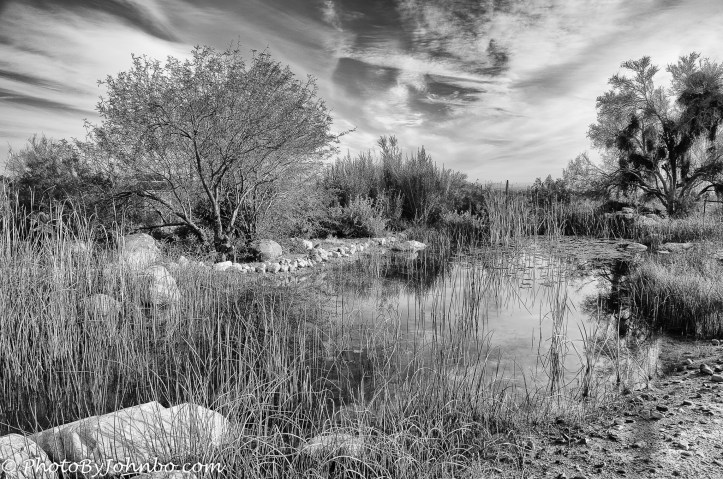
My opening photo features a wildlife pond in the White Tanks that is, in fact, a fully engineered, solar‑powered reservoir. I selected this image to highlight the contrast between its mechanical purpose and its natural charm. By using an irregular shoreline of jagged, interlocking rocks to prevent erosion, along with plants arranged in seemingly random patterns, the construction breaks up the harsh, linear shapes typical of man‑made structures. It shows that the most effective designs often borrow nature’s chaotic geometry to blend into their environment. I was so intrigued by the design that I plan to post more about how engineers mimicked nature to keep the park looking “natural.”

In western New Mexico, Kasha-Katuwe Tent Rocks National Monument features pyramidal formations that resemble Native American tipis. In this composition, the narrow slot, angled walls, and repeating triangular forms echo the very idea of intentional design, even though they were carved entirely by erosion. The monument, closed for several years, recently transitioned to a reservation-only system, and I’m glad I have these photos to share for those who haven’t yet navigated the new entry process. The shapes feel arranged, almost architectural, making the scene a natural fit for Tina’s design-focused challenge. This is the only truly natural design in my response, shaped entirely by wind, water, and time.

I couldn’t leave out my favorite dessert when it comes to mathematical design. This cheesecake is fluent in geometry: first a perfect circle, then a set of tidy triangles, and finally, a minimalist study in negative space. All that remains of the design are the circular cardboard base and the accordion-pleat paper dividers that once held the slices. Is it magic, or simply the most delicious form of natural disappearance?

In Rotterdam, the Netherlands, one of the most interesting apartment complexes is the Cube Houses (Kubuswoningen), where each wall is angled steeply, and the floors bisect those angles, creating unusually shaped rooms. The interior feels like a study in geometry: triangles, trapezoids, and unexpected slants appearing everywhere you look, all created by the 45‑degree tilt of the cubes. Though compact, our tour of the show cube—configured as a model apartment—revealed a surprisingly spacious interior design spread across three floors.

I promised you a look at an automobile design. In this case, it’s something rare in 21st‑century automotive design: a hood ornament. I’ve never before shared this image, as it was in my private archive of experiments in high‑key photography. This particular ornament, a stylized bird with swept‑back wings, reflects the sculptural flair Packard embraced in the mid‑20th century. Its curves, posture, and streamlined form speak to an era when even functional elements were shaped as works of art. In a challenge about shapes and designs, it’s a reminder that automotive styling once extended all the way to the tip of the hood.

This photo studio recreation at the Albuquerque Museum captures the mechanical rhythm of early photography. The repeating angles of the bellows contrast sharply with the busy, organic patterns of the floral background. It’s a great example of how turn-of-the-century design found a balance between industrial function and decorative Victorian scrollwork.

The Oklahoma City National Memorial relies on simple geometry to tell its story. The dark rectangular wall and its centered opening frame the moment marked “9:01,” the minute before the bombing. Its clean lines and symmetry create a quiet boundary between what was and what followed, a design that speaks through structure rather than words.
Thanks to Tina for this week’s challenge. Even though it was “Looking Back,” I decided not to use any photos that had been included in any previous challenges. If you’d like to pixel-peep or view the metadata, you can find the images on my Flickr site here. Last week, I really enjoyed Egidio’s “Rejected” challenge that focused on recovering photos originally destined for the recycle bin. Next week, Beth hosts the challenge. Be sure to follow her here so you don’t miss her challenge, which goes live at noon Eastern Time on Saturday.
If you’re joining the Lens‑Artists for the first time, welcome—we’d love to see your work. To participate, simply create your own post responding to this week’s theme and include a link to this page so we can find you. Be sure to add the Lens‑Artists tag so your post appears in the WordPress Reader for others to discover. You can find more detailed instructions on how the challenge works here.
John Steiner
 Journeys with Johnbo
Mmmmm….cheesecake 😋
Indeed!!
What a clever and beautifully expressed response to Tina’s challenge, John. I’m impressed xx
Thanks, Jo! It was fun finding photos previously unpublished in any challenges.
You caught my attention with “Cheesecake Geometry” in the title and I had to look. So glad I did because it is such a fun post. The cube houses are intriguing. How in the world do they place cabinets up with walls like that?
thanks, I enjoyed finding photos for it. As I recall, cabinets and shelves were mounted only on interior walls so that they stand vertically. They also had free cabinets, I remember a four-sided bookcase mounted on the floor, not attached to the walls. 🙂 Here’s link to my interior photos: https://photobyjohnbo.com/2025/05/06/cube-houses-urban-living-reimagined/
Thanks for the link. I remembered seeing the post after I followed your link. Thanks for the reminder for my senior moment.😉
Thank you. I have many of those moments these days. >grin<
Great photos John! The cheese cake and cube homes are both very cool to include in this challenge! Im so curious about the cube homes!
Thanks, Jo! Here’s a link to my post that shows some interior views. https://photobyjohnbo.com/2025/05/06/cube-houses-urban-living-reimagined/
Those homes are so fascinating!
They are!
Some amazing examples this week John- loved your post! Rare for me to see a post with images that I’ve not only never seen, I’d never heard of them! Several favorites but the one I most loved was your closing image – because really without words it says it all.
Thanks, Tina!! Fun challenge this week!! I enjoyed processing them for the challenge.
John, I really like the variety of deigns in your collection. The tent rocks are fascinating. I’ve never heard of them before. Great image of the cube houses but I’m not sure I would want to live in one of them.
Thanks, Beth! Nor would I, even though I toured one, found it to be more spacious than I thought… it’s just too wonky for me.
Love the photo studio recreation shot, and the one in Oklahoma City tales my breath away.
When I walked through the museum and saw the old-timey camera, I had to frame a shot around it. Thanks, Lindy. That OKC memorial is indeed breathtaking!
Another reason to love cheesecake: geometry.
It made me think, “I’d like to make another (though the one in the photo was from a bakery, I almost always make my own.)
A real chef. How wonderful. Enjoy.
Nope, just playing around in the kitchen. But I do make a mean cheesecake. >grin<
Great choices for this challenge John. I’ve never thought of cheesecake in mathematical terms. But it will still be one of my favorites!
Cheesecake breaks all the rules… remember the saying “PieRsquare? No Pie_R_NOTsquare, PieRround, cakeRsquare.” Well there’s an exception, cheesecakeRround. >grin<
😎
Some great shapes, John.
Thanks!!
John, this is a very beautiful gallery. The cube houses are mind boggling. Ten Rocks is a place I’d love to visit, but haven’t made time to go there yet. Thanks for the info regarding reservations.
Tent Rocks is worth the trip. Until this year, it was closed since the COVID shutdown.
The cube houses are cool and i like the hood ornament!
Cube houses, cute to look at, and from the fact that there are few available for sale, they must be OK to live in. 🙂
Great blog John. The cube houses steal the show, against stiff opposition 🙂
Thanks, Steve! I had fun looking for potential candidates.
John you have found so many great places an things to demonstrate shapes and designs. The ‘Cormorant’ and cube houses, well they as shots stood out to me
Thanks, Ritva! I’m enjoying all of the responses.
A wonderful gallery of nature’s shapes and man-made designs, John. The Netherlands’ apt house and the car cormorant are amazing to me!
Thanks, Terri! Fun challenge this week from Tina!
Great gallery, John! Spectacular and welll thought through. Loved the cormorant and the cubes, but the cheese cake ponderings really caught me! Now I will go back to your thoughts every time I eat a piece!
Thanks, Ann-Christine!! Enjoy that cheesecake! >grin<
Hi John. What a wonderful and varied assortment of images–from cheesecake to a hood ornament! Marvelous choices, but the one that really resonates with me is the Oklahoma City Memorial. I went there several years ago and was dumbstruck by the power of that monument. And to think it was the beginning of the terrorist bombings. So sad.
That memorial is probably the most moving memorial I have ever seen. The room of photos of victims is heartbreaking!
Fantastic fun selection, John. Needless to say, the cheesecake is particularly appealing to me. 😉
My favorite desert!! Thanks, Yanaj!
[…] Journeys with Johnbo […]
I love the Roterdam cube houses! That’s so unique. I’m glad you included the hood ornament and cheesecake. Those made me feel right at home! All your shapes are very cool, though. None would ever classify a rejects! 🙂 xxx
Thanks, Marsha!