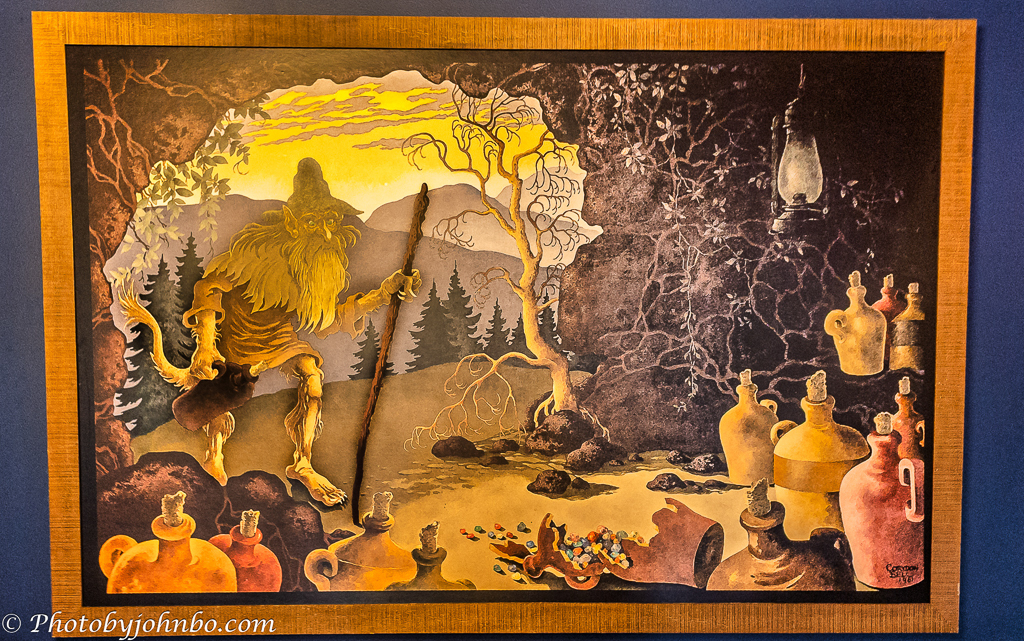
(Corydon Bell, 1961)
September 2025.
Waynesville, North Carolina.
Today’s post lands on my son Josh’s birthday, which feels like the perfect excuse to revisit a North Carolina memory Lynn and I shared with him and his wife, Nichole. In September 2025, we rented a VRBO in Maggie Valley—their familiar home base for exploring the Great Smoky Mountains—and spent a long weekend tracing the folds of the landscape and the stories tucked within them. One meandering day brought us to Waynesville, where the Blue Ridge rises behind the storefronts and Main Street hums with small‑town charm.
We parked on Main Street and found our way into the strangely named Boojum Brewing Company. At least, the name was strange to us, but the locals all knew what we didn’t. It turned out that we stopped for a beer and learned of a legend—a tall, shaggy mountain creature said to roam the Blue Ridge, hoarding gemstones in old jugs and keeping a watchful eye on anyone who wandered too close to his territory. Part wild man, part gentle mischief‑maker, the Boojum is woven into western North Carolina folklore, and apparently into the décor of the brewery as well.
But the legend goes deeper than the depiction by Corydon Bell, the artist and author—along with his author-wife, Thelma—who helped immortalize the creature in mid-century mountain literature. The jars full of gemstones and stolen moonshine are but one of his legendary quirks. The Boojum also had a girl—Hootin’ Annie Ginn—who, according to mountain lore, fell in love with him after catching sight of his lonely, sorrowful eyes. While the men of the valley swore he was a menace, Annie saw something gentler in the great shaggy creature and chose to live with him deep in the woods. When he wandered off at night in search of rubies and sapphires, she’d call out to him with a strange cry somewhere between an owl’s hoot and a monkey’s chatter, a sound the old‑timers claimed you could still hear echoing through the Balsams if you listened just right.
And yes, we made sure to toast the tale properly with a glass of Hootin’ Annie Wheat Ale—the brewery’s nod to the Boojum’s elusive sweetheart. It didn’t make us any better at spotting gemstones in the woods, but it did make the legend feel a little more alive. And while the linguists insist that “hootenanny” has nothing to do with Hootin’ Annie, I’m not sure the mountains agree. Around here, stories have a way of blending together until you can’t tell where the language ends, the legend begins, or the beer takes over.
About the photo: I captured the image with my Samsung S25 Ultra. It was a difficult shot to make because a nearby window let daylight spill across the painting, washing out parts of the Boojum. I used the Subject mask in Adobe Lightroom Classic to bring out the detail in his face and body, and I even sent the untouched version to Luminar Neo to see whether its radial mask could do any better. In the end, Lightroom’s treatment won out, though I’m still not entirely happy with the results—especially around his face. I considered not using the photo at all, but without it, I’d have nothing to share the legend except a handful of family selfies.
John Steiner
 Journeys with Johnbo
I’ve never heard of the Boojum nor Hootin’ Annie – a great tale!
It was new to me, as well. I love to find stories like these, even better when there is something to photograph, even if only a painting. 🙂
Fun story and well told John. I love that region but had not heard of the boojum. Cheers. 😊
Thanks, Brad!
John, I enjoyed learning about these mountain legends. We’ve been to that part of North Carolina and but I never heard of the Boojum or Hootin Annie.
We wouldn’t have either, had we not stopped at the Boojum Brewery in Waynesville! >grin<
We’ve gone to Boojum’s a couple of times. You have to go there when they are decorated for Halloween – it’s a hoot
That sounds like a plan!
Great picture of the Boojum in challenging light conditions. It’s a great illustration!
Thanks. I almost didn’t tell the story, but I’m glad I did. It is a fascinating folk tale so tied to the region.