February 2007.
Honolulu, Hawai‘i.
It has been 84 years since President Franklin D. Roosevelt spoke to Congress about the surprise attack on Pearl Harbor. His words, “Yesterday, December 7, 1941—a date which will live in infamy—the United States of America was suddenly and deliberately attacked by naval and air forces of the Empire of Japan.”
On this Travel Tuesday, I am honoring the memory of those who died on that fateful day by revisiting the memorial photos I captured during my 2007 trip to Hawai‘i. Since I first shared the images on this blog in 2013, I’ve honored the memory of the fallen at Pearl Harbor on several occasions. For this, the 84th-anniversary week, I didn’t just repost the photos I’d initially processed from my trip to the memorial; I completely reprocessed them using modern tools. The processing details will be shared at the end of this tribute.
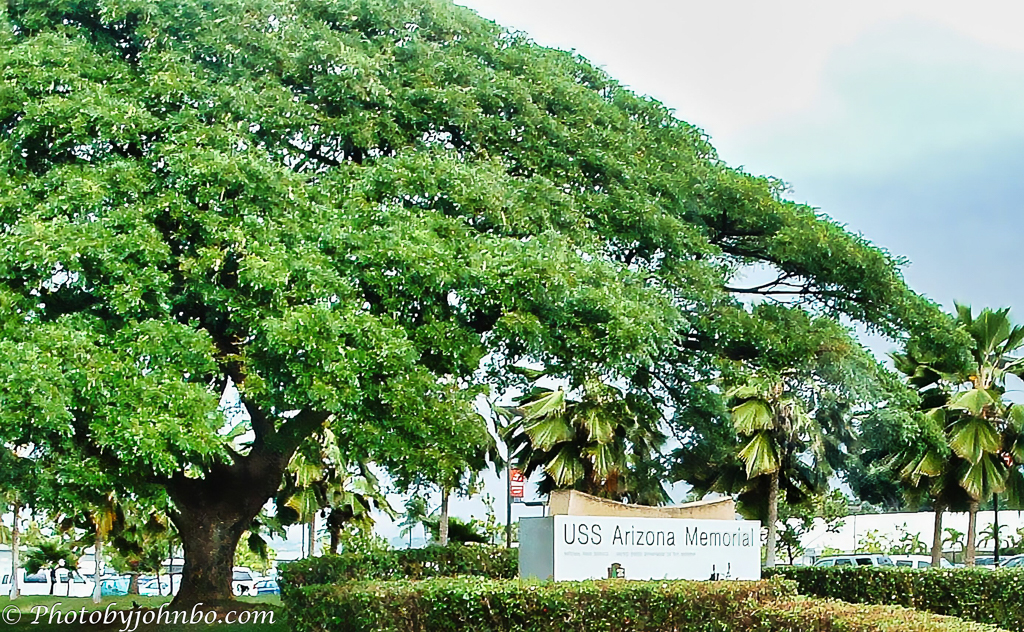
The boat to the USS Arizona Memorial departs from the Pearl Harbor National Memorial Visitor Center, located at 1 Arizona Memorial Drive in Honolulu. This site is on the southeastern edge of Oʻahu, near the entrance to Joint Base Pearl Harbor-Hickam.

On the left is the USS Missouri, famously known as the site where Japan formally surrendered on September 2, 1945, marking the end of World War II. Its presence near the USS Arizona, where the US entered the war, creates a powerful symbolic arc—from the war’s first casualties to its final peace.
The Missouri was permanently moored at Pearl Harbor in 1998 and now serves as a museum ship. Visitors can walk her decks and reflect on the full sweep of the war’s history.

The memorial straddles the sunken remains of the USS Arizona, where 1,177 sailors and Marines lost their lives during the attack on Pearl Harbor. It serves as a final resting place for those who perished aboard the ship, making it a sacred space of national mourning and reflection.

One of the first things I saw to photograph after entering the memorial was our flag flying proudly from the USS Arizona’s mast. The flag still flies, even over a sunken vessel, echoing the spirit of survival and national pride.
The memorial doesn’t touch the ship—it floats above it. This separation is intentional, preserving the site’s sanctity while allowing visitors to look down into the water and see parts of the wreckage.

Much of the USS Arizona lies beneath the surface, but the exposed portions give visitors a tangible connection to the ship. After the attack, the Navy salvaged usable parts of the ship, including guns and turrets. The remaining superstructure was largely left in place.

The forward deck is visible from the viewing platform just below the waterline in the calm, clear harbor waters. The three circular structures are mooring bitts, heavy-duty fittings once used to secure the ship to the dock.

This view from the memorial platform shows one of the salvage platforms that was attached to the USS Arizona during World War II. These platforms were welded to the wreck after the attack to support salvage operations, allowing Navy crews to remove guns, equipment, and other materials critical to the war effort. My research indicated that as of 2025, the US Navy had begun removing these platforms due to structural decay and environmental concerns. This article from Stars and Stripes Online, published here in 2023, offers a more recent perspective on one of the concrete structures.
A dark area of water is visible in the view below the salvage platform. The slow oil leak from the USS Arizona, often called the “black tears,” is visible from the platform and serves as both a poignant symbol and a complex environmental concern. The oil has been leaking since the ship sank, and estimates of up to 9 quarts per day continue to rise to the surface.
The USS Arizona was fully fueled before the attack, carrying 1.5 million gallons of oil. Roughly 500,000 gallons may still remain onboard. There is considerable published research on the leak and its potential hazards to the memorial and the surrounding marine environment. The Navy and the National Park Service have opted for non-invasive monitoring, striking a balance between environmental stewardship and historical reverence.

Traditionally, a life ring represents hope and survival. Here, it takes on a more solemn tone—a reminder that no such rescue was possible for most of the 1,177 men who perished when the ship exploded and sank. Positioned prominently on the memorial, the ring is often photographed by visitors, and I had to wait in line to capture a full-on view of it that day in 2007. The ring acts as a symbolic anchor, linking the past to the present, and the ship to the sacred space that now honors her.

As our tour boat brought us back to the Visitor Center, I captured one last look at the memorial and the flagpole mounted to the USS Arizona’s mast. Before leaving the visitor center to visit the monument, guests begin their experience at the theater, where they watch a short documentary, then board a Navy-operated shuttle boat that takes them across the harbor to the memorial itself.
If you’re planning a visit, it’s a good idea to arrive early; parking can fill up quickly, and the boat ride is part of a timed program. The video is a 23-minute documentary, and the ferry ride to the memorial takes about 10 minutes each way, leaving plenty of time to reflect on the solemnity of the site. Given it’s been 18 years since I visited the memorial, I can only estimate how long we spent at the USS Arizona from the timestamps on the photos. My first photo of the flagpole and the last picture of the memorial, taken as we departed, were separated by about 30 minutes.
About the reprocessed photos: At the time, I owned a Fujifilm FinePix 3800, a then-popular mid-range digital camera. The 3.2-megapixel sensor produced an image at 2048 x 1536 pixels, more than enough resolution for my future blogging needs. The f/2.8-3.0 lens had a zoom range of 6x (equivalent to 38-228mm 35mm film cameras of the era).
To reprocess these images, I used the latest version of Luminar Neo. Most photos were processed similarly, first selecting the crop tool to focus the viewer on my subject, then upscaling the result to maximize resolution in Flickr. I then used Noiseless AI on images that had increased noise after upscaling. Most of the photos were in-camera sharp, but a couple required the Supersharp AI module to achieve sharper results.
I used the Develop module’s new one-click Auto-Adjust feature to tweak exposure, contrast, highlights, and shadows, then made manual adjustments to the sliders based on those settings. Finally, I used Enhance AI’s masking feature to select the inverse of the sky mask, and I adjusted the Accent slider for both the subject and the background. I usually don’t include the sky when adjusting the slider, as it often adds too much “enhancement,” making the sky look unnatural. I then close the Enhance tool and reopen it. Using the Sky Enhance slider, I make sparing adjustments to add more definition to clouds and a pleasing blue to clear skies. To view the images and metadata on my Flickr site, click here.
John Steiner
 Journeys with Johnbo
A thought provoking look at the remains of war.
The memorial is a somber reminder of theose who are buried within and their sacrifice.
John, thank you for this post honoring the memory of those who lost their lives that day. You have done a great job describing the memorial with your words and images. We visited the memorial in 2008 and I felt like I was revisiting it as I read your post.
Thanks, Beth. I felt the same as I reworked the photos!
It’s good to remember December 7, 1941. But it is also good to remember December 8, 1941 (due to the International Dateline) when the Japanese attacked the Philippines which affected many Americans there including my still unaccounted for great-uncle who perished in a Japanese POW internment camp after living through the Bataan Death March.
You’re absolutely right—December 8 brought devastation to the Philippines, and countless Americans and Filipinos endured unimaginable hardship in the days that followed. Your great‑uncle’s sacrifice, surviving the Bataan Death March only to perish in a POW camp, is a story that deserves to be remembered alongside Pearl Harbor. Thank you for adding that perspective to this post.
I’m having a difficult time commenting on this John. We can never forget what a tragedy war is, how it starts and the humanity that is lost.
I just responded to chava61’s comment about the wider scope of the war’s beginning. His story deserves to be remembered as well.
❤️