May 2025.
Kaua‘i, Hawai‘i.
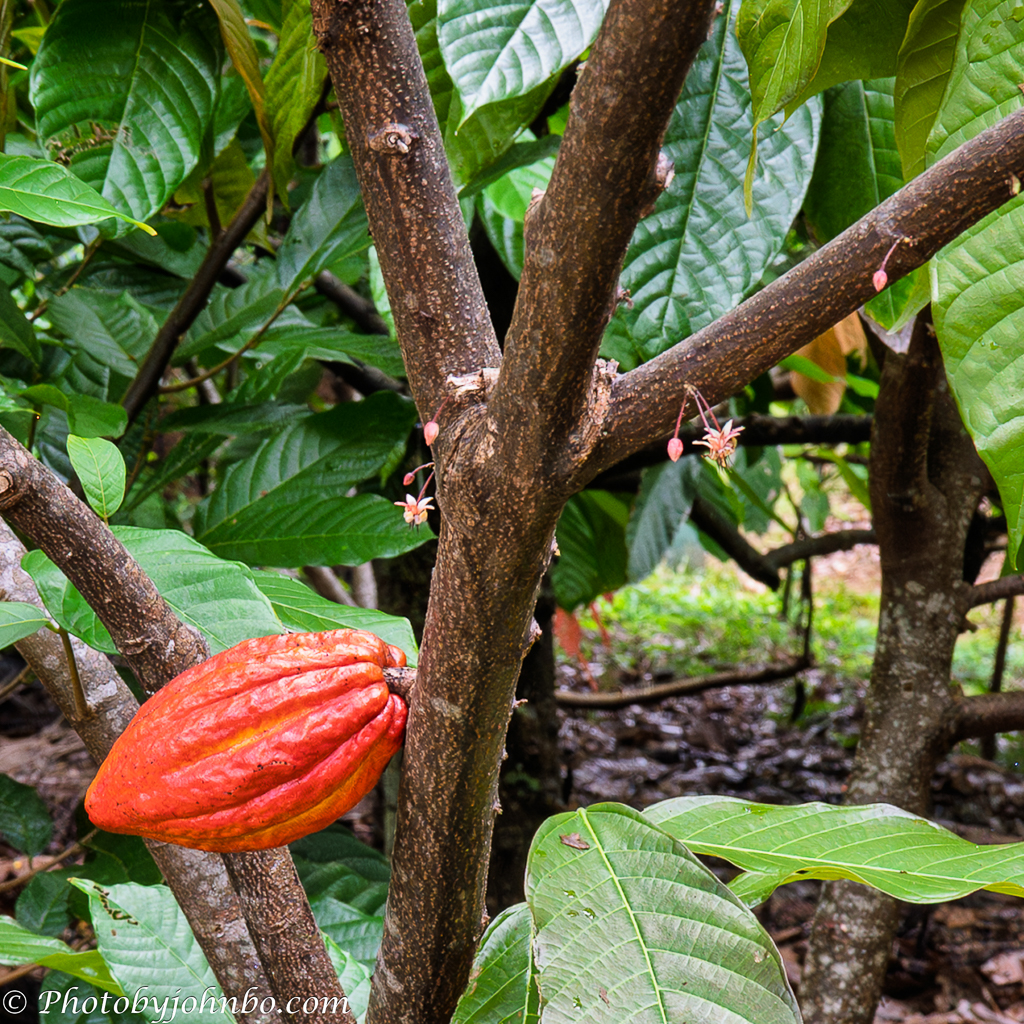
That small football-shaped pod is a ripening cacao pod. Inside, you will find the beginnings of a sweet fruit. That’s right, cacao beans are a fruit. Look closely at the tree; you will see several buds that will also become pods. We visited Lydgate Farms near Kapa‘a for a farm tour

Trees like the cacao tree, which can produce fruit directly on their trunks and main branches, are called cauliflorous trees. This unique growth pattern enables pollinators, such as tiny midges, to access the flowers more easily, and helps the tree efficiently distribute its fruit in dense rainforest environments. We learned that mosquitoes are one of the primary pollinators, and we were provided with mosquito spray before starting our walking tour.

Our tour guide, Mason, shared the story of Lydgate Farms, where a unique variety of Hawaiian crops, including cacao, vanilla, and apple bananas, are cultivated. Along the way, we sampled many of their craft chocolates. Their farm markets single-origin Hawaiian chocolate, which has been recognized multiple times at the Cocoa of Excellence Awards in Paris.

With humor and a flair for storytelling, Mason described the process from pod to bar. At one point, he used a large, sharp knife to open a pod. The interior reveals a central core, or placenta, from which 30 to 50 beans are arranged in neat rows, much like kernels on a corn cob. Each almond-shaped cacao bean is individually encased in a thick layer of glistening, white, sweet, and gooey pulp, often referred to as “baba de cacao.” We were given small paper cups, and Mason broke apart the beans and dropped one into each of our cups. We were told to first enjoy the pulp around the bean, but not open the bean.

This pulp is not only edible and quite delicious, offering a tangy, fruity flavor reminiscent of tropical fruits like lychee or passion fruit, but it’s also crucial for the fermentation process, which is the first step in transforming the beans into chocolate.
Before fermentation, the beans are typically a purplish color, sometimes white, and have a bitter, astringent taste. We were told to bite the bean in two and note the slight purple color of the interior. The bean certainly tasted bitter in my mouth.

Cacao pods change color as they ripen. They can turn yellow, orange, red, or even purple depending on the variety. Since cacao trees produce fruit year-round and don’t all ripen simultaneously, you’ll often see pods at different stages of maturity and thus different colors on the same tree. There are also different varieties of cacao trees, each with its own natural color for ripe pods. Mason told us that shaving off a bit of the hard shell with a knife will tell an expert whether the pod is ready to harvest.

Because cacao trees cross-pollinate easily, a single tree may exhibit characteristics of more than one variety, resulting in a broader spectrum of pod colors. The mix of colors seen on a single cacao tree is a visual indicator of the pods’ maturity and the specific genetic makeup of the tree and its fruit.

Mason pointed out that Lydgate Farms produces “craft chocolate,” which encompasses everything from ingredients and production methods to flavor profiles and ethical considerations. The photo above shows that a single chocolate bar (18 USD) is far more expensive than the bar you buy at a grocery store. We learned that you don’t “gobble” a craft chocolate bar. Like a fine wine, you savor each mouthful. Let the cocoa butter melt in your mouth and enjoy the flavor. It is different from the typical chocolate.
The primary distinction between commercial and craft chocolate lies in its focus on production methods, ingredient quality, and overall flavor profile. Commercial chocolate, often mass-produced, prioritizes cost-effectiveness and shelf life, resulting in a standardized flavor that can be less nuanced. Craft chocolate focuses upon the unique character of the cacao bean, artisanal skill, and ethical practices, resulting in a more complex and refined tasting experience. That’s how you sell an $18 chocolate bar.
Here is a link to learn more about the differences between commercial and craft chocolate. Read it to justify why you would spend five to ten times the price of a commercial chocolate bar. I must admit that Lydgate’s 70% Dark Chocolate bar, made with single-sourced cacao beans, pure cane sugar, cocoa butter, and Hawaiian sea salt, provides a pleasant culinary experience.
Lynn and I have been on many excursions and tours, and we think this farm tour is one of the best we have ever taken. The farm also produces honey and vanilla. Mason touched on those plants during the three-hour tour, which includes a short walk to two different areas for presentations. They also have a honey tour that includes dressing up in a bee suit and interacting with bees in their hives.
The tours are located on the farm, a few miles from Kapa‘a, and a free tasting room is available in downtown Kapa‘a. Don’t go to the farm if you want to start with the tasting room. You’ll be given a map and directions back to town. We made that mistake. For our trouble, though, we saved $10 each on our tour admission by ordering the tour in the tasting room. The chocolate tour lasts three hours and offers numerous samples to savor. As of this writing, tours are available Monday through Friday, scheduled hourly from 9 AM to 1 PM. Check their website here to order tickets and see the available tours. Please note that you may not receive a tour on the same day you place your order.
John Steiner
 Journeys with Johnbo
Thanks for the tour John. I missed that one when I was in Kauai, and I love chocolate!
Plan for it the next time you visit. It’s well worth the experience.
😎
Very interesting post and photos, John. I was surprised at “baba de cacao.” I wonder if that comes from Portuguese. It is the same words. “Baba” in Portuguese means “drool.” I love 100% cacao chocolate bars.
It does, indeed. I remember him mentioning that when he defined it as “drool”. 🙂