February 2025.
Tui, Spain.
In last week’s Travel Tuesday post, our story began with a tour bus that transported us from the cruise ship dock in Vigo, Spain, to Valença, Portugal’s fortress on the frontier —a town defined by its stone ramparts and centuries of vigilance along the Minho River. Just across that waterway lies Tui, Spain’s sentinel on the opposite bank. If Valença stands guard over Portugal’s edge, then Tui answers with its own quiet strength and cobbled streets that echo with history.

After a short drive just across the river from Valença, we were let off the bus in the Galician town of Tui, where this sculpture greets visitors with a striking monument to its medieval guardians—the Knights Templar. Carved in stone, the dynamic sculpture captures a moment of collective resolve. The artwork stands not merely as a tribute to the past but as a symbol of unity and vigilance, echoing the centuries when Tui served as a strategic stronghold (particularly under the Order of Santiago). After our guide’s introduction, we started our journey into the city’s oldest quarter.

Tui’s oldest section is traversed by Rúa Seixas. At the corner of the building, a wrought iron lamp juts proudly from the stone façade. The lamp was once lit by a flickering bulb; now, it glows with a discreet LED interior, a nod to 21st-century efficiency hidden inside 19th-century ornament. It occurred to me that even in towns steeped in history, modern technology illuminates the past with present-day clarity. Cafés spill onto the cobblestones, their awnings fluttering in the breeze, while boutique storefronts display handwoven textiles, artisanal sweets, and ceramic keepsakes.

As Rúa Seixas dips westward, the street narrows and the buildings seem to huddle closer, their stone walls catching the warmth of the afternoon sun. The façades here are less commercial; homes with shuttered windows, balconies draped in laundry or potted geraniums. Cars are parked along the street, their license plates a reminder of modern mobility in a town built for walking. Overhead, a contrail slices the blue sky, another trace of contemporary technology above a place rooted in time.

Above the cobbled street, a woman leans gently over her wrought iron balcony, her purple gloves bright against the stone and blooms. She tends to her flower pots with the care of someone who’s done this daily for years—a personal garden suspended in midair. Her presence adds a lived-in warmth to the architecture—a reminder that behind each balcony and shuttered window, life’s routines unfold quietly.

The cathedral rises like a stone sentinel over Tui, its pointed arch entrance framed by slender columns and crowned with sculpted saints and biblical scenes. Crenellations line the roof like battlements, a reminder that this was once both a sanctuary and a stronghold. The Gothic spires and pinnacles reach skyward, their silhouettes etched against the blue. Standing at the base of the stairs, I felt the weight of history drawing me inside.

The Main Altarpiece of the Concatedral de Santa María de Tui towers above the altar in gilded splendor, a vertical tapestry of saints, angels, and divine figures carved with precision. Each tier tells a story: apostles in solemn poses, cherubs in mid-flight, and at the pinnacle, a radiant depiction of Christ in glory, framed by swirling clouds and golden rays. The scrollwork and floral motifs weave through the architecture like vines of faith, binding the earthly and the heavenly in one ornate vision. It’s a declaration of belief, rendered in wood and gold, echoing centuries of devotion.

Tucked within the cathedral’s stone interior, the cloister garden reflects a quieter form of reverence, shaped by symmetry, silence, and architectural restraint. At its center stands a tall cypress, surrounded by manicured hedges and rounded topiary that soften the angular lines of the Gothic arches. Terracotta roof tiles add warmth and contrast to the gray stone. Historically, cloisters like this served as meditative spaces for clergy, where daily prayers and reflection took place beneath vaulted walkways.

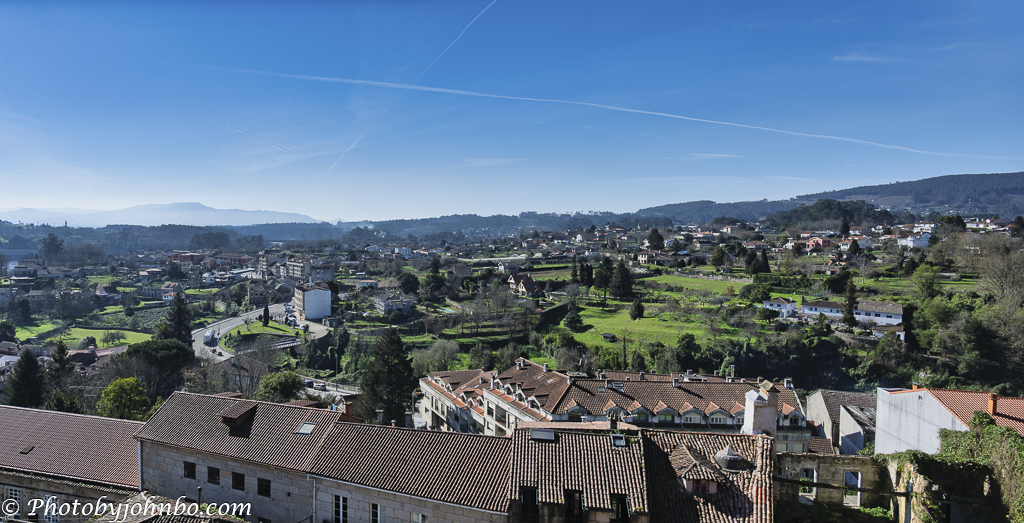
Our last views of the two cities were seen from the cathedral’s rooftop vantage point, perched above the cloister and facing outward toward the ancient walls across the river. From this elevated position, Valença revealed its defensive past; sentinels once stood watch over the Minho River. A telephoto lens revealed the strategic layout of Valença, a city built for vigilance. In the distance, the modern bridge spanning the Minho cut a clean line above the river, a reminder that while Valença once watched for invaders from its fortified walls, it now welcomes travelers with open borders and quiet ease.

Rotating the zoom lens back to wide angle, the view stretches across the Minho toward Valença, where fortress walls once braced for conflict and now frame a border softened by time. Below, red-tiled roofs and winding streets trace the contours of Tui’s layered history, while the river flows with quiet continuity. It’s a fitting farewell before boarding our bus to return to the ship. We took one last look at two towns shaped by conflict, watchfulness, faith, and the rhythms of daily life.
About the photos: Captured with my Nikon Z7 II, these photos were processed in Adobe Lightroom Classic and Luminar Neo (with AI used to remove some distractions). To see the complete gallery, head over to my Flickr site. It contains more photos of Tui and the Cathedral of Santa María, including additional interior details and street scenes.
John Steiner
 Journeys with Johnbo
What a lovely lyrical piece, John. I missed last week’s post so I’ll have a dip back. I don’t know this part of the peninsula yet but we are in Vigo and surrounds late in May. I’m looking forward to it xx