February 2025.
Valença, Portugal.
On a cruise ship stop at Vigo, Spain, we chose a tale of two cities (to borrow a book title) for our excursion. Valença, Portugal, and Tui, Spain, are separated by the Minho River and a political divide, but their histories are deeply intertwined. Just a half-hour inland from the port of Vigo, Valença offers a fortified glimpse into Portugal’s northern frontier—close in distance, but layered in history. But, I’m getting ahead of myself. First came the bus ride through rural Spain, accompanied by a tour guide who provided explanations with both historic and cultural focus.

Along the way, we passed through O Porriño, Spain, where we learned that the city is known for its granite industry and is located near the Portuguese Way (Caminho Português). The town’s quarries have supplied stone for monuments across Europe, but its streets also welcome pilgrims on their way to Santiago de Compostela. As our bus journeyed through the valley, red-tiled roofs gave way to forested hills and soon, the Minho River—marking a border we were about to cross.

The Minho River winds peacefully between Valença and Tui, its waters reflecting centuries of shared history and quiet rivalry. Although it serves as a natural boundary, it has long been a political divide, marking the edge of kingdoms, languages, and loyalties.

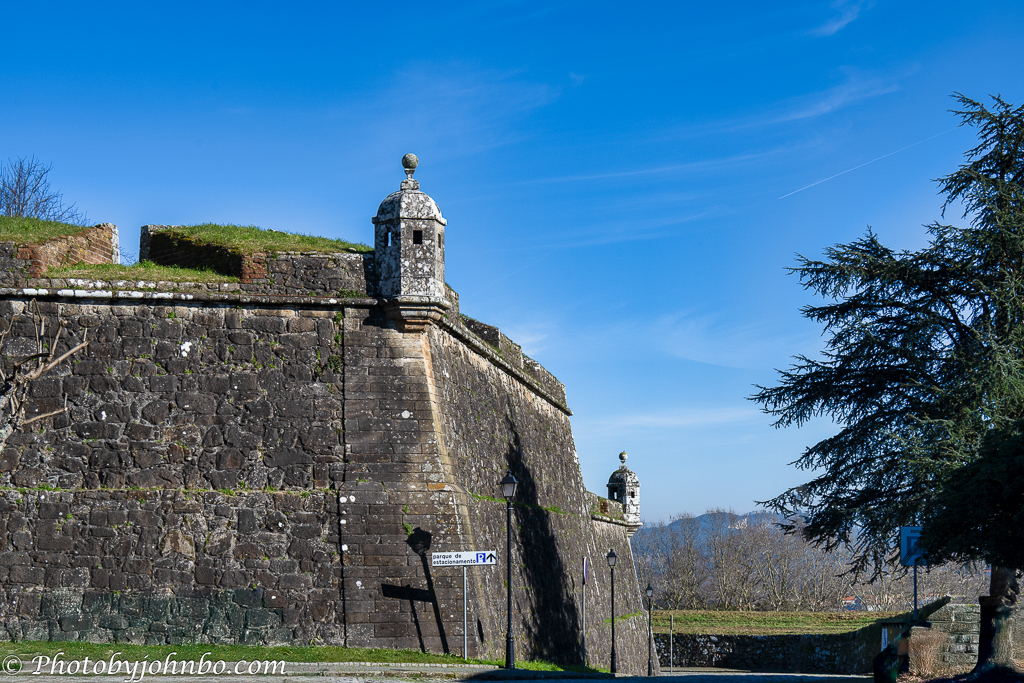
We stepped off our tour bus to visit the city, which features a blend of residential, commercial, and government buildings, all nestled within centuries-old fortifications. Valença dates back to the 13th century, when King Sancho I established a defensive outpost opposite Tui. Originally called Contrasta, a name that literally means “facing” or “opposite”. Valença was later renamed and gradually transformed into one of Portugal’s most important border fortresses.
Today, the city’s layered identity is readily apparent. Stone walls and bastions frame narrow streets lined with tiled facades and wrought iron balconies. A satellite dish perches atop a centuries-old roof; TV antennas rise above weathered stone. It’s a quiet reminder that Valença is no museum piece—it’s a living city, where history and daily life share the same skyline.

At the center of Valença’s walled city lies Praça da República, a civic square where public life unfolds against a backdrop of stone and history. Government buildings with whitewashed facades and red-tiled roofs line the plaza, their balconies and symmetrical windows lending a formal elegance to the scene. Just beyond, the fortress wall curves around the square, its arched tunnel and grassy ramparts reminding us that this administrative hub was once a military stronghold. Today, cars park where cannons once stood, and pruned trees shade benches where locals gather—indications that Valença’s fortified past now supports a quieter rhythm of civic life.

As we walked around the city, we turned to proceed down a narrow cobblestone street. The buildings leaned in close, their weathered facades and wrought iron balconies casting shadows across the stone pavement. Shops spilled into the alley, displaying walking sticks, umbrellas, and woven textiles. Though the fortress walls tower nearby, this street is a place where commerce and conversation have unfolded for generations. The vendors didn’t just feature souvenirs; Lynn even picked up some kitchen linens for our house… OK, so maybe they were souvenirs.

We continued uphill toward the archway that marks one of Valença’s historic entrances. Along the way, we passed Casa Azul, a long-standing home textiles shop known for its Portuguese-made linens and decor, its storefront framed in blue-and-white azulejos—Portugal’s signature ceramic tiles. The building’s stone facade and decorative tilework offered a quiet contrast to the cobbled street and the red “49 TRINTA” sign above the door. While we never deciphered its meaning (we later found that “49” was likely the old postal code and “Trinta” means “Thirty”), the sign was just one element in a living street scene: a white car idled nearby, and a few tourists walked with purpose or stopped to view the storefront wares.

Continuing our walk through the commercial area, Lynn and I passed by a stone building with a clock mounted high on its facade. Next door, a shop displayed postcards, and, next to that, polished crystals. The windows caught the light beside signs for minerals and jewelry. Holding our wallets tightly, we resisted the urge to step inside; the mix of geological sparkle and historic stonework felt emblematic of Valença itself. Above us, wrought iron balconies and arched windows framed the cobblestone path, a visual treat in the city as we continued toward the last stop on our tour, the city’s center of religion.

As we neared the end of our walk through Valença’s downtown, the bell tower of the parish church came into view, rising above the rooftops. The narrow street, with whitewashed buildings on one side, a stone wall, and an iron fence on the other, defined our path. Beyond the lane, Santa Maria dos Anjos stood in calm contrast to the bustle of the commercial district.

No trip to Europe can ever be complete without a nod to the historic churches that for centuries anchored the communities that built them. This church’s facade was a study in symmetry. The bell tower to the right held a single visible bell, its silhouette framed by a weather vane and the soft lines of the plastered walls. We paused outside, taking in the clean geometry of the structure—a modest parish built for continuity.

Inside, the church became a quiet counterpoint to its plain, whitewashed exterior. Wooden pews lined the nave, their surfaces worn smooth by generations of the faithful. A red carpet led to the altar, where gold leaf and carved details lifted the space. Humble benches and ornate devotion stood side by side, and I paused, letting the contrast settle in before raising my camera.

Stepping outside and back into the bright sunshine and blue skies, we passed near the Baluarte do Socorro. I stopped briefly to capture the scene in a panoramic view. The grassy bastion sloped gently toward the edge of the fortress, its stone chambers tucked beneath the turf like quiet sentinels of the past. Beyond the bastion flanked by trees, the Minho River flowed invisibly, separating Valença from Spain, and across the valley, the rooftops and cathedral spire of Tui beckoned. One last look at Portugal before boarding the bus and crossing into Spain, where the next chapter of our journey awaited.
About the photos: The photo of O Porriño was taken with my Samsung S23 Ultra through the bus window. I’ve learned not to take pictures through windows with ultraviolet-coated glass to keep occupants cool. The filtered light results in a photo so lacking in warm colors that it’s nearly impossible to recover in post-processing. Fortunately, this bus didn’t have a strong UV filter on its windows, but they still reflected the interior, which marred the view of the sky. Adobe Lightroom Classic’s reflection removal tool did a great job of removing the reflection.
All remaining images were captured with my Nikon Z7 II. In processing, I used AI selectively to remove distractions. The panorama of the bastion was initially intended to be stitched from three images; however, I ended up using just two, as the full width would have produced an extended, narrow photo with details too small to appreciate in a blog post. My usual workflow involved Lightroom Classic for cropping, noise reduction (when needed), and geometry correction, followed by final processing in Luminar Neo. All photos are available on my Flickr site in 2K HD for pixel peeping and metadata sleuthing.
John Steiner
 Journeys with Johnbo