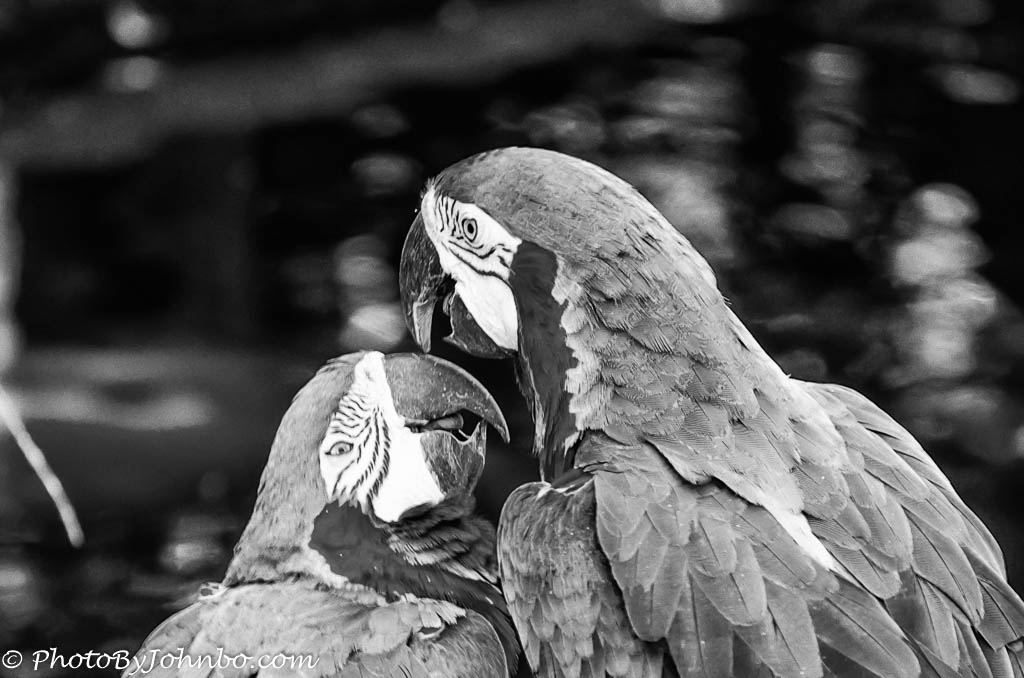
This week, Egidio hosts a challenge that was hard for me to wrap my head around. His black‑and‑white examples explore the relationship between tonal suggestion and color memory. He asks, “Can you think of other examples that come to mind showing the implied presence of color in a black-and-white photo? I’d love to see your take on the challenge.” You can read his entire challenge post here.
For my opening photo, I searched my gallery for black‑and‑white images that might evoke a strong sense of color. You see, dear readers, I apparently don’t have that “sense of color” gene—I couldn’t detect any visual cues in either Egidio’s examples or my own selections. Take this photo of two macaws: in my mind, their feathers were a vivid green. To be sure of the breed, I checked the original color image from the Wildlife World Zoo in Litchfield Park, Arizona. The photo quickly corrected my lying memory; they are Blue‑and‑Yellow Macaws.

From the bright plumage of the macaws, I moved to another familiar subject in nature: the mallard. At a man‑made pond in Highlands Ranch, Colorado, I photographed this duck gliding across water that reflected its distinctive coloration and the bright, cloud‑filled sky. In color, the scene was vibrant; in black‑and‑white, those hues translated into clean tonal contrasts. And unlike the macaws, the unmistakable colors of a mallard triggered my color memory, this time telling me the truth.

Off the coast of San Diego, California, Coronado Island is a major draw for tourists. We purposely drove across the curved bridge in the late afternoon to capture the sand sculptures on the beach and, hopefully, photograph a beautiful sunset. We were not disappointed on either count. This photo was taken about 30 minutes before sunset, and I exposed for the sky so the sailboats and lighthouse would fall into silhouette. Even in black‑and‑white, I can still recall the yellow-golden light in the sky, though my favorite version of the image is the monochrome one I processed in Silver Efex 3.

At the Musical Instrument Museum in Phoenix, Arizona, the galleries span everything from ancient traditions to modern innovations. In the Asia section, I found myself drawn less to the instrument itself and more to the exquisite carving on its scroll. This black‑and‑white photo still evokes the warm brown—almost reddish—finish the craftsman used to highlight the detail in this labor of love. The carving belongs to a morin khuur—the Mongolian horse‑head fiddle, a two‑stringed instrument whose distinctive scroll symbolizes strength, spirit, and the deep connection between Mongolian herders and their horses. Traditionally carved from local woods and finished in warm tones, the morin khuur has been central to Mongolian music for centuries and remains a treasured emblem of national identity.

On our first cruise out of New York City, heading toward eastern Canada, I was pleasantly surprised to see Lady Liberty as we began our journey. I hadn’t expected to pass her, mostly because I didn’t yet understand the lay of the Hudson River or exactly where France’s gift to the United States stands. The green patina stood out vividly in my memory, and even though I can’t see it in the black‑and‑white version, I still know it forms a perfect counterpoint to the gold-leaf torch in her upraised hand.

This final image brings me full circle in the challenge. Taken on September 11, 2013, it carries a weight that goes beyond its composition. From the vivid colors of nature to the crafted symbols of culture, I end with the American flag—an emblem whose colors are so deeply ingrained in our nation’s collective memory that they remain unmistakable even in monochrome. Reprocessing this photo for Egidio’s challenge reminded me how powerfully color can persist in the mind, long after it disappears from the frame. It feels like a fitting close to a theme built on the idea that sometimes we don’t need to see color to know exactly what it is.
Thanks to Egidio for stretching my mind, my memory, and my perception of black‑and‑white photography. Next week, Tina hosts the Lens-Artists Challenge, which goes live at noon Eastern Time on March 28. Be sure to follow her blog here so you don’t miss her challenge topic. If you’d like to join in the challenge but aren’t sure how to start, check here. Finally, for those interested in metadata and photographic details—camera, lens, and exposure information—this gallery is reproduced on my Flickr site here.
John Steiner
 Journeys with Johnbo