January 2023.
Anastasia Island, Florida.
In 2023, we spent time in St. Augustine, Florida. Our rental condo sat between the Atlantic surf and the historic streets of St. Augustine, a short walk from St. Augustine Beach. Part of the city lies on Anastasia Island, a barrier island, and we’d never explored Florida’s Atlantic coast before. One day, while wandering the area, we came across Anastasia State Park. This barrier island retreat offers four miles of protected shoreline, shifting dunes, and subtropical habitats that feel worlds away from the busy city traffic on A1A, the main highway recently renamed the Jimmy Buffett Memorial Highway. Instead of congestion, the park features sea oats bowing to the breeze, sandpipers tracing the tide, and palm silhouettes rising against a sky that never quite settles.

The elevated boardwalk viewing platform offers a sweeping view inland toward the maritime hammock—a dense, subtropical forest that thrives just beyond the dunes. This protected habitat, typical of Florida’s barrier islands, features live oaks, cabbage palms, and red bay trees rooted in sandy soil. Shielded from salt spray by the dune ridge, the hammock provides a quiet refuge for birds, small mammals, and native plants. The boardwalk itself passes through this transitional zone, bridging the open beach and the shaded interior with minimal impact.

Elsewhere in the park, a separate boardwalk leads directly to the beach—this one lower to the ground and designed for accessibility. Along its path, an interpretive sign introduces Florida’s beach-nesting birds, including the Black Skimmer, Least Tern, and Wilson’s Plover. These species rely on undisturbed stretches of sand to raise their young, and the signage encourages visitors to tread mindfully. Unlike the elevated overlook boardwalk, which ends at a viewing platform, this beach access route connects visitors with the shoreline while quietly reinforcing the park’s conservation mission.

Closer to the shoreline, an ADA-compliant beach mat stretches across the sand, providing stable access for wheelchairs, strollers, and individuals navigating the terrain with care. Flanked by dunes and sparse vegetation, the mat leads toward the water while preserving fragile habitats. A posted sign, “Please Do Not Walk on Dunes,” serves as a quiet reminder that even a single footprint can disrupt the delicate root systems that hold these sandy ridges in place. Here, accessibility and conservation walk hand in hand, guiding visitors toward the ocean without compromising the landscape.

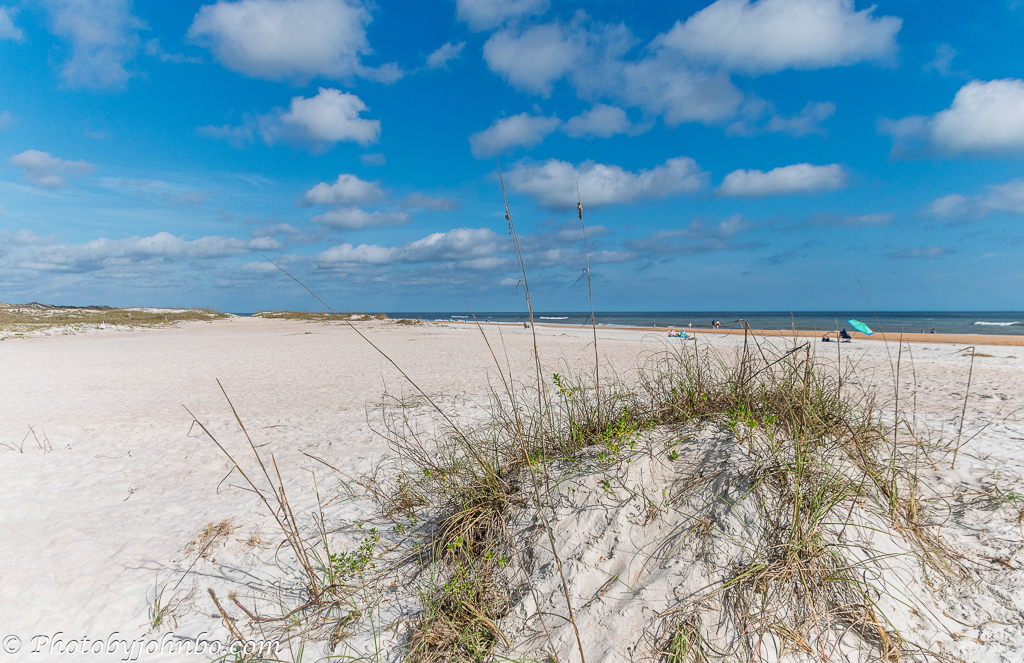
Beyond the dunes, the beach opens up—an expanse of pale sand stretching toward the Atlantic, with only scattered driftwood and the occasional beach umbrella interrupting the horizon. In cooler January days, the shoreline feels almost private, its gentle waves and open sky offering a kind of coastal stillness that’s hard to find elsewhere.

The dunes, anchored by palmetto bushes, sea oats, and hardy shrubs, form a dynamic buffer between the ocean and inland habitat. Their vegetation stabilizes the terrain, trapping windblown sand and absorbing the impact of storms. In the photo, the interplay of white sand and green foliage reveals a landscape shaped by wind—a living system that shifts with each season, tide, and gust.

Despite their rugged appearance, the dunes are fragile. Their sandy soils are nutrient-poor, and the plants that survive here do so by developing deep root systems and exhibiting salt tolerance. Visitors are asked to stay off the dunes not just for preservation, but because even a few footsteps can undo years of slow growth. In quieter moments, the dunes feel almost untouched—an undisturbed threshold between land and sea.

From the viewpoint, the St. Augustine Lighthouse rises above the tree line—its black-and-white spiral bands visible across the dense canopy of the maritime hammock. The view reveals the layered geography of the barrier island: sandy foreground, tangled vegetation, and the distant silhouette of town and water beyond. Even in a protected park, history and development are never far away.

In another view, the lighthouse peeks through a frame of palmettos and tangled undergrowth—part of the maritime hammock that stretches inland from the dunes. This dense, salt-tolerant forest anchors the barrier island, characterized by its layered texture and deep-rooted resilience. The wild foreground softens the lighthouse’s structured silhouette beyond.

For us, Anastasia State Park was a quiet interlude on that cool January day. The walk from hammock to shoreline gave us space to slow down, notice the textures of windblown sand, and listen to the hush between waves. It was the curve of the boardwalk, the rustle of palmettos, and the soft admonition not to tread on the dunes that lingered after we left.

Anastasia State Park is located at 300 Anastasia Park Rd, St. Augustine, FL 32080. As of this writing, it’s open daily from 8:00 AM until sundown. Admission is $8 per vehicle (up to 8 people), $4 for single-occupant vehicles, and $2 for pedestrians and cyclists. Visit the official park website here for maps, reservations, and updates.

About the photos: All photos were captured with my Nikon D500 using three-image brackets and then processed in Adobe Lightroom Classic to achieve an exposure-blend effect, enhancing the dynamic range. Some images were additionally processed in Luminar Neo, and the picture above was enhanced with AI to remove distractions.
John Steiner
 Journeys with Johnbo
I love this post, John. I can feel the peace, and the landscape is so reminiscent of our barrier islands and shoreline here. The main difference is your profusion of palmettos. Ours are more scattered xx
Thanks, Jo! On the south end, the condos dominate, but on the north, Anastasia has that natural barrier island vibe!
I love that long boardwalk. Great way to experience the dunes without damaging them. 😊
It is, indeed, an advantage to both the dunes and the people who want to go to the seashore.
I’d love to see them do something similar and the Indiana Dunes National Park and also the State Park.
I’ve only visited Indiana Dunes once, on the one day it’s really crowded when they open house those Century of Progress homes. Sometime I need to revisit when its not so crowded.
So sorry You picked the busiest day to be on that part of the National Park.
John, you have captured the beauty of Anastasia Island in your amazing images and descriptions. We camped there a few years ago. I loved waking up and walking to the beautiful beaches or on one of the nature trails. Florida has many beautiful state parks.
They do, indeed. And the two coasts are somehow noticeably different.
That is so my sort of beach – a bit wild-looking but accessible, lined with those beautiful dunes 🙂
I love how they are keeping it that way with the boardwalk to keep people from damaging that delicate ecosystem.
What a beautiful and different sort of beach. Great find and photos!
Thanks, Anne!
😎
I thoroughly enjoyed this post, thank you. You are a brilliant story-teller and, with your photos woven into the narrative, it makes for very pleasurable reading. Thanks, John! pp
Thanks Pamela! Pam! I appreciate the compliment.
Thanks for your comments about dunes and their plants. I had not realized how delicate they were.
I learned much about the dunes when I wrote the review. A pity I don’t do that research before I visit. >grin<
Beautiful photos and tour John. Anastasia reminds me of the barrier islands in North Carolina.
Having visited the Outer Banks and the Crystal Coast. I, too, was reminded of the NC barriers when we visited Saint Augustine.
Nice photos.
Thanks, Egidio!!
Looks like an interesting place to visit, John. Many years ago, my parents had a lot on Sanibel Island, where they were planning to retire. Thankfully, they sold it and ended up in Arizona, where there aren’t no-see-ums, few mosquitos, no alligators, no humidity! The other blessing is that, after that last hurricane, we wouldn’t have had to worry about taking care of all their things after they had past away, as everything would have been destroyed!!
I know what you mean, Janet. As beautiful as Florida is, the negatives outweigh the positives, especially when comparing to the Southwest.
I won’t mind spending a full summer day like this in this lovely park. Such a wonderful place for mindfulness 🙂
It is, indeed. The natural vibe is strong even with the environmental protections added.